
Petergof and its fountains at the edge of Sankt Petersburg
Published on 08/31/2026 at 14:18 | Editorial responsibility: Rafael Müller, Editor-in-Chief AD HOC NEWS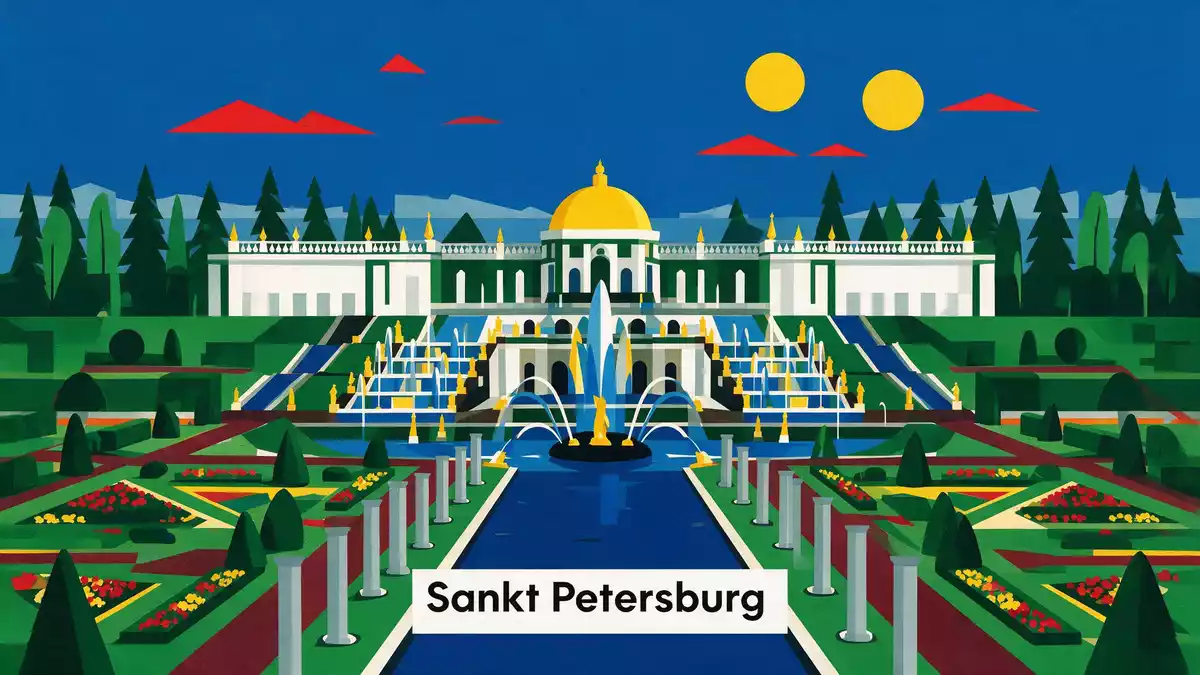
Petergof, just outside Sankt Petersburg in Russia, is a grand palace-and-park ensemble built on a coastal bluff where formal architecture meets a landscape organised around water. The complex was developed for Peter the Great in the early eighteenth century and belongs to the Historic Centre of Saint Petersburg and Related Groups of Monuments on the UNESCO World Heritage List, linking this estate formally with the city’s core.palace-and-park ensemble
Petergof as an early eighteenth-century Baltic residence
Petergof occupies a coastal site on the southern shore of the Gulf of Finland, west of Sankt Petersburg, with its palaces and gardens set above and below a low bluff that looks towards Kotlin Island and the approaches to the city. The development began in the reign of Peter the Great, in the early eighteenth century, when the ruler sought a residence facing the Baltic Sea and the new city that grew along the Neva.Peter the Great’s residence The Grand Peterhof Palace, with a facade stretching for almost 300 m (984 ft), occupies the top of the bluff and forms the architectural centre of the upper level, tying the Upper Garden above to the Lower Park below in a single composition.Grand Peterhof Palace facade
The palace complex grew in stages across the eighteenth century, reflecting the Petrine Baroque style that came to characterise the era around Sankt Petersburg with its emphasis on long facades, gilded ornament and axial planning.Petrine Baroque style Around the Grand Palace on the upper level lies the Upper Garden, laid out with formal parterres and straight alleys, while the Lower Park spreads out below the bluff towards the sea, holding cascades, fountains, canals and several smaller palaces. Together these elements create a residence that combines courtly architecture with engineered water and long vistas down towards the Gulf.
The Grand Cascade and Petergof’s water architecture
Water is the organising element of Petergof’s lower level, and nowhere more visibly than in the Grand Cascade set directly before the sea-facing front of the Grand Palace. Built between 1714 and 1724, this stepped structure of basins, channels and grottoes carries water down from the upper terrace towards the Marine Canal that leads from the park to the Gulf of Finland.Grand Cascade construction The cascade is lined with gilded sculptures and spurting jets, forming one of the most ambitious fountain ensembles of the eighteenth century, with dozens of individual fountains integrated into a single descending composition.ambitious fountain structure
At the centre of the Grand Cascade stands the Samson Fountain, depicting the biblical figure opening the jaws of a lion and throwing a high column of water into the air. Around it, bronze statues, mascarons and decorative reliefs are set among the stair-like basins, with water fed by gravity through concealed conduits from higher ground. On either side of the main axis, additional water features extend the ensemble: terrace fountains decorate the green slopes flanking the cascade to east and west, and smaller cascades are matched to subsidiary palaces, creating a network of water features across the Lower Park.Samson and associated fountains
Gardens, smaller palaces and the wider Petergof landscape
The gardens of Petergof are organised into distinct areas that wrap around the main palace and extend along the shore. The Upper Garden, set at the level of the Grand Palace, follows a French formal pattern with straight alleys, clipped greenery and parterres arranged around ornamental basins. Below, the Lower Park stretches between the palace terrace and the coastline, divided by canals and avenues into compartments that hold cascades, ornamental ponds and free-standing pavilions.Upper Garden and Lower Park Within this landscape stand smaller palaces such as Monplaisir and Marly, along with structures like the Hermitage Pavilion and the Chess Mountain Cascade, each with its own architectural character and associated water feature.
Beyond the formal core, the wider domain includes landscaped areas and parkland that blend more naturalistic planting with views towards the Gulf of Finland and the approaches to Sankt Petersburg. The entire ensemble forms part of the Historic Centre of Saint Petersburg and Related Groups of Monuments recognised by UNESCO, a status that reflects both its architectural significance and its role in the early development of the city along the Baltic.UNESCO inscription A visit to Petergof therefore encompasses not only the main palace and its richly decorated interiors, but also a broad coastal landscape where terraces, tree-lined walks and engineered water features connect the residence with sea and sky.
Visiting Petergof: what travellers from Western Europe should know
- Petergof lies west of central Sankt Petersburg on the southern shore of the Gulf of Finland, and can be reached by road or by hydrofoil services that link the city’s riverside piers with the Marine Canal in the Lower Park.
- The estate is spread over a bluff and the land below it, so moving between the Upper Garden, the Grand Palace and the Lower Park involves long walks on level paths combined with staircases alongside the cascades.
- The fountains stand outdoors in the Lower Park and are integrated with terraces and garden walks, so a visit involves spending extended time outside on gravel paths, paved surfaces and lawns.
- The official language is Russian and the currency is the rouble.
Searching for Petergof on social platforms
These links open searches for Petergof on each platform.
Frequently asked questions about Petergof
Where is Petergof and how does it relate to Sankt Petersburg?
Petergof is a coastal palace-and-park estate west of Sankt Petersburg on the southern shore of the Gulf of Finland, forming part of the wider historic area linked with the city.
What can visitors expect when exploring Petergof?
Visitors encounter the Grand Peterhof Palace on its bluff, formal gardens on the upper terrace and a Lower Park filled with cascades, fountains and smaller palaces stretching towards the sea.
What makes Petergof distinctive among European royal residences?
Petergof stands out for the way its early eighteenth-century palace complex is integrated with a large system of gravity-fed fountains and cascades that structure the entire coastal landscape.


