
Patuxai in Vientiane turns a victory arch into Lao architecture
Published on 09/24/2026 at 12:38 | Editorial responsibility: Rafael Müller, Editor-in-Chief AD HOC NEWS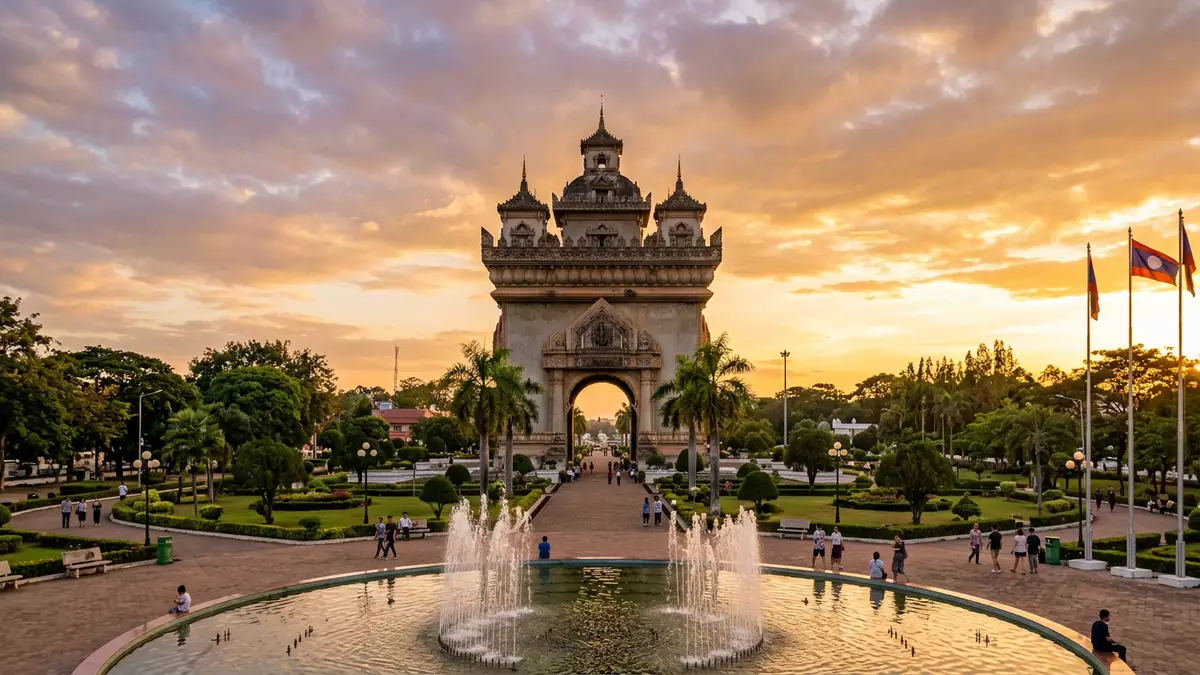
Patuxai rises above central Vientiane as a monumental concrete arch crowned by Lao-style towers. Completed in 1968, it combines the formal vocabulary of a triumphal gate with Buddhist and Hindu imagery, making the structure read as both memorial and civic landmark.
Patuxai’s concrete arch and five towers
The Lao name Patuxai translates as “Victory Gate” or “Gate of Triumph”. The monument occupies the end of Lane Xang Avenue, where its broad gateways face the cardinal directions and its heavy concrete mass forms a strong urban axis. It is also known as the Arc de Triomphe of Vientiane because its overall arch recalls the Paris monument, while its decoration belongs to Laos.
Five towers rise above the main structure, with four positioned at the corners and a taller tower at the centre. Their profiles carry temple-like ornament, spires and floral decoration. The arrangement is described through Buddhist principles and ideas of coexistence, linking the monument’s vertical silhouette with religious and civic symbolism. Patuxai’s five Lao-style towers sit above the arch as a clearly visible second architectural layer.
Tham Sayasthsena and a memorial of independence
Patuxai was designed by Tham Sayasthsena, a Lao soldier, journalist and self-taught sculptor. His design was selected in 1957, when Laos was a constitutional monarchy and the country was passing through the political changes surrounding the end of French colonial rule. Construction began in 1957 and continued until 1968.
The monument commemorates Lao soldiers who died during the Second World War and the struggle for independence from France in 1949. Its earlier name was Anousavary, meaning monument, while Patuxai became the established name after the political change of 1975. The memorial therefore carries several layers of twentieth-century Lao history without losing its architectural identity. The 1968 completion date places the building within the late colonial and post-colonial history of Southeast Asia.
Mythical figures beneath the gates
Patuxai’s decorative programme extends across ceilings, corners and upper galleries. Buddhist symbols appear beside Hindu deities, apsaras and mythical creatures, including the Kinnaree and the three-headed elephant Erawan. Naga figures occupy the corners of the gateways, adding a recognisable Lao mythological presence to the concrete structure.
The four gateways open towards the surrounding avenues and landscaped grounds. Ponds stand in front of the gates, while ornamental details continue across the ceilings beneath the arches. Inside, staircases wind through the monument’s levels, with galleries, a museum area and a viewing platform above. From the upper levels, the city appears through the building’s open sides and framed spaces. The monument’s Lao decorative vocabulary is visible in the combination of foliage, religious imagery and temple-like finials.
Patuxai is often linked with the nickname “Vertical Runway”, a reference to the concrete and funds associated with an airport project. That story belongs to the monument’s political folklore, while the structure itself remains legible through its form: a broad arch, layered galleries, upper towers and a dense surface of Lao imagery. Its contrast with Parisian triumphal architecture lies in the details that cover the concrete.
Visiting Patuxai: what travellers from Western Europe should know
- Patuxai stands at the end of Lane Xang Avenue in central Vientiane, surrounded by Patuxay Park. The monument is reached through the city streets and sits within the capital’s central urban area.
- The interior route uses staircases winding through the monument’s levels. The upper galleries and viewing platform require an ascent inside the structure.
- The official language is Lao and the currency is the Lao kip.
- Patuxai’s gateways face the cardinal directions, with ponds and landscaped space outside the monument.
Searching for Patuxai on social platforms
These links open searches for Patuxai on each platform.
Frequently asked questions about Patuxai
Where is Patuxai?
Patuxai stands at the end of Lane Xang Avenue in central Vientiane, Laos. Patuxay Park surrounds the monument.
What can visitors expect at Patuxai?
The monument contains staircases, galleries, decorative ceilings and a museum area. An upper viewing platform looks across Vientiane through the open sides of the structure.
What makes Patuxai distinctive?
Patuxai combines a European-style triumphal arch with Lao Buddhist and Hindu imagery. Five towers, naga figures, apsaras and other mythical forms cover the concrete monument.


