
Patuxai in Vientiane: a Lao triumphal arch of concrete and myth
Published on 08/28/2026 at 06:54 | Editorial responsibility: Rafael Müller, Editor-in-Chief AD HOC NEWS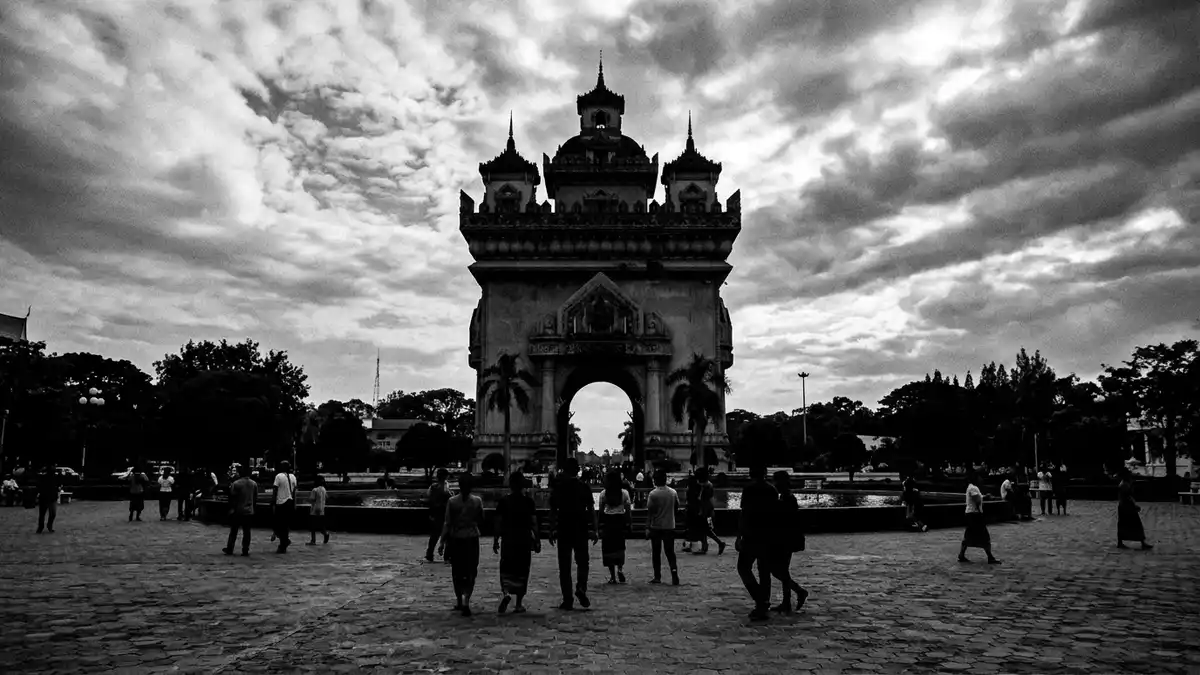
Patuxai, the concrete war monument that rises over Lane Xang Avenue in central Vientiane, is Laos’s own triumphal arch, blending French-inspired geometry with distinctly Lao decoration and views across the capital. Built between 1957 and 1968 as a memorial to those who fought for the country’s independence from France, it turns a ceremonial crossroads into a piece of architecture that visitors can walk through, climb and look back from.Built between 1957 and 1968
From Anousavary to Victory Gate
Patuxai stands at the end of Lane Xang Avenue, a broad axial road laid out through Vientiane’s governmental district, and marks the transition from city blocks to open parkland.Located along Lane Xang Avenue Its Lao name translates directly as “Victory Gate”, and the monument has carried several labels over its history, including Anousavary or Anosavari Monument and the French designation Monument Aux Morts.Victory Gate and earlier names The structure belongs to the period when the Kingdom of Laos was defining its post-colonial identity, and it commemorates Laotian soldiers who died during the Second World War and the struggle for independence in 1949.Memorial to Laotian soldiers
The monument’s bulk is cast from concrete, a material linked in local memory to United States funding originally earmarked for airport construction, redirected in the late 1950s and early 1960s into this central landmark.Concrete built with repurposed funds While the exact timeline of its inauguration is reported with minor variations, the physical completion of the arch structure in 1968 places it firmly in the Cold War era, with Laos navigating regional conflicts and internal political change.Completed as a war monument in 1968
Architecture: a hybrid triumphal arch
Seen from a distance, Patuxai echoes the outline of the Arc de Triomphe in Paris, with a blocky mass, prominent cornices and a sequence of arches facing the major approach roads.Resemblance to the Arc de Triomphe Up close, the differences are immediately visible: the monument rises into towers that recall Lao temple roofs, and the surfaces carry reliefs of lotus buds, floral scrolls and figures from Buddhist and Hindu iconography.Traditional Lao motifs on the exterior The combination of European arch form and Lao ornament makes the building read as both triumphal gate and vertical shrine.
Inside, the ceiling panels above the main passage are painted with deities and cosmic scenes, a visual language familiar from temple interiors elsewhere in Laos.Decorated interior ceilings A sequence of internal floors, reached by stairs, contains small souvenir stalls and display spaces before leading to the upper platforms, where travellers step out onto open terraces under corner pavilions.Stairs, interior levels and viewing platform Concrete balustrades, ornamental finials and the skyline of Vientiane beyond give the monument a layered profile in photographs taken from almost any angle.
Park, perspectives and the city around
Patuxai sits in the centre of an urban park laid out with broad walkways, ornamental pools and planting, creating a formal forecourt between the avenue and the monument’s base.Monument in the middle of Patuxai Park The axis of Lane Xang Avenue aligns with the central arch, so that visitors approaching from the south see the war memorial closing the vista of government buildings and traffic lanes. Around the park, low-rise structures, offices and ministries frame views of the arch, underlining its role as a civic landmark as well as a tourist destination.
From the upper levels, the view opens across Vientiane’s grid of streets, the surrounding district and towards the Mekong corridor that defines the city’s broader setting.Panoramic views over Vientiane The combination of ceremonial park, traversable monument and elevated platforms gives Patuxai multiple scales: it is experienced as a gate along the avenue, as an object in the park and as a tower from which to read the city plan below.
Visiting Patuxai: what travellers from Western Europe should know
- Patuxai stands on Lane Xang Avenue in central Vientiane, southeast of the Mekong riverbank, and is easily reached by road from the city’s commercial districts.Location on Lane Xang Avenue
- The monument itself rises above an urban park with paved paths and broad steps; anyone aiming for the upper platforms must climb internal staircases through several levels.
- The official language is Lao and the currency is the Lao kip.
- Entry requirements depend on your nationality; UK travellers can check the FCDO travel advice at gov.uk/foreign-travel-advice, Irish travellers the Department of Foreign Affairs at ireland.ie.
Searching for Patuxai on social platforms
These links open searches for Patuxai on each platform.Frequently asked questions about Patuxai
Where is Patuxai located within Vientiane?
Patuxai stands on Lane Xang Avenue in central Vientiane, close to government buildings and within reach of the city’s main commercial and riverfront areas.
What can visitors expect during a visit to Patuxai?
Visitors pass through a decorated archway, explore interior levels with stalls and displays, and may climb staircases to open platforms that overlook Vientiane.
What makes Patuxai distinctive among war monuments?
Patuxai combines the massing of a European triumphal arch with Lao religious motifs, concrete construction and a role as both memorial and elevated city viewpoint.


