
Patuxai and the layered face of Vientiane
Published on 08/29/2026 at 09:36 | Editorial responsibility: Rafael Müller, Editor-in-Chief AD HOC NEWS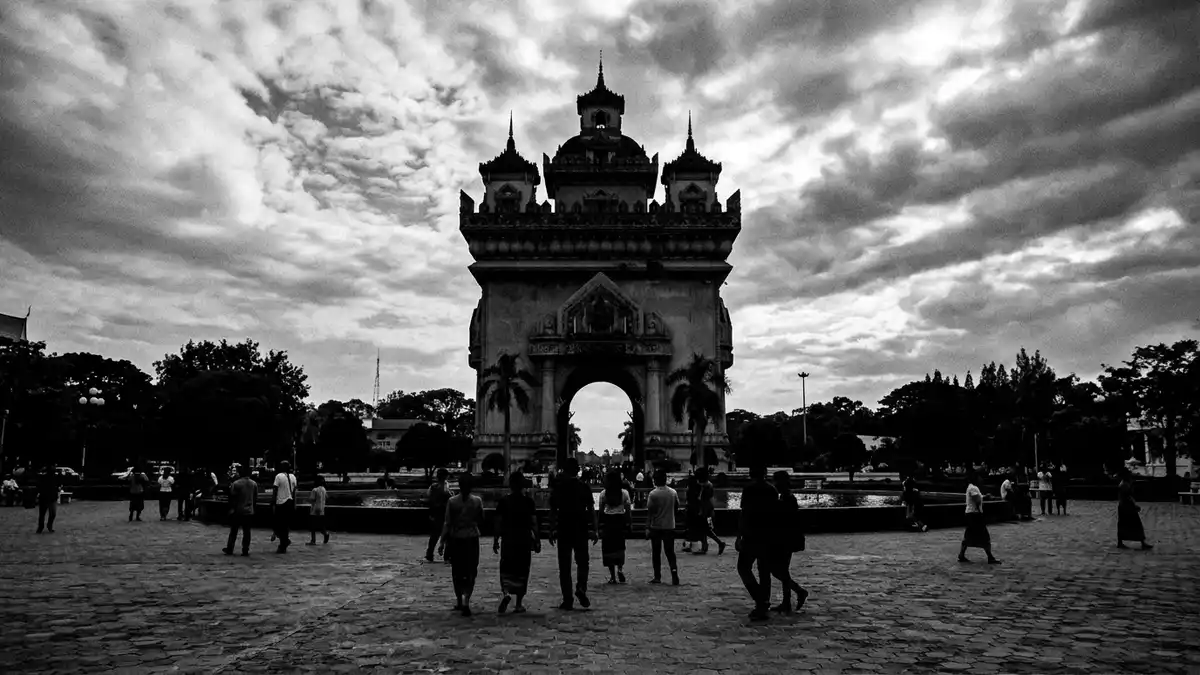
Patuxai rises in central Vientiane as a concrete triumphal arch with Lao ornament, five towers and four gateways. Built between 1957 and 1968, it is a war monument tied to Laos’s independence struggle and later renamed Patuxai, meaning Victory Gate.
Patuxai’s French outline and Lao surface
The monument is at the end of Lane Xang Avenue in downtown Vientiane, with Patuxai Park around it. Its overall mass echoes the Arc de Triomphe in Paris, but the surface carries kinnari, naga and lotus motifs rather than restrained classical reliefs.Lane Xang Avenue
Tham Sayasathsena is named as the designer, and the monument’s construction belongs to the late 1950s and 1960s. The mix of monumental arch, corner towers and Laotian decorative language gives the structure its lasting character.Tham Sayasathsena
Inside the monument
Patuxai has four gateways and interior staircases that lead upwards through several levels. The upper floors include viewing galleries, while the summit opens towards the city skyline.interior staircases
The monument is associated with a memorial function as well as a civic one, and that dual identity is visible in its scale and its commemorative character. It stands as a formal public structure rather than a temple, despite the religious vocabulary in its decoration.memorial function
Why the monument reads so clearly from the avenue
Seen from Lane Xang Avenue, Patuxai works as a strong axis marker: a broad arch below, towers above and a central vertical emphasis in the middle. The form is recognisable from a distance, yet the details reward a slower look at the reliefs and rooftop figures.broad arch below
The structure is part of a broader story of postcolonial monument building in Southeast Asia, but it remains anchored in one city and one avenue. That combination of familiar monument form and local ornament is what gives Patuxai its particular presence in Vientiane.postcolonial monument building
Visiting Patuxai: what travellers from Western Europe should know
- Patuxai stands on Lane Xang Avenue in central Vientiane, and city transport runs through the district. The monument is easy to place within the city’s main ceremonial axis.
- The tower climb involves interior stairs rather than a lift. The upper levels are reached on foot through the structure itself.
- The monument sits in open surroundings with a broad paved forecourt and park space. That leaves the facades visible from several angles.
- Patuxai is a civic monument in a capital city, so nearby streets carry government and administrative traffic. The setting feels formal and urban rather than secluded.
Searching for Patuxai on social platforms
These links open searches for Patuxai on each platform.
Frequently asked questions about Patuxai
Where is Patuxai?
Patuxai stands in central Vientiane, at the end of Lane Xang Avenue. It is one of the city’s most prominent civic monuments.
What does a visit involve?
The monument presents a ground-level forecourt, an interior climb and upper viewing spaces. Its facades and towers can also be seen from the avenue without entering the structure.
What makes Patuxai distinctive?
Its form recalls a European triumphal arch, but the decoration is distinctly Lao. Kinnari figures, naga forms and lotus motifs give the monument a local visual identity.


