
Paseo de la Reforma and Mexico City’s grand boulevard
Published on 09/21/2026 at 09:33 | Editorial responsibility: Rafael Müller, Editor-in-Chief AD HOC NEWS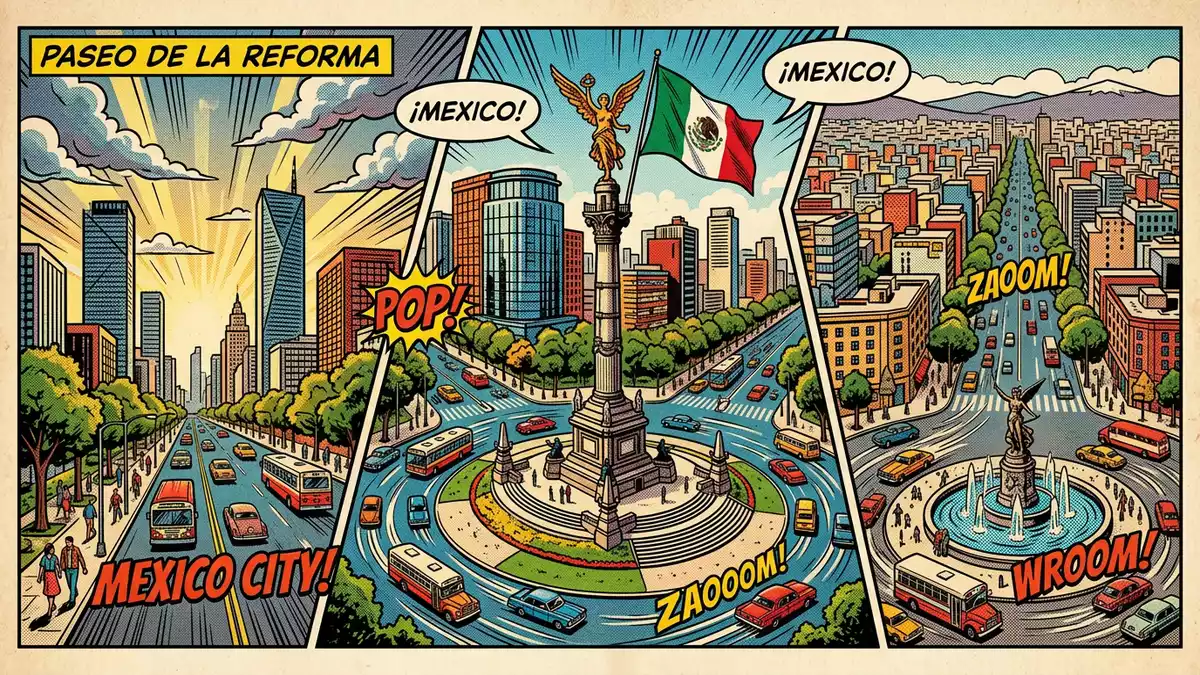
Paseo de la Reforma is one of Mexiko-Stadt’s broadest urban axes, a diagonal boulevard that links the city’s historic centre with Chapultepec. Its most recognisable feature is the line of monuments and roundabouts that breaks up the long avenue.
Its history reaches back to the reign of Maximilian I and the Second Mexican Empire, when the avenue was laid out as an imperial promenade. The boulevard later took the name associated with Benito Juárez and the Reform era, and that political shift remains legible in its urban form.historic centre
The avenue also belongs to a wider nineteenth-century language of European boulevards. Its long perspective, planted edges and formal intersections recall the grand urban corridors that inspired planners across the century.European boulevards
Paseo de la Reforma’s imperial origins
The avenue is tied to Maximilian I, Empress Carlota and the Second Mexican Empire. It first carried the name Paseo de la Emperatriz, a title that kept the imperial connection visible in the street itself.Paseo de la Emperatriz
That origin gives the boulevard a clear historical frame: it is not only a traffic artery, but a nineteenth-century ceremonial route recast by later politics. The name Paseo de la Reforma marks that change, and the avenue’s present identity still carries both layers at once.
Monuments, roundabouts and the long central axis
What gives the boulevard its character is the sequence of glorietas, statues and landmark buildings along its length. The Angel of Independence, the Monument to Cuauhtémoc and the Monument to Christopher Columbus belong to that procession of fixed points.Angel of Independence
The avenue’s scale is important as a visual experience. It offers wide carriageways, planted medians and long sightlines, and the monuments sit within that open framework rather than hiding inside side streets.long sightlines
Paseo de la Reforma in the modern city
Reforma also serves as a setting for embassies, office towers, museums and public squares. That mixture gives the boulevard a layered urban feel, with nineteenth-century planning beside twentieth-century and twenty-first-century construction.office towers
Chapultepec lies at one end of the axis, and the historic centre lies towards the other. Between them, the avenue gathers formal monuments, civic buildings and everyday city movement into a single, readable strip.
Visiting Paseo de la Reforma: what travellers from Western Europe should know
- The boulevard runs through central Mexiko-Stadt, between the historic centre and Chapultepec. Metro and bus services serve the area, and many of the main landmarks sit along the avenue itself.
- The street is wide and busy, with broad crossings, traffic islands and long blocks. The monuments stand in roundabouts rather than in enclosed squares.
- English is not an official language. The official language is Spanish and the currency is the Mexican peso.
- Entry requirements depend on your nationality; UK travellers can check the FCDO travel advice at gov.uk/foreign-travel-advice, Irish travellers the Department of Foreign Affairs at ireland.ie.
Searching for Paseo de la Reforma on social platforms
These links open searches for Paseo de la Reforma on each platform.
Frequently asked questions about Paseo de la Reforma
Where is Paseo de la Reforma?
It runs through central Mexiko-Stadt, linking the historic centre with Chapultepec. The boulevard crosses some of the city’s most formal urban space.
What should visitors expect on a walk there?
A wide avenue, heavy traffic, planted medians and a chain of monuments and roundabouts. The street reads as both a daily route and a ceremonial axis.
What makes the boulevard distinctive?
Its blend of imperial origins, republican renaming and monumental urban design gives it a clear identity. The avenue combines history, public space and modern city life in one continuous line.


