
Parque Nacional Torres del Paine and its granite towers of Patagonia
Published on 09/09/2026 at 22:21 | Editorial responsibility: Rafael Müller, Editor-in-Chief AD HOC NEWS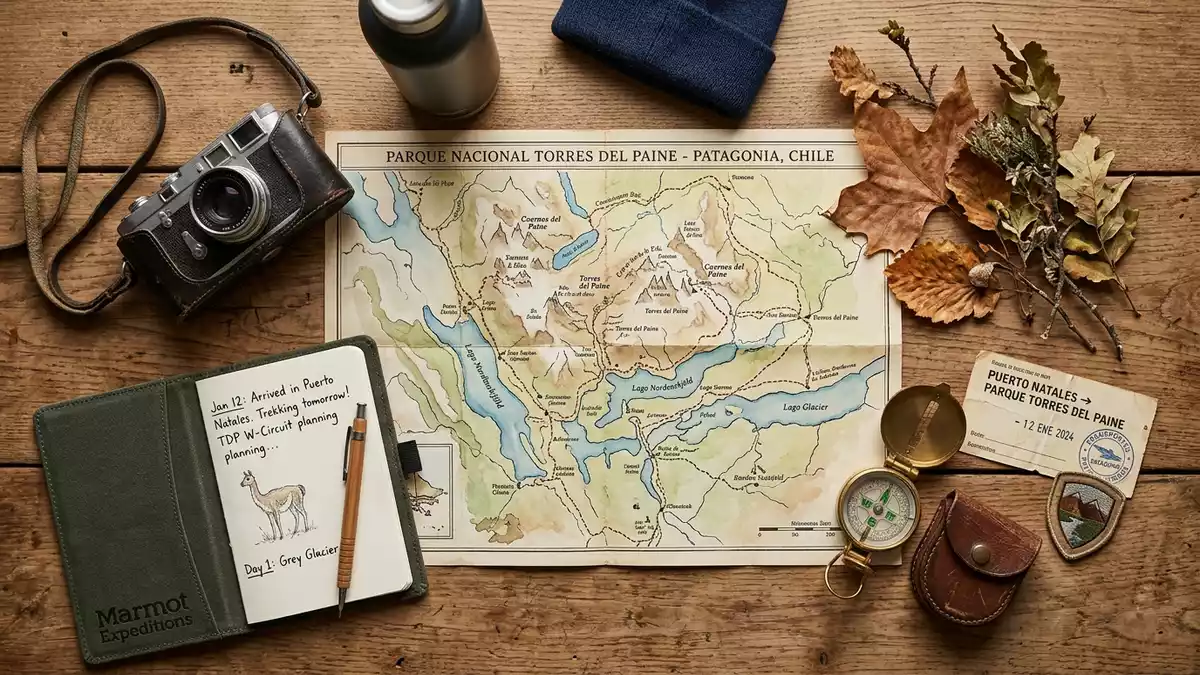
Parque Nacional Torres del Paine in southern Chilean Patagonia is a protected landscape where pale granite towers rise above glacier-fed lakes and open steppe north of Puerto Natales. Established as a national park in 1959, it forms part of a wider biosphere reserve recognised by UNESCO in 1978, placing its jagged peaks and plains within an internationally defined conservation framework.
Granite towers and the Paine massif
The park centres on the Paine massif, a compact group of mountains whose steep granite towers give Parque Nacional Torres del Paine both its name and its most recognisable silhouette. Three principal towers stand above the surrounding plains and valleys, with elevations that reach around 2,500 m (8,202 ft) and mark the transition between the Patagonian steppe and the higher Andes.Three vertical granite towers Behind them the highest summit, Cerro Paine Grande, reaches 2,884 m (9,462 ft), carrying extensive glaciation across its upper slopes and feeding lakes and rivers below.Cerro Paine Grande reaches 2,884 metres
At lower elevations the massif breaks into carved ridges and cliffs that catch snow and ice, while glacier tongues descend towards long lakes such as Grey and Nordenskjöld. These water bodies lie within view of the towers and peaks, reflecting the rock above and carrying icebergs that have calved from nearby glaciers. The contrast between bare pale granite, darker sedimentary rock and opaque turquoise water is one of the most striking visual patterns in Parque Nacional Torres del Paine.
Lakes, glaciers and Patagonian steppe
Parque Nacional Torres del Paine encompasses a mosaic of lakes, rivers, glaciers and grassland within a single protected area in the Magallanes Region of southern Chile.Torres del Paine lies between the Andes and the Patagonian steppe Glacial meltwater fills lakes such as Pehoé, Nordenskjöld and Sarmiento, turning their surfaces turquoise with suspended rock flour carried downstream from the ice.Glacial meltwater fills lakes like Pehoé and Nordenskjöld Grey Lake on the western side of the park holds floating ice that has separated from Grey Glacier, a tongue of the Southern Patagonian Ice Field that reaches into the protected area.
Beyond the water and ice, extensive pampas grasslands and shrub steppe spread across the lower parts of the park. These plains form part of the ecological zones described in the UNESCO biosphere reserve designation and carry native vegetation adapted to strong winds and cool temperatures.The biosphere reserve comprises four ecological zones Wildlife such as guanacos, foxes and a range of bird species use these open areas, moving between the grasslands, lake shores and rocky slopes. The way water, ice, rock and steppe sit alongside each other is central to how Parque Nacional Torres del Paine is experienced on foot and from its viewpoints.
A protected Patagonian landscape north of Puerto Natales
Parque Nacional Torres del Paine lies in the Región de Magallanes y de la Antártica Chilena, within the province of Última Esperanza and the commune that shares the Paine name, north of the town of Puerto Natales.The park lies north of Puerto Natales in the Magallanes Region The wider biosphere reserve recognised in 1978 covers more than 770,000 ha (1,904,773 acres), of which the national park forms a substantial terrestrial core.Surface 770,889 hectares This designation ties Parque Nacional Torres del Paine into a network of protected areas that stretch along the Andes in southern South America, including neighbouring national parks over the border in Argentina.
The protected land within the park itself spans over 220,000 ha (over 540,000 acres), bringing mountain ridges, valleys, lakes and plains together under one management framework.The protected area covers more than 220,000 ha Trails and viewpoints lead into different sectors, including the valleys beneath the granite towers, shores of major lakes and lookouts over Grey Glacier and the Southern Patagonian Ice Field. Taken together, the park and biosphere reserve form a substantial slice of Patagonian wilderness, anchored by its distinctive massif and open steppe.
Visiting Parque Nacional Torres del Paine: what travellers from Western Europe should know
- Parque Nacional Torres del Paine lies north of Puerto Natales in southern Chilean Patagonia, with road access linking the town to several park entrances and valleys around the Paine massif.
Puerto Natales functions as the main urban gateway for visitors approaching the park overland. - The terrain in the park ranges from level grassland and lakeshore paths to steep mountain tracks that climb towards high viewpoints and passes.
Sections of the approach to the towers and other elevated areas involve sustained ascents over rocky ground. - Parque Nacional Torres del Paine is in Chile, where the official language is Spanish and the currency is the Chilean peso.
- In parts of the park, weather can change quickly, with strong winds common around exposed ridges and lakes.
Walks that reach higher ground demand appropriate clothing for cold and wet conditions. - Entry requirements depend on your nationality; UK travellers can check the FCDO travel advice at gov.uk/foreign-travel-advice, Irish travellers the Department of Foreign Affairs at ireland.ie.
Searching for Parque Nacional Torres del Paine on social platforms
These links open searches for Parque Nacional Torres del Paine on each platform.Frequently asked questions about Parque Nacional Torres del Paine
Where is Parque Nacional Torres del Paine in relation to Puerto Natales?
Parque Nacional Torres del Paine lies north of Puerto Natales in southern Chilean Patagonia, in the Magallanes Region and the province of Última Esperanza.
What should visitors expect when exploring the park?
Visitors encounter granite towers, glaciated peaks, turquoise lakes and open steppe, with trails that range from lakeside walks to demanding mountain routes.
What makes Parque Nacional Torres del Paine distinctive among Patagonian landscapes?
The juxtaposition of steep granite towers, extensive glaciers and wide pampas within one protected area, combined with its UNESCO biosphere reserve status, gives the park a distinctive character.


