
Parque Nacional Torres del Paine and its granite towers of Patagonia
Published on 08/21/2026 at 21:12 | Editorial responsibility: Rafael Müller, Editor-in-Chief AD HOC NEWS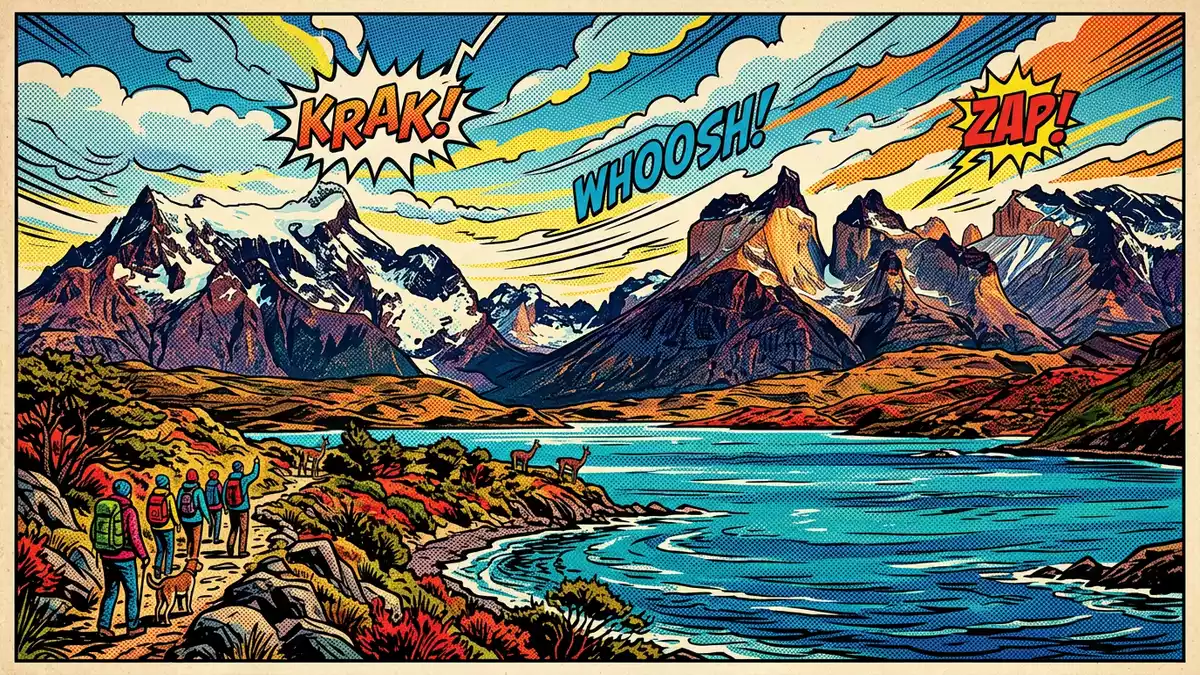
Parque Nacional Torres del Paine in southern Chile is a landscape where sheer granite towers, pale-blue lakes and Patagonian steppe come together in one compact panorama. North of Puerto Natales, the park forms part of the Magallanes Region and has been protected as a national park since 1959, placing its jagged skyline among the most recognisable silhouettes in Patagonia.
Granite towers and the Paine massif
The centrepiece of Parque Nacional Torres del Paine is the Paine massif, a self-contained mountain system that rises between the Andes and the open steppe of southern Patagonia.The park lies in the Región de Magallanes y de la Antártica Chilena and is administered as part of the province of Última Esperanza.Puerto Natales is the nearest town of any size
The massif itself combines sedimentary rock in its upper reaches with granite lower down, a contrast that gives the famous towers and horns their banded appearance.The Cordillera Paine is described as a system separate from the main Andes chain and rises sharply from the surrounding plains. Glaciers occupy high cirques and valleys, feeding lakes that range from deep blue to milky turquoise beneath the peaks.
A protected Patagonian landscape
Torres del Paine was formally created as a Chilean national park on 13 May 1959, when a decree of the Ministry of Agriculture set aside the land as a protected area.The protected unit belongs to the national system of state natural areas and covers a landscape of mountains, valleys, rivers and lakes. In 1978, UNESCO recognised the wider area as a biosphere reserve under its Man and the Biosphere Programme, integrating national park and surrounding zones into a single designated region.The Torres del Paine Biosphere Reserve extends over more than 770,000 ha
Within the park boundary, the terrain ranges from wind-exposed steppe to lenga and coihue woodland, with glaciers descending from the Southern Patagonian Icefield into broad lakes. Trails cross moraines, river valleys and open slopes, offering views of the Paine towers, the Cuernos del Paine and the broad surfaces of lakes such as Nordenskjöld and Grey. The combination of rock, ice and water gives the area a character that shifts from open grassland to rugged mountain amphitheatre in short succession.
Getting a sense of scale on foot
Although maps and figures capture some of the scale of Parque Nacional Torres del Paine, the park is most readily understood on foot along its established trails. Multi-day routes trace arcs around the massif, linking valleys, high viewpoints and lake shores into continuous journeys beneath the granite walls. Single-day walks lead to viewpoints beneath the towers or along the margins of glaciers, offering close-up perspectives on the cliffs and ice.
The approach roads and paths converge on several park sectors, each with its own combination of steppe, woodland and mountain backdrop.The park sits more than 100 km north of Puerto Natales along a route that leaves the coastal town for the interior.Roads from Punta Arenas and the Argentine town of El Calafate converge on Puerto Natales as the main service centre for visits to Torres del Paine.
Visiting Parque Nacional Torres del Paine: what travellers from Western Europe should know
- Parque Nacional Torres del Paine lies in Chilean Patagonia north of Puerto Natales, reached overland on roads that branch inland from the coastal town towards the interior.
- The terrain inside the park includes steep paths, exposed ridges and long sections on foot across open Patagonian steppe, where wind and weather can change quickly.
- Lakes, rivers and glaciers are prominent features, so paths may involve river crossings on bridges and sections along uneven, rocky shorelines.
- The official language is Spanish and the currency is the Chilean peso.
- Entry requirements depend on your nationality; UK travellers can check the FCDO travel advice at gov.uk/foreign-travel-advice, Irish travellers the Department of Foreign Affairs at ireland.ie.
Searching for Parque Nacional Torres del Paine on social platforms
These links open searches for Parque Nacional Torres del Paine on each platform.
Frequently asked questions about Parque Nacional Torres del Paine
Where is Parque Nacional Torres del Paine?
Parque Nacional Torres del Paine is in the Magallanes Region of southern Chile, inland from Puerto Natales in the province of Última Esperanza.
What can visitors expect inside the park?
Visitors encounter granite towers, glaciers, lakes, rivers and Patagonian steppe, linked by marked trails that cross valleys, ridges and lake shores beneath the Paine massif.
What makes Parque Nacional Torres del Paine distinctive?
The park combines a compact granite mountain group, large lakes and open steppe within a protected area recognised as a UNESCO biosphere reserve since 1978.


