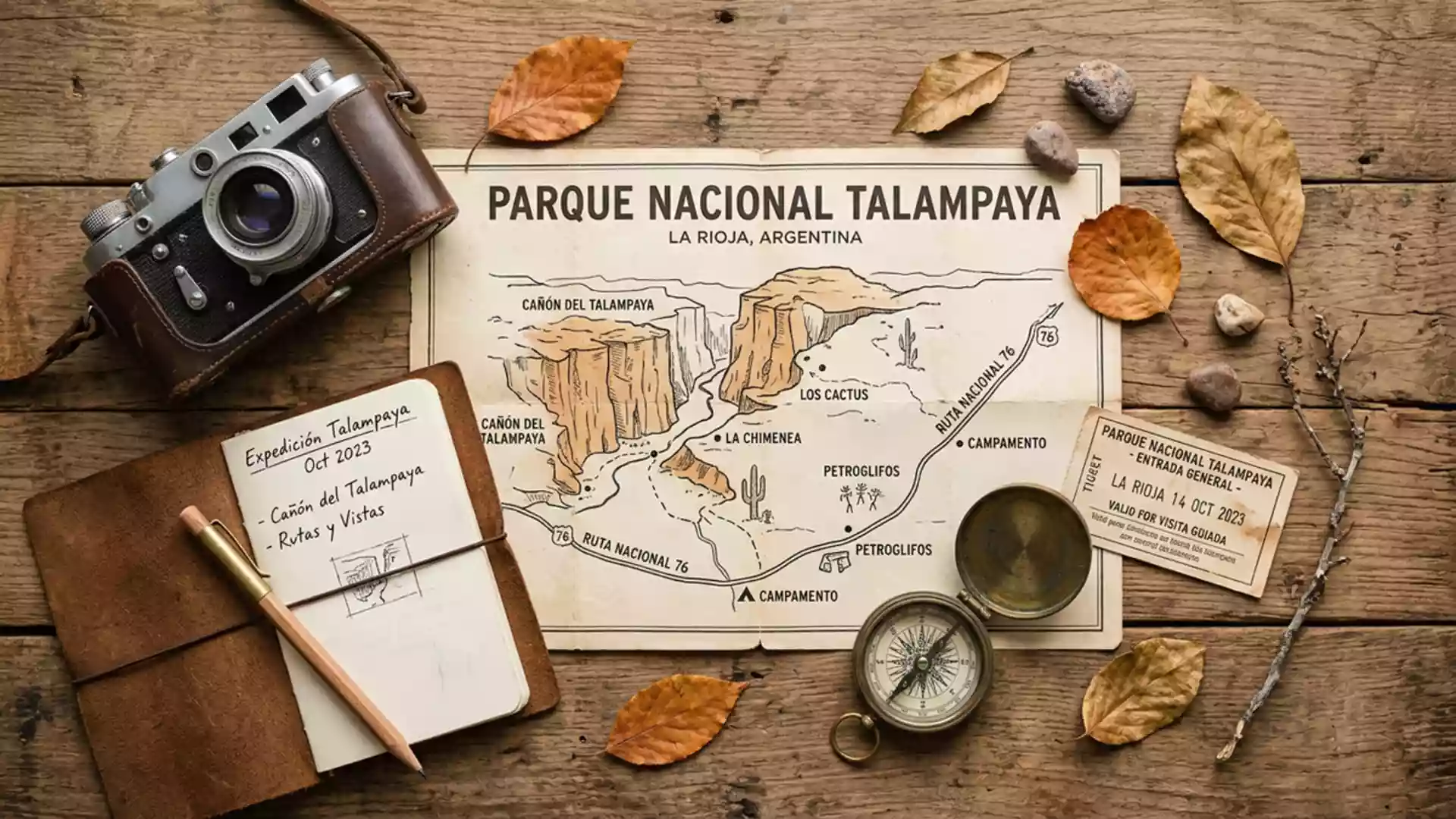
Parque Nacional Talampaya and its towering red-rock canyon
Published on 09/09/2026 at 07:31 | Editorial responsibility: Rafael Müller, Editor-in-Chief AD HOC NEWS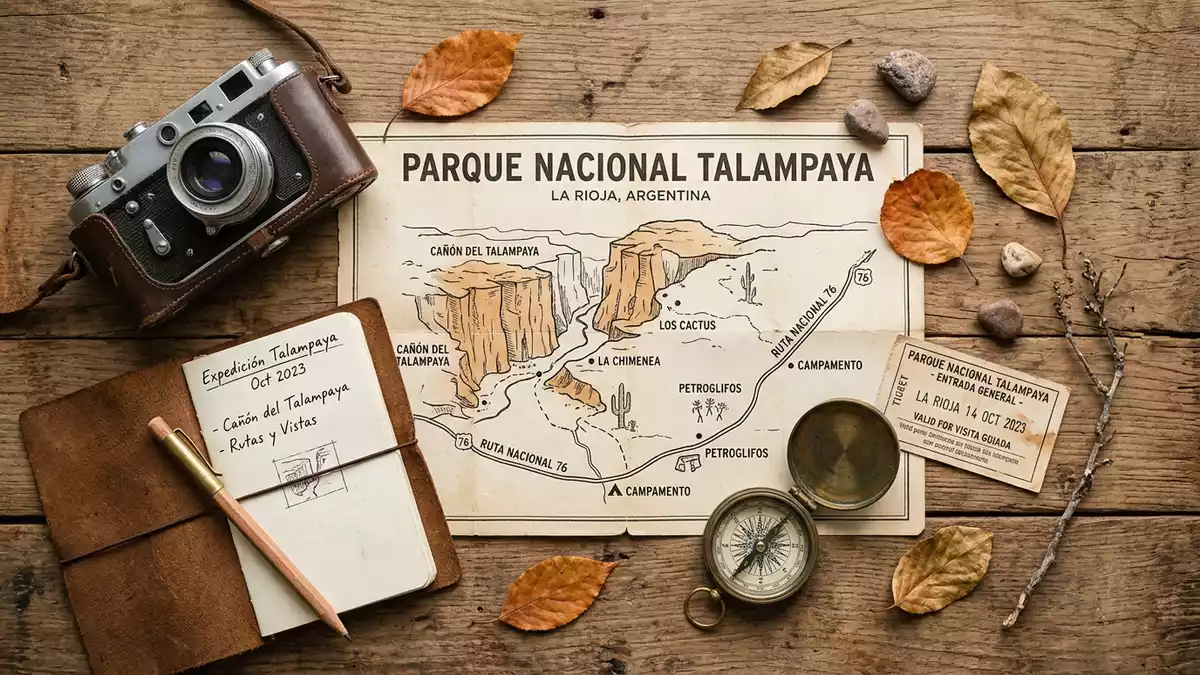
Parque Nacional Talampaya in La Rioja is a protected desert park where towering red-rock cliffs, eroded canyons and open plains expose an extraordinary slice of Argentina’s Triassic past. This national park was designated a provincial reserve in 1975 and became a national park in 1997, reflecting its role in preserving important archaeological and palaeontological sites in the region. In 2000 it was recognised as part of a UNESCO World Heritage site, highlighting the global significance of its fossil-bearing rocks and dramatic geology.
Red sandstone walls and a sculpted desert canyon
The most striking feature of Parque Nacional Talampaya is its wide desert canyon, where vertical cliffs of reddish sandstone rise sharply from a dry valley floor. In places the rock faces reach substantial heights, forming a corridor of walls that frame the canyon like an outdoor gallery of sedimentary layers shaped by erosion. Within this landscape, wind and water have carved pillars, buttresses and other rock forms that stand out against the pale desert surface and the high, sparsely vegetated plateau above.Talampaya National Park
The cliffs and surrounding desert belong to the Monte de Sierras y Bolsones ecoregion, an arid environment of rocky outcrops, dry riverbeds and broad basins.Monte de Sierras y Bolsones Sparse shrubs and hardy plants dot the sandy ground, while dry channels cut across the plateau and descend into the main canyon. Travellers who enter the canyon encounter sheer walls close at hand, with layered rock surfaces displaying subtle variations in colour from deep red to lighter tones. The open sky above and the broad valley beneath the cliffs make the canyon one of La Rioja’s most recognisable desert settings.
A window onto the Triassic and vertebrate evolution
Beneath the visible desert landscape, the rocks of Parque Nacional Talampaya hold one of the most complete sequences of Triassic continental sediments known, recording tens of millions of years of geological history.Triassic fossil sequence These sedimentary layers preserve fossils of early vertebrates, including ancestors of mammals and remains linked with dinosaur lineages, as well as impressions of ancient plants. Together they reveal a record of how vertebrate life evolved and how desert and river environments changed during the Triassic period of the Mesozoic era.
Parque Nacional Talampaya forms part of a World Heritage inscription known as the Ischigualasto–Talampaya Natural Parks, shared with the neighbouring Ischigualasto area in San Juan Province.Ischigualasto–Talampaya Natural Parks This combined protected zone preserves fossiliferous basins where successive strata document the Triassic in continuity, rather than as isolated pockets of fossils. In the La Rioja sector, the national park safeguards both the canyon landscape and surrounding plains, maintaining conditions that allow ongoing study of rock sequences, fossils and the wider desert ecology.
Scale, access and the surrounding Andean region
Parque Nacional Talampaya covers more than 213,000 hectares of desert and canyon terrain in the centre-west of La Rioja Province, within departments such as Coronel Felipe Varela and Independencia.area and provincial setting The park stands in the Andean rain shadow, bordered by ranges including Cerro Los Colorados on one side and Sierra de Sañagastana on the other, with average elevations of around 1,500 m (4,921 ft) above sea level in the wider protected area.Cerro Los Colorados and Sierra de Sañagastana This setting places Talampaya within the broader transition zone between the high Andes to the west and the interior plains of central Argentina.
The main gateway town serving Parque Nacional Talampaya is Villa Unión, a locality recognised in official park documents as the nearest urban centre.Villa Unión as access point Roads cross the desert from Villa Unión towards the canyon sector, bringing travellers to bases on different access routes. From these bases, guided excursions follow established tracks across the desert floor and into the canyon, revealing viewpoints of the high cliffs, rock formations and wide basin beyond the main walls. The journey across the plateau and into the canyon emphasises the park’s scale: a protected area large enough that the desert, the rock faces and the fossil-bearing strata all sit within a single conservation landscape.
Visiting Parque Nacional Talampaya: what travellers from Western Europe should know
- Parque Nacional Talampaya lies in the centre-west of La Rioja Province in Argentina, with access commonly arranged from the town of Villa Unión by road across desert terrain.
- The desert setting includes uneven ground, dry channels and sections of coarse sand, so visiting the canyon sector involves walking on varied surfaces and stepping over low rock and shrub-covered areas.
- Parque Nacional Talampaya is in Argentina, where the official language is Spanish and the currency is the Argentine peso.
- Entry requirements depend on your nationality; UK travellers can check the FCDO travel advice at gov.uk/foreign-travel-advice, Irish travellers the Department of Foreign Affairs at ireland.ie.
Searching for Parque Nacional Talampaya on social platforms
These links open searches for Parque Nacional Talampaya on each platform.
Frequently asked questions about Parque Nacional Talampaya
Where is Parque Nacional Talampaya located?
Parque Nacional Talampaya is in the centre-west of La Rioja Province in Argentina, with the access town of Villa Unión serving as a main gateway.
What should travellers expect on a visit?
Visitors encounter a wide desert canyon lined by high red-rock cliffs, eroded formations and sandy channels, reached by road through arid plateau terrain.
What makes Parque Nacional Talampaya distinctive among desert parks?
Talampaya combines a dramatic sandstone canyon landscape with a remarkably complete Triassic fossil record, protected as part of a UNESCO World Heritage site.