
Parque Nacional Talampaya and its sandstone canyon walls
Published on 09/11/2026 at 13:05 | Editorial responsibility: Rafael Müller, Editor-in-Chief AD HOC NEWS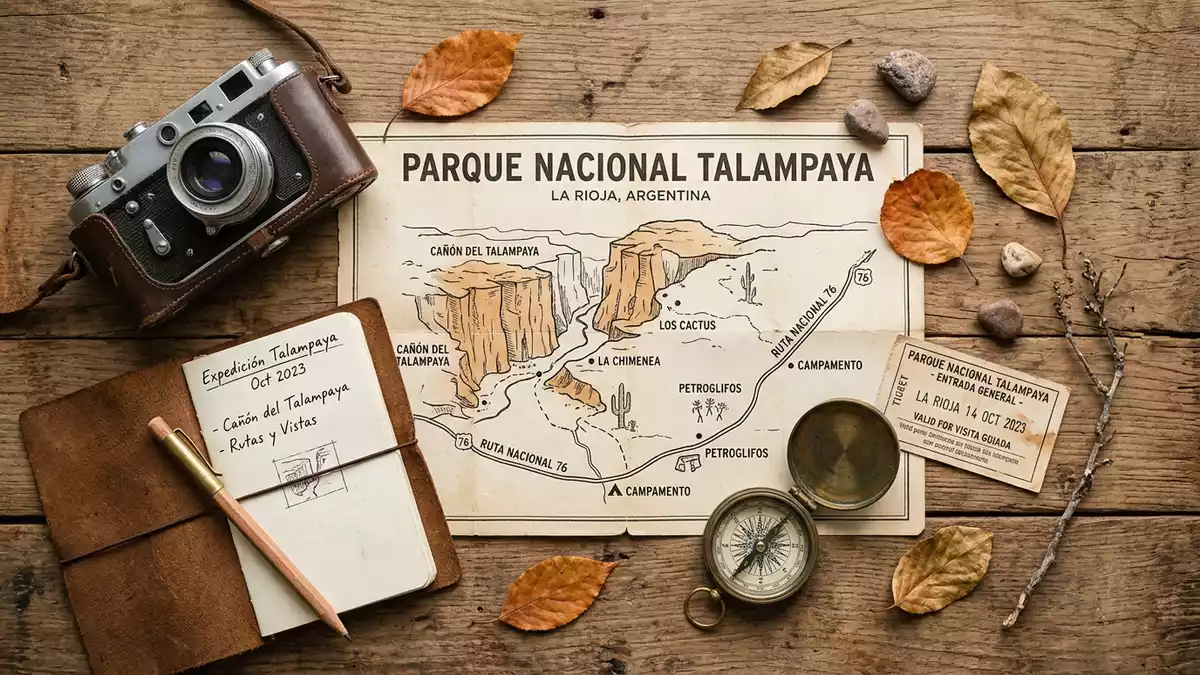
Parque Nacional Talampaya in La Rioja, Argentina is a desert national park where towering reddish sandstone cliffs enclose a broad canyon, and Triassic fossils lie in the surrounding strata. Established as a provincial reserve in 1975 and a national park in 1997, it forms part of the Ischigualasto–Talampaya Natural Parks recognised as a UNESCO World Heritage Site for their Triassic rock record.Talampaya National Park
Sandstone walls and desert canyon landscape
Parque Nacional Talampaya lies in the centre–west of La Rioja Province in an arid belt known as the Monte de Sierras y Bolsones ecoregion, a landscape of basins framed by sierras on the inland side of the Andes.Monte de Sierras y Bolsones ecoregion Within this dry environment the main Talampaya canyon cuts through reddish sedimentary rocks, exposing vertical cliffs that rise sharply above a sandy floor where sparse vegetation marks the course of intermittent water.
Walking along the canyon, the scale of the sandstone faces becomes the defining impression of the park, with sheer walls standing in sequences that frame the open valley like a series of natural corridors. The rock surfaces display layers and textures that record deposition during the Triassic Period, giving the valley an appearance shaped by deep geological time rather than recent erosion. In places, freestanding rock forms break away from the main cliff line, forming isolated pillars and sculpted masses that emphasise the height and colour of the surrounding walls.
Triassic fossils and a protected geological record
The core significance of Parque Nacional Talampaya lies in the continuity of its Triassic sedimentary sequence and the fossils preserved within it, which together document a chapter in the evolution of vertebrates on land.Triassic vertebrate evolution The park conserves continental deposits where fossil remains of early mammal ancestors, dinosaurs and associated plant life are found, illustrating changes in ecosystems during the Mesozoic era. These geological and palaeontological assets are part of the reason Talampaya, together with the neighbouring Ischigualasto Provincial Park, was inscribed on the World Heritage List in 2000.World Heritage inscription in 2000
Within the protected area, the rock record is accompanied by archaeological and historical sites that reflect human use of the region over long periods, although the modern park is centred on conservation and controlled access rather than settlement.archaeological and palaeontological sites The formal creation of Talampaya as a national park in 1997 under Argentine law provided a framework for safeguarding this scientific heritage, with management plans focused on both landscape protection and visitor access that respects the fragility of the canyon environment.national park creation in 1997
Access routes and the wider La Rioja setting
Parque Nacional Talampaya sits to the west of the settled valleys of La Rioja, with access roads running through semi–desert terrain towards the canyon entrance. The main approach follows National Route 76, which links the park with towns such as Villa Unión and the junction at Patquía, bringing travellers from regional centres across the dry basins that characterise this part of Argentina.Access via National Route 76 The journey towards Talampaya marks a gradual transition from cultivated land to open scrub and rock, with the enclosing canyon walls only appearing close to the protected area.
Within the park boundary, internal routes follow the main canyon and neighbouring valleys, with guided excursions using authorised vehicles and walking sections where terrain and conservation rules permit movement on the canyon floor.protected area access The wider region includes the Monte de Sierras y Bolsones landscapes and the paired World Heritage site of Ischigualasto in neighbouring San Juan Province, creating a broader route through arid Andean forelands for travellers interested in geology and desert environments.Ischigualasto–Talampaya Natural Parks
Visiting Parque Nacional Talampaya: what travellers from Western Europe should know
- Parque Nacional Talampaya lies in the west of La Rioja Province in Argentina, with the main road approach along National Route 76 linking the park to Villa Unión and other regional junctions.
- The terrain in the canyon is desert and rocky, with stretches of sandy ground, exposed rock faces and sections reached by guided vehicles and walking on the canyon floor.
- The wider setting is an arid inland region on the Andean side, so sun exposure and temperature variation are characteristic features of any visit.
- The official language is Spanish and the currency is the Argentine peso.
- Entry requirements depend on your nationality; UK travellers can check the FCDO travel advice at gov.uk/foreign-travel-advice, Irish travellers the Department of Foreign Affairs at ireland.ie.
Searching for Parque Nacional Talampaya on social platforms
These links open searches for Parque Nacional Talampaya on each platform.
Frequently asked questions about Parque Nacional Talampaya
Where is Parque Nacional Talampaya?
Parque Nacional Talampaya is in the centre–west of La Rioja Province in Argentina, within the Monte de Sierras y Bolsones ecoregion on the inland side of the Andes.
What can visitors expect on a visit to Talampaya?
Visitors encounter a desert canyon landscape with high reddish sandstone cliffs, sandy ground and guided routes that follow the main valley and adjoining sectors.
What makes Parque Nacional Talampaya distinctive?
Talampaya is distinctive for its Triassic rock sequence, its fossils of early vertebrates and plants, and its recognition as part of a UNESCO World Heritage site.


