
Parque Nacional Talampaya and its red rock walls
Published on 08/22/2026 at 12:00 | Editorial responsibility: Rafael Müller, Editor-in-Chief AD HOC NEWS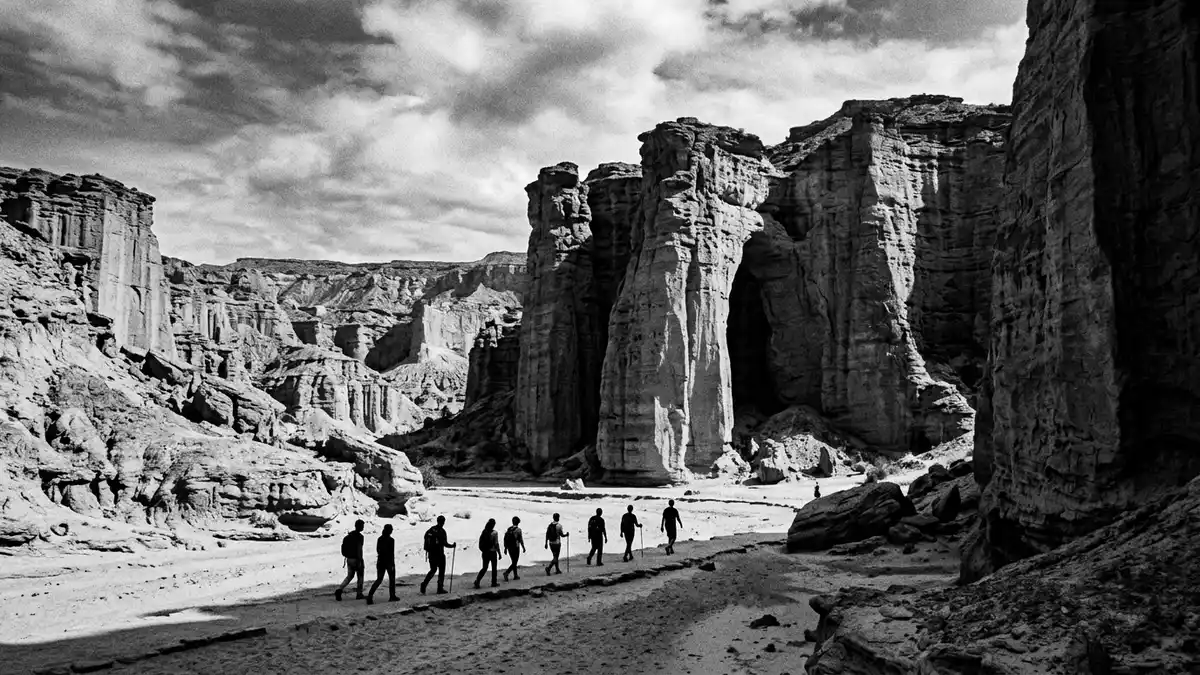
Parque Nacional Talampaya in La Rioja is a desert landscape of tall red rock walls, narrow ravines and broad exposed strata. It was created as a provincial reserve in 1975, became a national park in 1997 and entered the UNESCO World Heritage list in 2000national park in 1997UNESCO World Heritage list. The first impression is geological rather than architectural, and that is the point of the place.
Red cliffs and Triassic layers
The park forms part of the Ischigualasto / Talampaya Natural Parks World Heritage property, a combined landscape in central Argentina recognised for its fossil record from the Triassic Period. In Talampaya itself, the cliffs expose sedimentary layers that make the colour and structure of the rock immediately legibleTriassic Period. The result is a place where vertical faces, canyons and carved forms dominate the view.
The park occupies a large protected area in the province of La Rioja, and the official park administration places it in the Monte de Sierras y Bolsones ecoregionMonte de Sierras y Bolsones. Fossils of plants, dinosaurs and other vertebrates are part of its significance, but the place remains first and foremost a landscape of rock and erosion. Talampaya is often discussed alongside Ischigualasto across the provincial border in San Juan, where the two protected areas form one geological story.
From provincial reserve to World Heritage
The park’s legal and conservation history belongs to the late twentieth century, when the area moved from provincial protection to national park status. That sequence places Parque Nacional Talampaya among Argentina’s major protected landscapes, but the physical setting is older by orders of magnitude. Its cliffs belong to the same Triassic terrain that has made the wider World Heritage area important to palaeontology and geology.
The UNESCO inscription links Talampaya with Ischigualasto because together they preserve a broad fossil record from the Triassic. That record includes ancestors of mammals, dinosaurs and plants, which gives the site a significance that reaches beyond its dramatic scenery. The park’s name is therefore attached to both a striking desert landscape and a scientific archive preserved in stone.
La Rioja desert scenery at close range
What gives Talampaya its force is the scale of its exposed rock. The walls rise abruptly from the floor of the canyon system, and the colour shifts between deep red, brown and pale bands as the light changes across the strata. The landscape is severe, open and highly legible, with little to hide the geology.
Because the rock faces are so prominent, the park reads as a sequence of surfaces: cliffs, gullies, ledges and flat ground. This is a place for observing formations rather than for looking past them, and the relation between void and mass is constant throughout the park.
Visiting Parque Nacional Talampaya: what travellers from Western Europe should know
- Parque Nacional Talampaya lies in La Rioja, Argentina, and access is normally via Villa Unión and the roads that link the town with the park area. The official park administration is based in Villa Unión.
- The terrain is dry, rocky and exposed, with steep walls, uneven ground and desert light. Footing varies on canyon floors and on the approaches to the main formations.
- The park is part of a UNESCO World Heritage property shared with Ischigualasto in San Juan. The two sites belong to the same Triassic geological story.
- The official language is Spanish and the currency is the Argentine peso. Entry requirements depend on your nationality; UK travellers can check the FCDO travel advice at gov.uk/foreign-travel-advice, Irish travellers the Department of Foreign Affairs at ireland.ie.
Searching for Parque Nacional Talampaya on social platforms
These links open searches for Parque Nacional Talampaya on each platform.
Frequently asked questions about Parque Nacional Talampaya
Where is Parque Nacional Talampaya?
It is in La Rioja province in north-western Argentina, within a desert region of the country’s interior. The park lies in the same World Heritage property as Ischigualasto in neighbouring San Juan.
What does a visit involve?
The place is a desert park with canyons, cliffs and exposed rock layers. Its setting is defined by geology, open ground and the colour of the sandstone.
What makes Parque Nacional Talampaya distinctive?
Its red rock landscape and Triassic fossil record define it. The park combines striking terrain with a scientific heritage recognised at World Heritage level.


