
Parque Nacional Natural Tayrona between mountains and Caribbean sea
Published on 08/28/2026 at 16:12 | Editorial responsibility: Rafael Müller, Editor-in-Chief AD HOC NEWS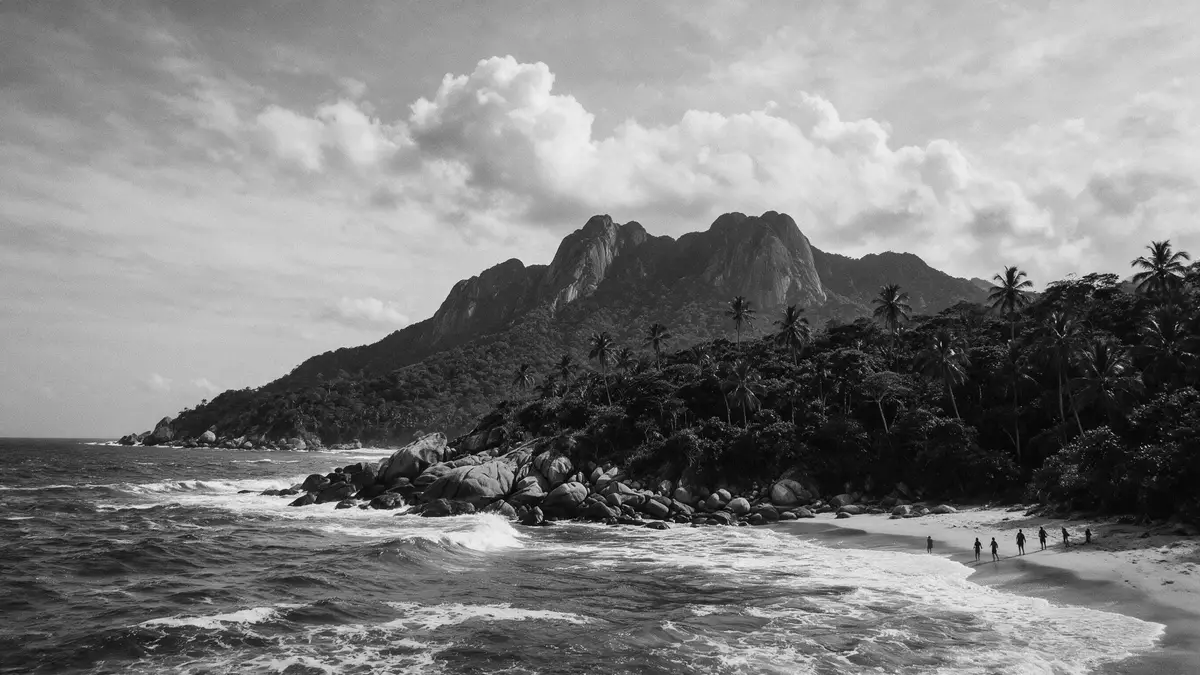
Parque Nacional Natural Tayrona on Colombia’s Caribbean coast is a protected landscape where the foothills of the Sierra Nevada de Santa Marta descend directly into the sea and meet sandy bays in a compressed strip of land and water. Established as a national park in the 1960s, it lies within the jurisdiction of Santa Marta in the Magdalena Department and preserves coastal forest, marine ecosystems and traces of the Tairona civilisation.
Mountains meeting the Caribbean
Parque Nacional Natural Tayrona occupies a stretch of shore along Colombia’s northern Caribbean coast, east of the city of Santa Marta, where mountains and sea share a narrow band of terrain. The park covers a defined land area and an adjoining portion of the Caribbean Sea in the Magdalena Department, creating a protected mosaic of slopes, beaches and near-shore waters.covers 150 square kilometres of land and 30 of sea The Colombian government created the park in the 1960s as part of a wider programme to safeguard ecologically rich regions, and its legal boundaries were confirmed by national institutions later in that decade.declared a protected park in 1964
The physical setting of Parque Nacional Natural Tayrona is shaped by the Sierra Nevada de Santa Marta, a coastal mountain range whose lower slopes run right down to the Caribbean shore and then into the sea. Within the park the elevation rises from sea level to around 900 m (2,953 ft) over short horizontal distances, creating steep gradients and abrupt changes in vegetation along the bays and headlands.altitude between 0 and 900 m Inlets such as Chengue, Gayraca, Cinto, Neguanje, Concha and Guachaquita form a sequence of bays separated by rocky stretches of coast, backed by forested slopes.bays including Chengue and Neguanje
Forests, reefs and coastal ecosystems
Within its land and marine boundaries Parque Nacional Natural Tayrona protects a concentration of tropical ecosystems, ranging from dry coastal scrub to cloud forest and coral reef. On land, the park includes matorrales espinosos, or spiny scrub, dry forests, more humid forests and patches of cloud forest at higher elevations, together with mangroves and coastal lagoons along the shoreline.ecosystems from dry forest to mangroves Offshore, the protected marine zone contains coral formations, seagrass meadows, praderas de algas and coastal rock, forming habitats for fish and marine invertebrates.
The park’s status as a protected area in Colombia’s Caribbean region reflects the importance of these ecosystems, which include endangered dry tropical forest and mangrove swamps. In the sea, coral reefs and seagrass beds line the bays and headlands, while on land the mixture of forest types supports diverse bird and mammal life.protects dry tropical forests and coral reefs Walks through Parque Nacional Natural Tayrona move across sandy beaches, through forest and alongside mangrove-fringed inlets, with the steep slopes of the Sierra Nevada de Santa Marta rising behind.
Tairona heritage in a coastal park
Beyond its natural landscapes, Parque Nacional Natural Tayrona contains archaeological remains linked to the Tairona civilisation that lived in these coastal mountains long before Spanish colonisation. Within the protected area, stone terraces, paved paths and foundations mark ancient settlements embedded in the forest, connected by networks of caminos that once linked ceremonial plazas and agricultural areas.over 250 ancient Tairona settlements These remains sit within the modern national park, giving the terrain a dual character as both a natural reserve and a cultural landscape.
The relationship between Parque Nacional Natural Tayrona and the indigenous communities of the Sierra Nevada de Santa Marta is reflected in the way the area is managed and described in official material. The national park authority in Colombia recognises four indigenous peoples linked to the mountain range and coordinates specific periods during the year when the territory rests and environmental, cultural and spiritual activities are emphasised.periods of closure aligned with indigenous calendars Visitors encounter traces of the Tairona heritage in walking routes that pass old stone structures and in the way certain sectors of Parque Nacional Natural Tayrona are treated as more sensitive or ceremonial.
Visiting Parque Nacional Natural Tayrona: what travellers from Western Europe should know
- Parque Nacional Natural Tayrona lies along the Caribbean coast east of Santa Marta in Colombia, reached overland on the trunk road towards Palomino and by sea routes serving bays such as Bahía Concha.located on the Caribbean littoral north-east of Santa Marta
- The terrain within Parque Nacional Natural Tayrona includes steep slopes rising from sea level to around 900 m (2,953 ft), sandy beaches backed by forest, rocky coastal stretches and footpaths that can involve sustained gradients and sections on uneven ground.altitude between 0 and 900 metres
- The official language in Santa Marta and Parque Nacional Natural Tayrona is Spanish and the currency is the Colombian peso.
- Entry requirements depend on your nationality; UK travellers can check the FCDO travel advice at gov.uk/foreign-travel-advice, Irish travellers the Department of Foreign Affairs at ireland.ie.
Searching for Parque Nacional Natural Tayrona on social platforms
These links open searches for Parque Nacional Natural Tayrona on each platform.
Frequently asked questions about Parque Nacional Natural Tayrona
Where is Parque Nacional Natural Tayrona located?
Parque Nacional Natural Tayrona is on Colombia’s northern Caribbean coast in the Magdalena Department, within the jurisdiction of the city of Santa Marta.located in Santa Marta, Colombia
What can visitors expect in terms of landscape?
Visitors encounter a narrow strip of bays, sandy beaches, rocky coast and forested slopes, where the lower Sierra Nevada de Santa Marta drops from about 900 m (2,953 ft) to sea level within the park.altitude between 0 and 900 m
What makes Parque Nacional Natural Tayrona distinctive?
Parque Nacional Natural Tayrona stands out for the combination of marine and terrestrial protection, its compressed meeting of mountains and Caribbean sea, and the presence of numerous archaeological sites linked to the Tairona civilisation within a modern national park.ancient Tairona settlements within the park


