
Parque Nacional Manuel Antonio’s compact Pacific drama
Published on 08/26/2026 at 15:39 | Editorial responsibility: Rafael Müller, Editor-in-Chief AD HOC NEWS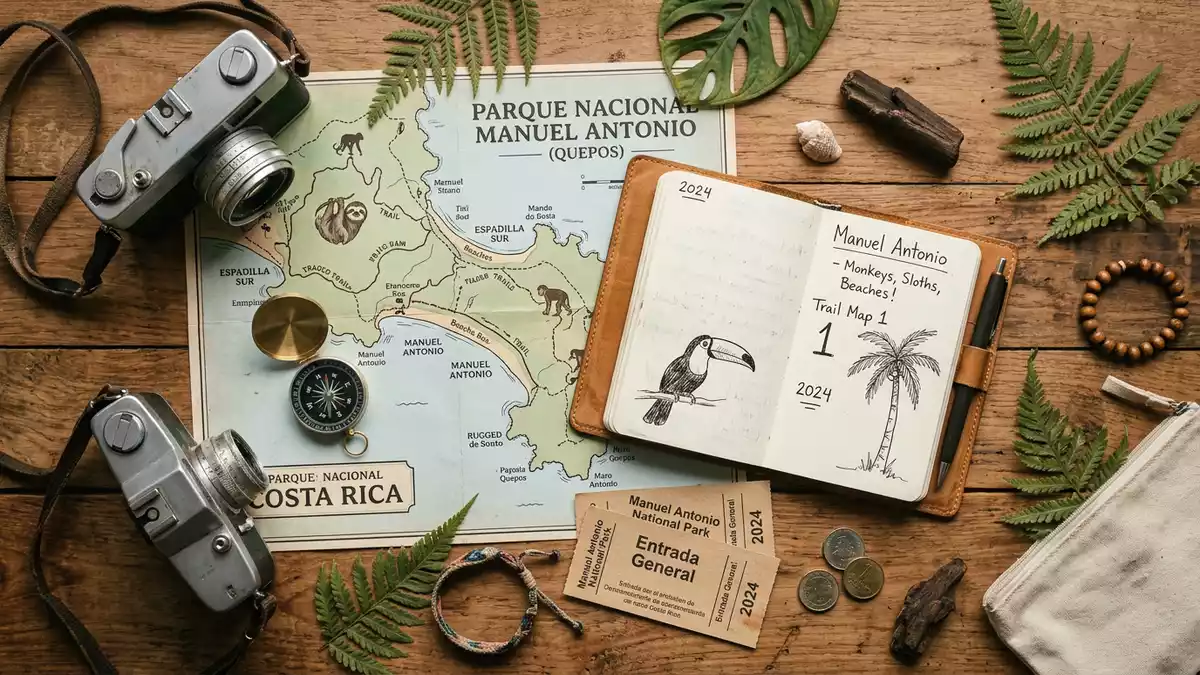
Parque Nacional Manuel Antonio on Costa Rica’s central Pacific coast is a compact national park where dense rainforest, bright Pacific coves and abundant wildlife share a small strip of land near Quepos. Set within the province of Puntarenas and formally established as a national park on 15 November 1972, it protects both terrestrial slopes and offshore waters in a conservation landscape that feels surprisingly concentrated for its scale.Manuel Antonio National Park
Rainforest meeting the Pacific in a small park
Parque Nacional Manuel Antonio lies just south of Quepos on the Pacific coast, within the Central Pacific Conservation Area that gathers several protected zones along Costa Rica’s shoreline.Central Pacific Conservation Area The core of the park covers a modest area of terrestrial forest that descends towards the sea, backed by low hills rather than high mountains, giving visitors short transitions from dense vegetation to open shore.
Unlike sprawling wilderness reserves, Manuel Antonio’s terrestrial section has been measured in the order of around 1,983 ha, with a much larger marine component extending offshore.terrestrial and marine figures The protected marine area includes coastal waters and islets beyond the headlands, placing the park among Costa Rica’s sites that combine forest conservation with marine protection. On land, the vegetation forms a compact rainforest mosaic where broad-leaved trees, lianas and epiphytes create enclosed paths that regularly break out towards viewpoints over the Pacific.
Trails, viewpoints and beaches within the protected area
Inside Parque Nacional Manuel Antonio, a network of marked trails threads through the forest, linking inland viewpoints with a series of beaches enclosed by headlands and rocky outcrops. The main access route reaches the park from Quepos along Route 618, and within the boundaries paths often use boardwalk sections and firm surfaces that make the short approaches between forest and shore straightforward.Route 618 from Quepos
The beaches inside the park sit within small bays framed by forested slopes, with offshore rocks adding texture to the views out over the Pacific.beaches within the park Some stretches of sand are reached directly from forest paths, where trees stand close to the high-tide line, while other viewpoints stand slightly above the shore, giving clear sightlines along the coast. Inland, short side trails lead towards small hilltops and platforms where the combination of canopy and sea becomes visible in a single sweep.
Wildlife and conservation in Manuel Antonio since 1972
Parque Nacional Manuel Antonio gained its national park status in 1972 by law number 5100, joining Costa Rica’s growing network of protected areas that safeguard forest and coastal ecosystems.law number 5100 in 1972 Conservation management falls under the National System of Conservation Areas (SINAC), and the park’s official description places it firmly within the Quepos canton, with coordinates documented in the Costa Rica Transversal Mercator projection.SINAC official information
The forest and coastal habitats support a broad range of wildlife, including mammals, birds and marine life that use the protected land and sea. Troops of monkeys move through the canopy, while smaller mammals and numerous bird species occupy the lower strata and edge habitats near the beaches. In the marine zone, reefs and rocky substrates provide structure for fish and invertebrates, all sheltered within the park’s designation. The combination of documented terrestrial and marine protection in a single, relatively small unit forms the park’s enduring character.
Visiting Parque Nacional Manuel Antonio: what travellers from Western Europe should know
- Parque Nacional Manuel Antonio lies in Puntarenas province on Costa Rica’s Pacific coast, south of Quepos, reached by road on Route 618 from the town towards the park entrance.
- Terrain inside the park includes forest paths with some boardwalk sections, gentle gradients and sandy beaches, so visitors encounter enclosed woodland stretches followed by open shore.
- The park protects both land and coastal waters, so views combine rainforest, beaches and offshore islets within relatively short walking distances.
- The official language is Spanish and the currency is the Costa Rican colón.
- Entry requirements depend on your nationality; UK travellers can check the FCDO travel advice at gov.uk/foreign-travel-advice, Irish travellers the Department of Foreign Affairs at ireland.ie.
Searching for Parque Nacional Manuel Antonio on social platforms
These links open searches for Parque Nacional Manuel Antonio on each platform.
Frequently asked questions about Parque Nacional Manuel Antonio
Where is Parque Nacional Manuel Antonio located?
Parque Nacional Manuel Antonio is on Costa Rica’s central Pacific coast in Puntarenas province, just south of the town of Quepos, with the main entrance reached along Route 618.
What can visitors expect inside the park?
Visitors walk on forest trails that link viewpoints and enclosed beaches, experiencing dense lowland rainforest, coastal scenery and a mix of terrestrial and marine wildlife within a relatively small protected area.
What makes Parque Nacional Manuel Antonio distinctive among Costa Rica’s parks?
The park combines documented rainforest and marine protection in a compact coastal setting, bringing trails, beaches and offshore islets into close proximity rather than spreading them across a vast area.


