
Parque nacional del Teide: volcanic heights above Tenerife
Published on 09/16/2026 at 17:14 | Editorial responsibility: Rafael Müller, Editor-in-Chief AD HOC NEWS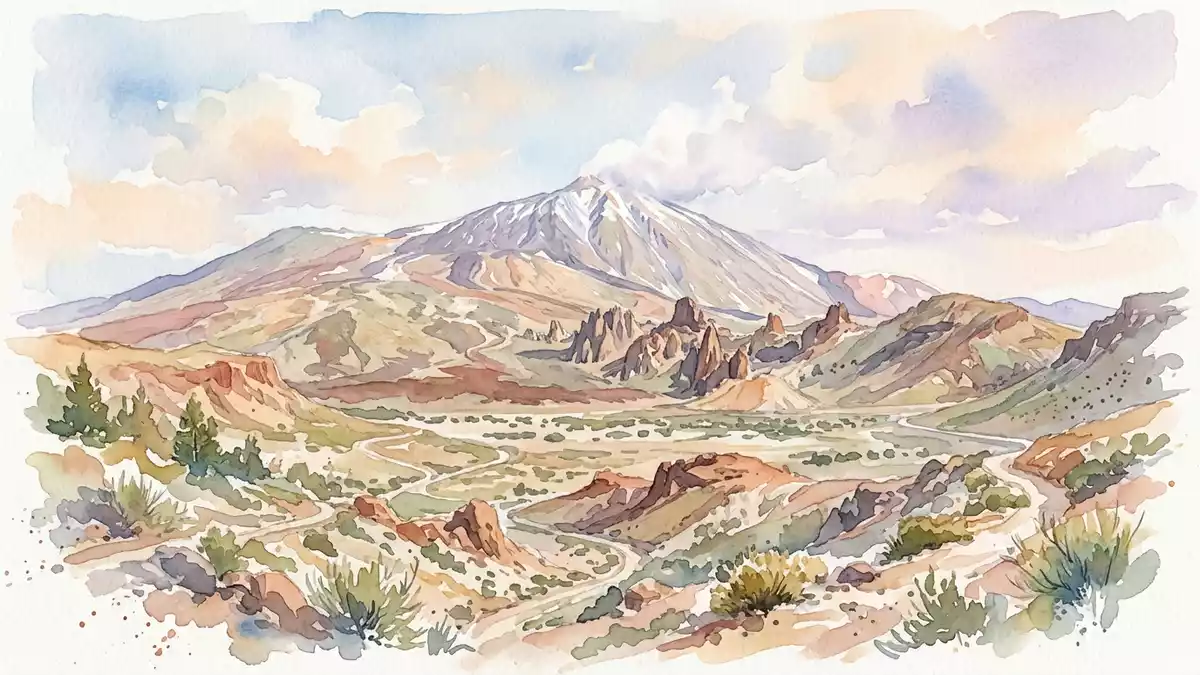
Parque nacional del Teide on Teneriffa is a high volcanic landscape dominated by the bulk of Mount Teide rising above a broad plateau in the centre of the island. The park is part of Spain and centres on an active volcanic massif that reaches well above 3,700 m (around 12,100 ft), forming Spain’s highest point and a clear landmark in the Canary archipelago.
Volcanic heights and a vast caldera
At the heart of Parque nacional del Teide stands the Teide–Pico Viejo volcanic complex, a stratovolcano whose summit cone reaches 3,715 m (12,188 ft) and marks the highest point in Spain.The Teide cone, at 3,715 meters The mountain rises from a great depression known as the Las Cañadas caldera, a wide amphitheatre of older volcanic walls and platforms encircling the central peaks.mostly located in a great depression
This caldera sits around 2,000 to 2,200 m (6,562 to 7,218 ft) above sea level and forms a high plateau where roads, viewpoints and footpaths cross old lava fields, pumice slopes and volcanic debris.at about 2000 - 2200 m altitude Above this floor rises the younger cone of Teide and the bulk of Pico Viejo, together creating a layered skyline of craters, domes and rugged ridges that frame almost every view within the park.the Teide-Pico Viejo Complex in the centre
A World Heritage volcanic laboratory
Parque nacional del Teide is recognised as a natural World Heritage Site, inscribed on the UNESCO World Heritage List in 2007 for its exceptional volcanic scenery and scientific value in understanding oceanic islands.Teide National Park, dominated by the 3,718 m Teide-Pico Viejo stratovolcano The inscription rests on criteria that highlight both the outstanding beauty of the park’s lava plains, cones and cliffs and the evidence they provide of long-term volcanic processes shaping Tenerife.Teide National Park was inscribed in the World Heritage List in 2007
Geologically, the park records a sequence of phases from early subaerial eruptions through the building and collapse of large edifices to the present stratovolcano and its younger lava flows.subdivided into several main phases Basaltic rocks dominate many of the older flows and ground surfaces, especially where dark lava streams descend from Teide and Pico Viejo, while lighter-coloured materials appear in pumice slopes and some domes.Basalts are the most common rocks in the park These contrasts create a patchwork of colours and textures that is visible from viewpoints along the caldera rim and from the flanks of the central cone.
Landscape of lava fields, cones and cliffs
The terrain of Parque nacional del Teide is built from platforms, lava flows, cones and erosional features that together form a high-altitude volcanic plateau.landscape structured into platforms, cones, lava flows and depressions Long tongues of solidified lava run across parts of the caldera floor, broken into rough blocks and ridges, while smoother slopes rise towards the summit area, cut by ravines and scattered with isolated rock formations.
Along the caldera walls, steep inner faces and massive rock masses such as La Fortaleza show remnants of earlier volcanic structures that were eroded and reshaped before the present cone formed.massive rocky formations (such as La Fortaleza) The combination of high elevation, sparse vegetation over large areas and exposed rock gives many viewpoints wide panoramas across Tenerife and, on clear days, towards other islands in the Canary group.
Visiting Parque nacional del Teide: what travellers from Western Europe should know
- Parque nacional del Teide lies in the centre of Tenerife, accessible by the TF-21 road that crosses the caldera between the El Portillo area and the Parador de Las Cañadas.
- The terrain within the park is at high altitude, with roads and paths crossing lava fields and pumice slopes; approaches to viewpoints and trails may include sections of uneven volcanic rock.
- The summit area of Teide stands well above 3,700 m (around 12,100 ft), so visitors reaching the highest viewpoints experience thin air compared with sea level.
- The official language is Spanish and the currency is the euro.
Searching for Parque nacional del Teide on social platforms
These links open searches for Parque nacional del Teide on each platform.
Frequently asked questions about Parque nacional del Teide
Where is Parque nacional del Teide located?
Parque nacional del Teide occupies the central part of Tenerife, one of Spain’s Canary Islands, surrounding the Teide–Pico Viejo volcanic massif within a broad high-altitude caldera.
What should visitors expect on a visit?
Visitors encounter a stark volcanic landscape of lava fields, pumice slopes, cliffs and cones at elevations around and above 2,000 m (6,562 ft), with long views across Tenerife and towards the summit area of Teide.
What makes Parque nacional del Teide distinctive?
The park combines Spain’s highest peak with a large caldera and well-exposed volcanic rocks, and it is recognised as a UNESCO World Heritage Site for both its dramatic scenery and its geological importance.


