
Parque nacional del Teide and the volcanic heart of Tenerife
Published on 09/07/2026 at 07:02 | Editorial responsibility: Rafael Müller, Editor-in-Chief AD HOC NEWS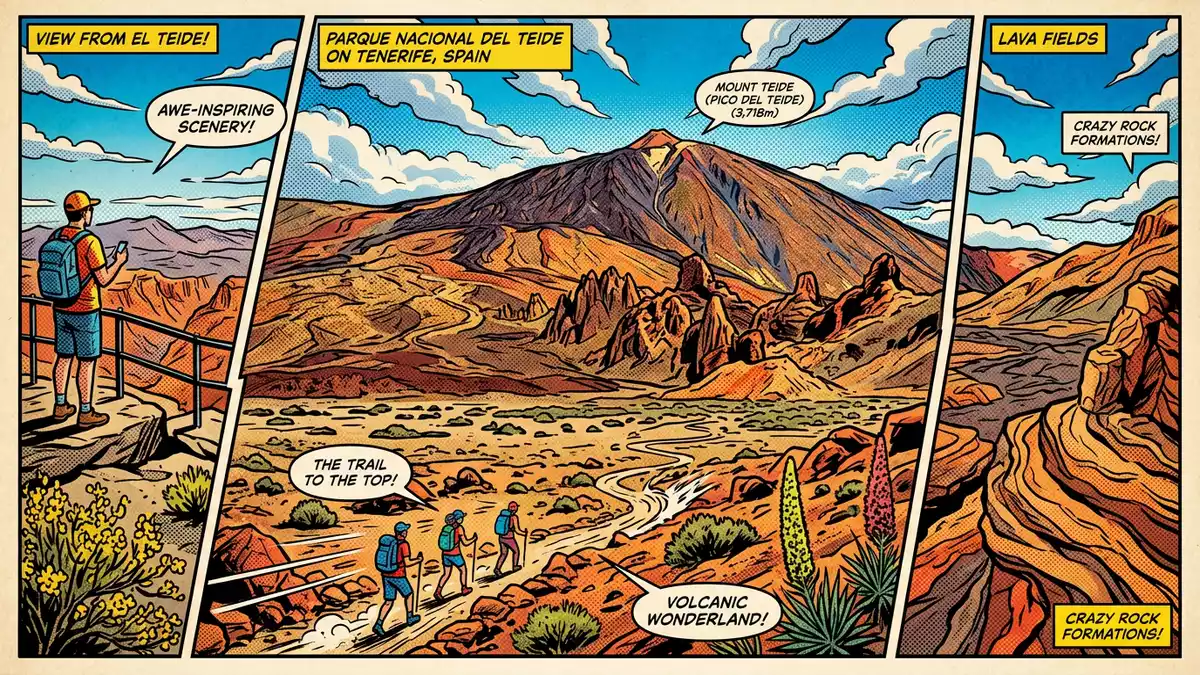
Parque nacional del Teide on Teneriffa is a high?mountain volcanic landscape built around the Teide?Pico Viejo stratovolcano, Spain’s highest peak rising to about 3,718 m (12,198 ft) above sea level.Teide?Pico Viejo stratovolcano The park was declared a national park on 22 January 1954 and later inscribed as a UNESCO World Heritage Site in 2007, giving formal protection to an extensive caldera and the surrounding lava fields.Date of creation as a national park
A vast caldera and Spain’s highest summit
At the core of Parque nacional del Teide lies the Las Cañadas caldera, a broad depression ringed by cliffs that frame the central volcanic cone and its neighbouring summits. Within this setting, the Teide?Pico Viejo complex forms a stratovolcano whose main summit reaches 3,718 m (12,198 ft), the highest point on Spanish soil and the highest mountain in the Canary Islands.Highest peak on Spanish soil Rising around 7,500 m (24,606 ft) above the ocean floor, this volcanic structure ranks among the tallest in the world when measured from its submarine base.Elevation of the volcano
The park’s protected area covers 18,990 ha of high?mountain terrain, concentrated largely in the municipality of La Orotava in the province of Santa Cruz de Tenerife.Extent of Teide National Park From the surrounding pine forests up to the summit cone, the landscape shifts from dark lava flows to pale pumice slopes and isolated volcanic domes. Standing on the caldera floor, the wall of cliffs and the cone of Teide form a visible contrast between ancient collapse structures and younger eruptive features.
Geology and colours of a high?mountain volcanic plateau
Parque nacional del Teide is fundamentally a geological park, preserving a rich collection of volcanic forms including stratovolcano cones, domes, dykes, scoria mounds and extensive lava fields.Description of the volcanic landscape The Las Cañadas caldera creates a wide plateau at high altitude, where solidified lava has weathered into intricate shapes and jagged outcrops. Rock formations rise from the plain in towers and buttresses, and the caldera rim itself forms a continuous backdrop of cliffs.
The range of colours is one of the most striking characteristics of the park’s terrain. Iron?rich basalt gives many flows a dark tone, while layers of lighter ash and pumice create pale slopes and ridges. In places, oxidised minerals bring reddish and ochre hues to the ground, contrasting with patches of black rock. Above this sculpted surface, the cone of Teide appears as a geometric peak capped by the summit crater, dominating the plateau in clear weather and forming a landmark visible across much of Tenerife.Overview of Teide National Park
Plants, altitude and the experience of high terrain
The altitude gradient inside Parque nacional del Teide brings a succession of plant communities adapted to high?mountain conditions in the subtropics. Below the park boundary, Canary Island pine forests occupy the slopes; higher up, on the caldera floor and the flanks of Teide, vegetation becomes more sparse and consists of shrubs, cushion plants and herbs tolerant of strong sunlight, thin soils and wide temperature ranges.Protected high-mountain landscape Snow can appear at the highest elevations in winter, and the combination of altitude and exposure gives the plateau a distinctive seasonal character.
Visitors moving through the park encounter long stretches of open ground on the caldera floor, walks over compacted volcanic deposits and, on steeper routes, paths that climb across loose rock and ash. The summit path from the upper cable?car station ascends through very high?altitude terrain where the ground surface changes from rough lava to more fragmented material near the crater rim. The wide views over Tenerife and towards other Canary Islands are a direct result of the park’s elevation and the absence of tall vegetation across much of the plateau.
Visiting Parque nacional del Teide: what travellers from Western Europe should know
- Parque nacional del Teide occupies the central part of Tenerife in Spain, with road access from coastal towns on the island’s north and south sides and signposted routes into the caldera.
- The high?mountain terrain includes long stretches of walking over uneven volcanic ground and, on routes towards the summit, steep paths at considerable altitude with sections of loose rock.
- Road viewpoints along the rim of the caldera and on the approaches give direct views into the plateau and towards the Teide cone, while tracks and marked footpaths lead onto the lava fields.
- The official language is Spanish and the currency is the euro.
Searching for Parque nacional del Teide on social platforms
These links open searches for Parque nacional del Teide on each platform.Frequently asked questions about Parque nacional del Teide
Where is Parque nacional del Teide?
Parque nacional del Teide is on the island of Tenerife in Spain’s Canary Islands, centred on the Teide?Pico Viejo stratovolcano within the municipality of La Orotava.
What kind of landscape should visitors expect?
The park offers a high?mountain volcanic plateau inside the Las Cañadas caldera, with lava fields, ash slopes, isolated rock formations and wide views towards the Teide summit.
What makes Parque nacional del Teide distinctive among European national parks?
Its combination of a very high stratovolcano, an extensive caldera and a concentration of volcanic features at altitude, all protected since 1954 and recognised by UNESCO, gives it a particular character.


