
Parque nacional del Teide and the vast volcanic bowl of Tenerife
Published on 08/27/2026 at 21:53 | Editorial responsibility: Rafael Müller, Editor-in-Chief AD HOC NEWS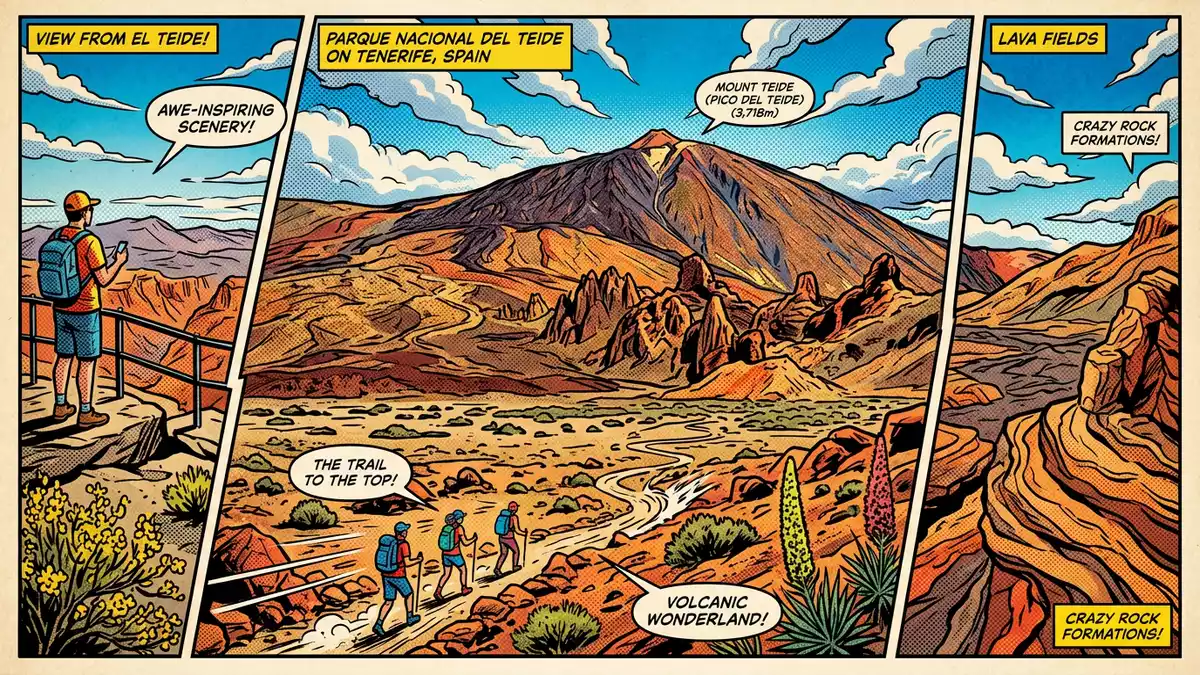
Parque nacional del Teide on Teneriffa in Spain is a high?altitude volcanic landscape wrapped around Mount Teide, the stratovolcano that forms the highest peak on Spanish soil at 3,718 m (12,198 ft). The park was declared a national park in 1954 and inscribed as a UNESCO World Heritage Site in 2007 for its outstanding volcanic features and scenery.
A national park built around Spain’s highest mountain
Parque nacional del Teide occupies the central part of Tenerife in the Canary Islands, with Mount Teide and the neighbouring Pico Viejo rising from a broad volcanic depression. Teide is described as a stratovolcano, a tall volcanic cone built from successive layers of lava and fragmented material, and reaches 3,718 m above sea level, making it the highest point in Spain.the highest peak on Spanish soil The volcano dominates the skyline of the island and sits within a protected area that covers a large expanse of terrain.
The park’s status within Spain’s protected?area network is long?standing, with national park designation dating from the mid?twentieth century.Declared Parque Nacional in 1954 In June 2007 Teide National Park was added to the UNESCO World Heritage List, recognising its value as one of the world’s notable volcanic landscapes and a site where geological processes can be seen on a grand scale.named a World Heritage Site in 2007
Las Cañadas: the giant volcanic caldera at Teide’s feet
The character of Parque nacional del Teide is defined by the enormous volcanic depression known as Las Cañadas del Teide, a caldera that forms a wide bowl around the base of Mount Teide. This depression has an elliptical plan and measures around 16 km across at its widest point, with steep walls that rise several hundred metres above the floor.Las Cañadas, an elliptical caldera 16 km wide Within this bowl lie lava fields, domes and sediments that record a complex volcanic history.
Geological studies describe Las Cañadas as one of the largest and best?exposed calderas associated with evolved alkaline volcanism, formed through overlapping collapse events over more than a million years.a multicycle overlapping collapse caldera The caldera walls expose the internal structure of the earlier Las Cañadas edifice, while the interior has been partially filled by the younger Teide?Pico Viejo volcanic complex and numerous smaller vents and domes.Teide-Pico Viejo complex inside the caldera
Volcanic landforms and high?altitude ecology
Parque nacional del Teide is widely recognised as a showcase of volcanic landforms, with lava flows, domes, pyroclastic deposits and intrusive bodies all visible within a relatively compact area.one of the best examples of volcanism in the world The floor of Las Cañadas contains sedimentary plains known as “cañadas”, lying at the foot of the caldera walls, and the Roques de García rock formations stand as prominent remnants of earlier structures in the landscape.Roques de García separating semi-calderas The high elevation and volcanic soils create conditions for specialised plant communities adapted to strong sunlight, thin air and marked temperature variations.
The park’s geology has been the subject of extensive research, with attention focused on the evolution of the Las Cañadas edifice, the formation of the caldera and the development of the twin stratovolcanoes Teide and Pico Viejo.Teide-Pico Viejo stratovolcano within the caldera For travellers, that research translates into a landscape where cliff faces, layered deposits and contrasting rock colours can be seen along roads and paths, providing a visible cross?section through a long volcanic history.
Visiting Parque nacional del Teide: what travellers from Western Europe should know
- Parque nacional del Teide lies in the centre of Tenerife in the Canary Islands, reached from coastal settlements by roads that climb to the high plateau within the caldera.
- The terrain inside the park is high?altitude volcanic ground, with extensive lava fields and rocky surfaces; moving away from paved areas involves uneven footing.
- The official language is Spanish and the currency is the euro.
Searching for Parque nacional del Teide on social platforms
These links open searches for Parque nacional del Teide on each platform.
Frequently asked questions about Parque nacional del Teide
Where is Parque nacional del Teide?
Parque nacional del Teide is in the centre of Tenerife in the Canary Islands, Spain, surrounding Mount Teide and the Las Cañadas caldera.
What kind of landscape does the park offer?
The park offers a high?altitude volcanic landscape with a large caldera, stratovolcanoes, lava flows, rock formations and plains within the depression.
What makes Parque nacional del Teide distinctive?
Its combination of Spain’s highest mountain, the wide Las Cañadas caldera and well?exposed volcanic structures gives Parque nacional del Teide a distinctive geological character.


