
Parque Nacional Cahuita where rainforest meets coral reef
Published on 09/22/2026 at 07:41 | Editorial responsibility: Rafael Müller, Editor-in-Chief AD HOC NEWS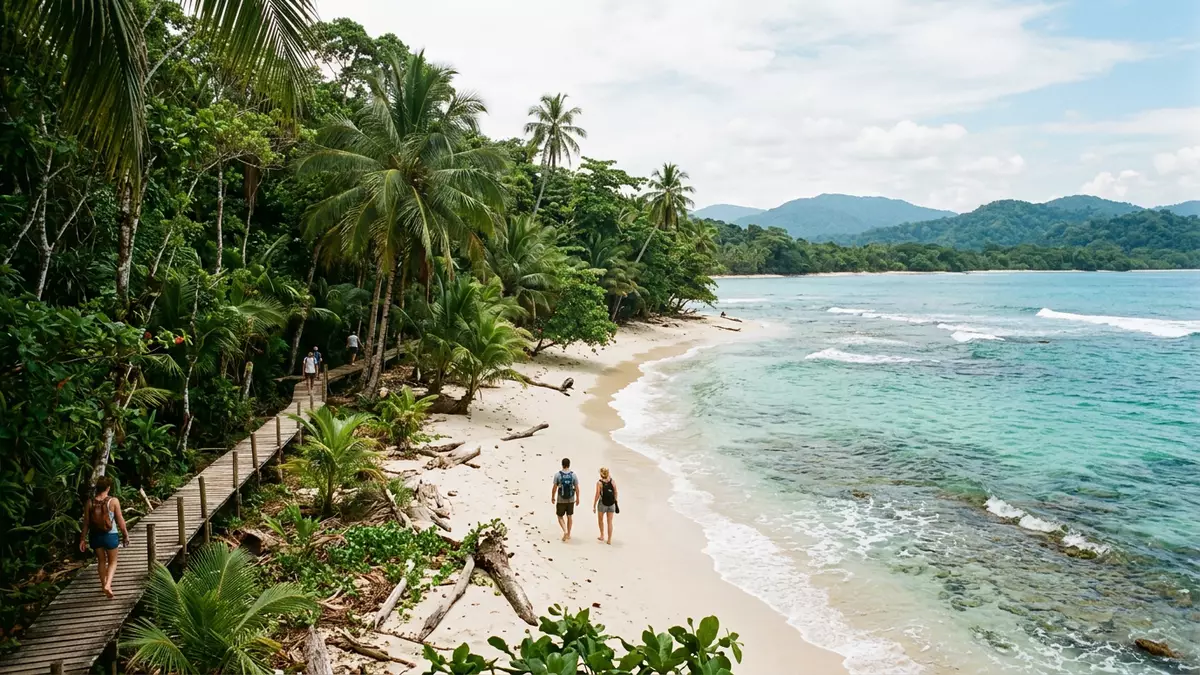
Parque Nacional Cahuita lies beside Cahuita on Costa Rica’s southern Caribbean coast, where tropical forest reaches white-sand beaches and a protected reef. The park’s identity is divided between land and sea, with paths through lowland forest and marine habitats around Punta Cahuita.
Established as Cahuita National Monument in 1970 and declared a national park in 1978, it remains closely linked with the community that shares its name.
Parque Nacional Cahuita begins with its coral reef
The marine zone is the park’s defining feature. Around Punta Cahuita, a fringing coral reef extends along the Caribbean coast, accompanied by seagrass beds, sandy seabeds and shallow coastal water.
The protected reef covers 600 hectares within a marine area of about 22,400 hectares. Its corals include brain coral, elkhorn coral and sea fans, while reef life includes angelfish, sea cucumbers, lobsters and sea turtles. the protected coral reef forms the marine centre of the park.
Scientific surveys have recorded the reef’s main crest along Punta Cahuita, with inner reef crests near Playa Blanca and Puerto Vargas. This arrangement places beaches, forest and coral habitats within one connected coastal landscape.
Forest, beaches and Caribbean wildlife
On land, Parque Nacional Cahuita preserves lowland tropical wet forest, swamp forest, mangroves and sandy beaches. The coastal trail passes through vegetation close to the shore, with stretches of forest and open beach forming distinct parts of the walk.
Wildlife associated with the park includes raccoons, coatis, sloths, iguanas and basilisk lizards. Howler monkeys, white-faced capuchins, spider monkeys, toucans, trogons and night herons also belong to the park’s recorded fauna.
The sea adds another layer of life. Green turtles and hawksbill turtles are part of the Caribbean ecosystem, alongside fish, sponges, molluscs, echinoderms and crustaceans. Cahuita’s forest wildlife includes species that are familiar in Costa Rica’s tropical lowlands.
A protected landscape shaped by Cahuita’s community
The history of Cahuita reaches back to the eighteenth century, when settlers arrived near the reef and coastal resources. William Smith’s family established a settlement at Punta Cahuita in 1828, where crops included yams, cassava, cacao and coconut.
The present town of Cahuita was founded in 1915. Afro-Caribbean cultural influences remain visible in local food, architecture and music, including the calypso tradition associated with Costa Rica’s Caribbean coast.
Protection began with the creation of Cahuita National Monument in 1970. National park status followed in 1978, and a shared management committee involving community organisations and conservation authorities was formed in 1998. The park therefore combines a formal protected area with a living settlement beside its boundaries. Cahuita’s protected-area history links conservation with the town’s Caribbean identity.
The result is a place read through contrasts: forest beside surf, pale sand beside dark green vegetation, and terrestrial paths beside a reef that continues beneath the Caribbean Sea.
Visiting Parque Nacional Cahuita: what travellers from Western Europe should know
- Parque Nacional Cahuita lies in Limón Province beside the town of Cahuita. Road access follows Route 36, with sectors at Playa Blanca near Cahuita and Puerto Vargas to the south.
- The coastal route crosses forest, beach and wet ground. Comfortable walking footwear suits the changing surfaces and exposed sections beside the shore.
- The park has both terrestrial and marine areas. Snorkelling belongs to the reef zone, while the coastal trail connects named beaches and forest habitats.
- The official language is Spanish and the national currency is the Costa Rican colón.
- Entry requirements depend on your nationality; UK travellers can check the FCDO travel advice at gov.uk/foreign-travel-advice, Irish travellers the Department of Foreign Affairs at ireland.ie.
Searching for Parque Nacional Cahuita on social platforms
These links open searches for Parque Nacional Cahuita on each platform.
Frequently asked questions about Parque Nacional Cahuita
Where is Parque Nacional Cahuita?
It is on Costa Rica’s southern Caribbean coast in Limón Province, beside the town of Cahuita. Playa Blanca and Puerto Vargas provide the principal land access sectors.
What can visitors expect at the park?
The landscape combines a coastal forest trail, white-sand beaches, mangroves and a marine zone with coral reef habitat. Wildlife may include sloths, monkeys, raccoons, birds, reptiles and sea turtles.
What makes Parque Nacional Cahuita distinctive?
Its protected landscape joins tropical forest and a substantial Caribbean coral reef. The park also retains a close relationship with Cahuita’s Afro-Caribbean community and its cultural traditions.


