
Parc Guell: Gaudí’s hillside mosaic landscape in Barcelona
Published on 08/31/2026 at 07:20 | Editorial responsibility: Rafael Müller, Editor-in-Chief AD HOC NEWS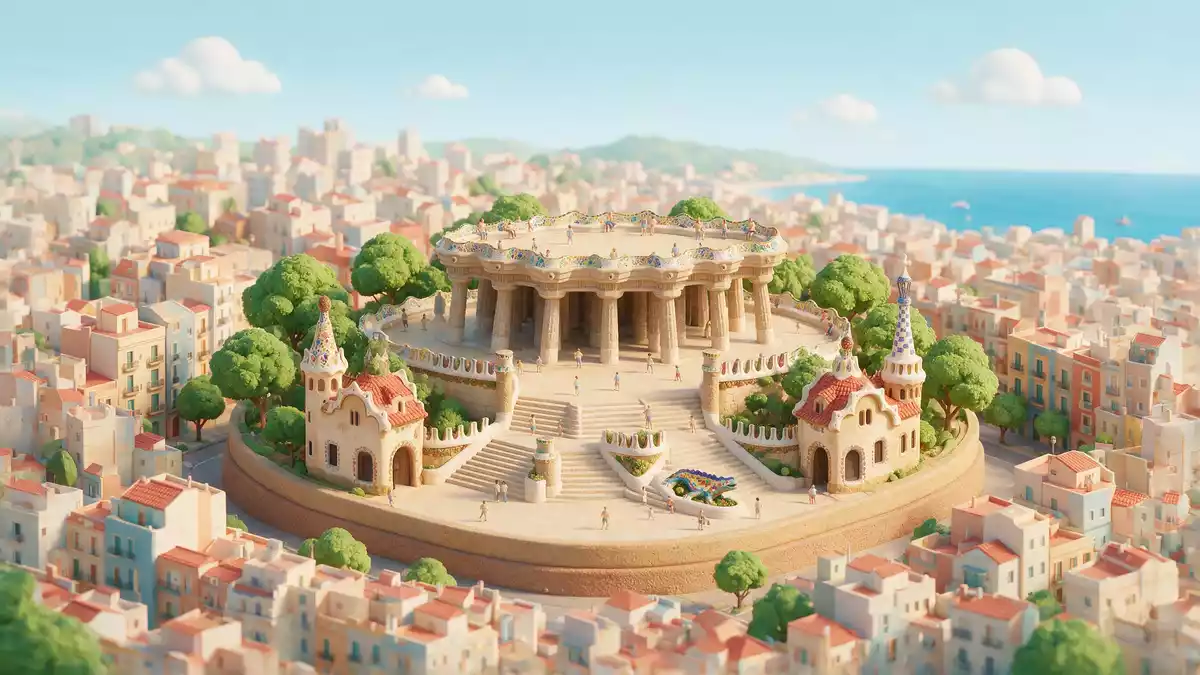
Parc Guell in Barcelona is a hillside park where Antoni Gaudí merged architecture, mosaics and Mediterranean planting into a single landscape, conceived in the early twentieth century as a garden city overlooking the expanding metropolis. Commissioned by industrialist Eusebi Güell in 1900 and opened as a public park in 1926, it now forms part of the UNESCO-listed “Works of Antoni Gaudí” that trace his development within Catalan modernism.
A garden city vision on Barcelona’s northern slopes
Parc Guell occupies a rocky hill on the northern edge of Barcelona, in the Gràcia and Horta-Guinardó districts, where the terrain rises above the Eixample grid and gives long views over the city towards the Mediterranean. The site covers hill slopes around the elevations known as Tres Creus and El Carmel, with paths, terraces and built structures woven into the contours rather than imposed on a flat ground.The park and its surroundings
The project began in 1900 when Eusebi Güell asked Gaudí to design a residential estate in this area, drawing on the emerging idea of a “garden city” where houses would stand within generous green plots.Over a hundred years of history Construction ran into the 1910s but the private housing scheme did not succeed, and Barcelona’s municipality acquired the grounds in the 1920s, opening Parc Guell as a public park in 1926.municipal purchase and opening as a public space
Antoni Gaudí’s naturalist architecture in the open air
Parc Guell belongs to Gaudí’s naturalist period, when he drew structural forms and ornament directly from geology, plants and animals, and treated architecture as part of a wider landscape composition.Park Güell Instead of a single monumental building, the park comprises gates, pavilions, stairways, retaining walls and colonnaded paths, all built in stone, brick and concrete and clad in ceramic mosaic or rough-textured finishes that echo the surrounding rock.
Key elements dating from the first decade of the twentieth century include the grand staircase with its tiled salamander figure, the terrace ring edged by undulating mosaic seating and the forest of columns in the Hypostyle Hall beneath.core monumental works Across the park Gaudí used trencadís, a mosaic technique based on broken ceramic pieces, to cover balustrades, benches and sculpture with colour that resists weather and follows curved surfaces without the regular joints of conventional tiling.terrace with undulating mosaic benches
From private estate to World Heritage landscape
Although Parc Guell originated as a private real estate venture, its life as a public park has lasted far longer than the initial commercial plan. After the city opened the site in 1926 it was gradually recognised for its architectural and artistic value, first through national protection as a monument of cultural interest and later through international recognition.
In 1984, Parc Guell was inscribed as a UNESCO World Heritage Site within the group of Gaudí works in and around Barcelona, alongside Palau Güell, Casa Milà, Casa Vicens, parts of the Sagrada Família, Casa Batlló and the Colònia Güell crypt.World Heritage Site since 1984 The park covers a large area on the hillside, measured by the municipal authorities in tens of hectares, with planted slopes, woodland patches and more formal monumental zones near the main entrance.
Visiting Parc Guell: what travellers from Western Europe should know
- Parc Guell lies on the slopes above the Gràcia district in Barcelona, around Carrer d'Olot, s/n, and is reached by city streets and access routes that climb from the lower neighbourhoods.
Public transport in Barcelona connects the centre with the surrounding districts, and from those points the final approach to the park involves an uphill walk. - The terrain inside Parc Guell includes gradients, stepped paths and stone surfaces, with some routes rising across the hillside and others passing under colonnaded structures.
- From the terrace level in the monumental zone, long views extend over the city’s grid towards the sea, with railings and mosaicked seating marking the edge between the constructed platforms and the slopes dropping away below.
- Parc Guell is in Spain, where the official language is Spanish alongside Catalan, and the national currency is the euro.
Searching for Parc Guell on social platforms
These links open searches for Parc Guell on each platform.
Frequently asked questions about Parc Guell
Where is Parc Guell in Barcelona?
Parc Guell stands on a hillside in the Gràcia and Horta-Guinardó districts of Barcelona, around Carrer d'Olot, s/n, above the northern edge of the Eixample grid.
What should visitors expect during a visit?
A visit to Parc Guell involves walking on gradients and steps through landscaped grounds, passing Gaudí-designed structures and mosaics, and reaching terraces with wide views over the city.
What makes Parc Guell distinctive among Gaudí’s works?
Parc Guell is distinctive because it applies Gaudí’s modernist architecture to an entire hillside landscape rather than a single building, combining planted slopes, stone structures and extensive trencadís mosaic surfaces.


