
Pantheon in Rom: a perfect ancient dome still in use
Published on 09/16/2026 at 20:14 | Editorial responsibility: Rafael Müller, Editor-in-Chief AD HOC NEWS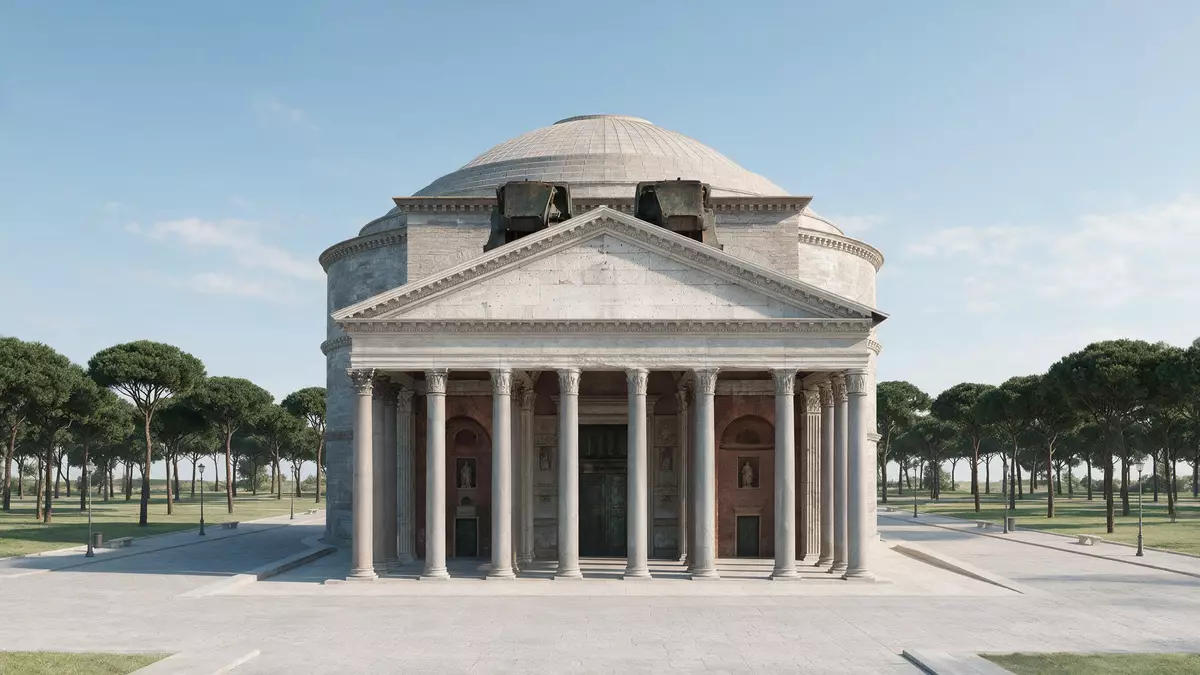
Pantheon in Rom is a Roman temple turned church where a monumental concrete dome rises behind a classical portico, forming one of the clearest encounters with ancient engineering in the city. Completed under Emperor Hadrian in the early second century AD and dedicated as a Christian basilica in 609, it compresses Roman, ecclesiastical and national Italian history into a single intact interior.
An ancient temple reshaped by Hadrian
The story of Pantheon begins with Marcus Vipsanius Agrippa, the powerful statesman and son-in-law of Augustus, who commissioned the first temple on this site in the late first century BC.Marcus Vipsanius Agrippa The original building, a conventional rectangular sanctuary, was later destroyed by fire, prompting a second reconstruction under Emperor Domitian which also suffered serious damage.
The present rotunda and portico were built during the reign of Emperor Hadrian, with most studies placing their completion in the period between 118 and 128.completion between 118 and 128 Hadrian retained Agrippa’s inscription on the pediment, so visitors still read “M·AGRIPPA·L·F·COS·TERTIVM·FECIT” when they approach the facade, even though the structure behind the portico belongs to a later imperial phase.Agrippa’s inscription on the pediment
From temple of all gods to Santa Maria ad Martyres
Pantheon takes its name from the Greek words “pan” and “theos”, combined to describe a sanctuary for all the gods of Rome.name from the Greek words In the imperial period it stood on the Campus Martius, a prestigious district of civic buildings, baths and temples near the Tiber, signalling its importance in the ceremonial topography of the city.Campus Martius district
In 609, during the pontificate of Pope Boniface IV, the building was consecrated as a Christian church under the title Basilica di Santa Maria ad Martyres, following a grant from the Byzantine emperor Phocas.consecrated as a Christian church This shift in dedication ensured continuous care through the Middle Ages, with the ancient temple fabric adapted to liturgical use rather than being dismantled for spolia, which helped Pantheon avoid the ruinous fate of many other Roman monuments.
The great concrete dome and interior space
Architecturally, Pantheon is defined by the relationship between its deep portico of Corinthian columns and the circular concrete hall concealed behind, a composition that has influenced architects for centuries.circular building of concrete The rotunda’s masonry carries a vast unreinforced concrete dome which, with its coffering and central opening at the crown, remains the largest of its kind in the world and a benchmark for later domed structures.largest unreinforced concrete dome
Inside, the floor, chapels and wall articulation are organised so that the height to the top of the dome corresponds closely to the diameter of the circular plan, creating a proportionally balanced volume that Renaissance designers studied as a model of classical geometry.model of classical geometry Among the later additions are tombs of figures including the painter Raphael and Italian royals from the House of Savoy, which layer artistic and national memory onto the ancient fabric without altering its essential form.
Visiting Pantheon: what travellers from Western Europe should know
- Pantheon stands on Piazza della Rotonda in the historic centre of Rom, a short walk from landmarks such as Piazza Navona and the Trevi Fountain.
- The approach from the surrounding streets leads into a paved piazza and then through the columned portico, with the interior reached across a threshold from the square.
- Rom is served by an urban transport network including metro and bus routes; the area around Piazza della Rotonda lies within the compact core of the old city.
- The official language is Italian and the currency is the euro.
Searching for Pantheon on social platforms
These links open searches for Pantheon on each platform.
Frequently asked questions about Pantheon
Where is Pantheon in Rom?
Pantheon stands on Piazza della Rotonda in the historic centre of Rom, within the dense network of streets between the Tiber and Via del Corso.
What can visitors expect inside Pantheon?
Visitors encounter a circular hall beneath a vast coffered dome, with chapels, tombs and altars arranged around the perimeter and daylight entering from the crown of the roof.
What makes Pantheon distinctive among Roman monuments?
Pantheon combines an intact ancient concrete dome with continuous use as a church since 609, making it a rare example of imperial architecture preserved as a functioning sacred building.


