
Panmunjom and the blue huts on Korea’s dividing line
Published on 09/23/2026 at 00:42 | Editorial responsibility: Rafael Müller, Editor-in-Chief AD HOC NEWS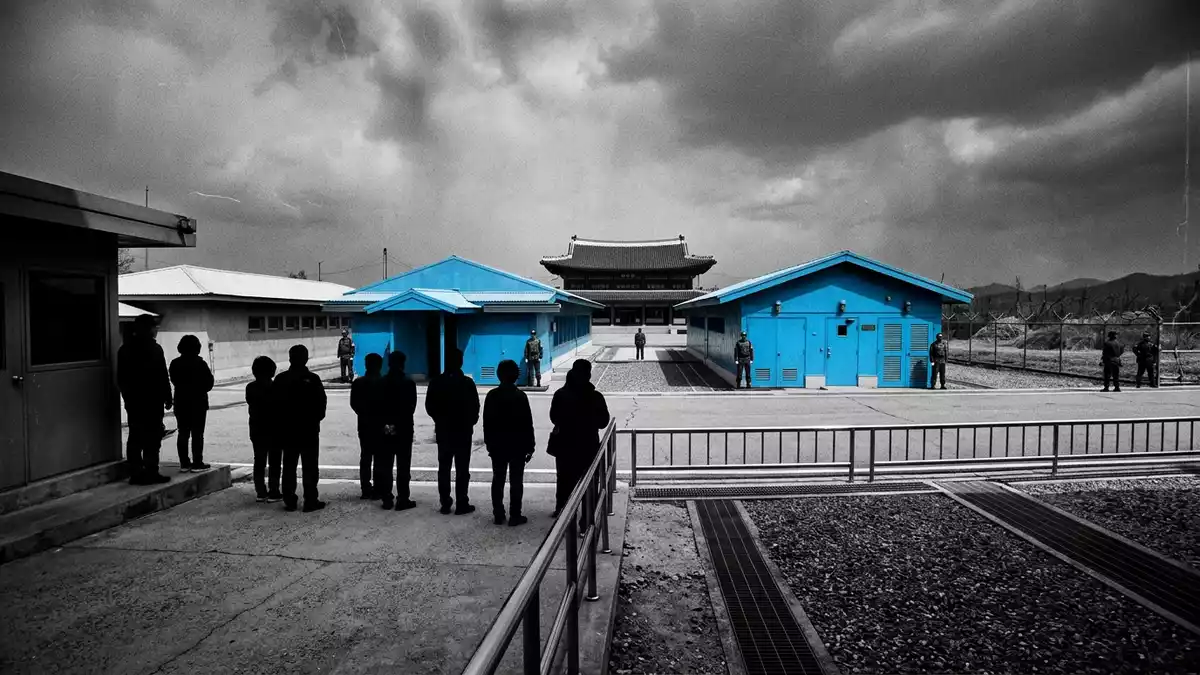
Panmunjom is a settlement beside the Korean Demilitarised Zone, where blue meeting huts sit across the line separating North and South Korea. The site is inseparable from the Korean Armistice Agreement signed on 27 July 1953.
Panmunjom on the Military Demarcation Line
Panmunjom is associated with the Joint Security Area, a meeting ground positioned on the Military Demarcation Line inside the Demilitarised Zone. The line divides the Korean peninsula into northern and southern military areas.
The best-known buildings are the blue conference rooms used for contact between North Korea and the United Nations Command. Their interiors extend across the line, while a low concrete marker runs through the central meeting space. The arrangement places the boundary inside the architecture rather than outside it. Joint Security Area history records the site’s role as the place where forces from both sides face one another.
The armistice that fixed Panmunjom in history
Negotiations between representatives of the United Nations forces, North Korea and China ran from 1951 to 1953. On 27 July 1953, military representatives signed the Korean Armistice Agreement at Panmunjom, ending active fighting in the Korean War.
The agreement suspended hostilities and established the Demilitarised Zone as a buffer between opposing forces. It also created the Military Armistice Commission, with Panmunjom serving as a location for military discussions and liaison work. the 1953 armistice remains the site’s defining historical reference.
From village name to international symbol
The original village and the Joint Security Area are closely linked in public usage, although the post-armistice meeting site was established separately from the wartime village. The name Panmunjom therefore refers both to a historic locality and to the wider diplomatic setting around it.
Several landmarks give the area its distinctive identity. Freedom House stands on the southern side, while Panmungak occupies the northern side. The Bridge of No Return lies within the wider area and is connected with prisoner exchanges after the armistice. Panmunjom’s linked sites reflect the military, diplomatic and symbolic roles attached to the place.
Visiting Panmunjom: what travellers from Western Europe should know
- Panmunjom lies inside the Korean Demilitarised Zone, north of Seoul and close to the Military Demarcation Line. Access routes from South Korea lead through the wider border area.
- The visit takes place in a controlled military landscape. The blue conference rooms, concrete boundary line and guard buildings form the central physical setting.
- The terrain includes roads, paved compounds and buildings rather than a conventional town centre. The surrounding zone contains restricted military land.
- The official language is Korean and the currency is the South Korean won.
Searching for Panmunjom on social platforms
These links open searches for Panmunjom on each platform.
Frequently asked questions about Panmunjom
Where is Panmunjom?
Panmunjom lies in the Korean Demilitarised Zone, near the Military Demarcation Line separating North Korea and South Korea.
What can visitors expect at Panmunjom?
The setting includes military buildings, the blue conference rooms, a concrete boundary line and tightly controlled compounds.
What makes Panmunjom distinctive?
Panmunjom combines a visible international boundary with the place where the Korean Armistice Agreement was signed in 1953.


