

Panmunjom and the armistice landscape in Korea
Published on 08/29/2026 at 19:39 | Editorial responsibility: Rafael Müller, Editor-in-Chief AD HOC NEWS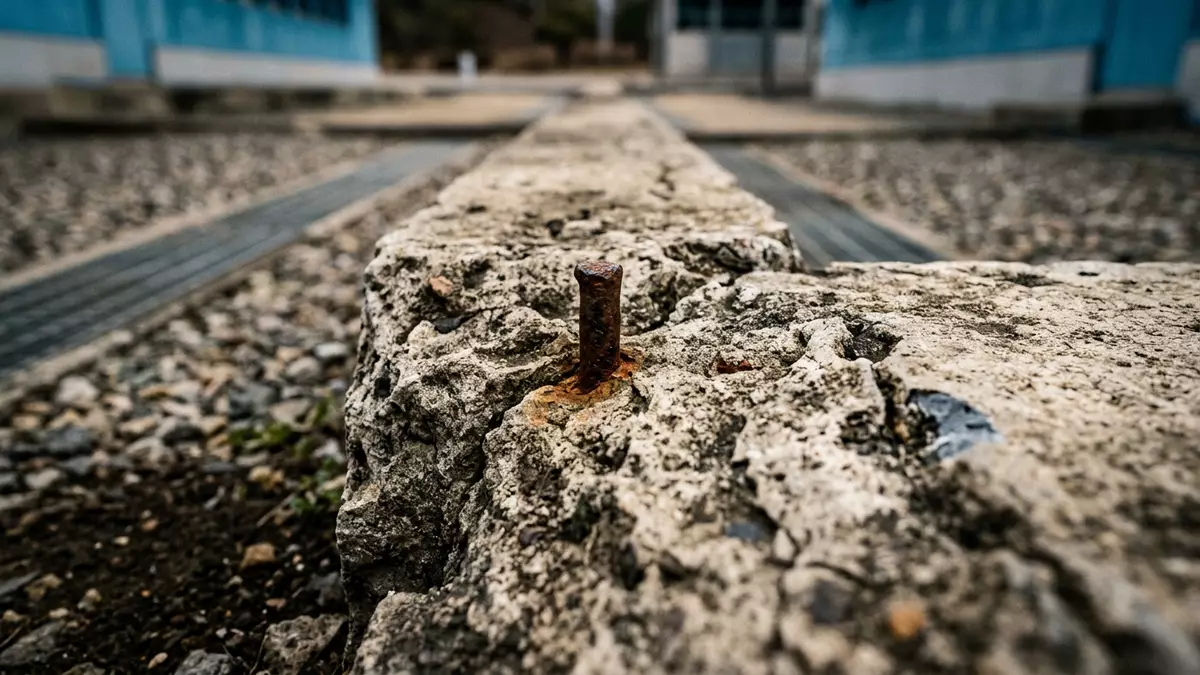
Panmunjom is a small place in the Korean Demilitarized Zone, best known for the armistice signed there on 27 July 1953. Its name is tied to the conference site where the Korean War settlement took shape, and to the military landscape that followed.
Panmunjom and the armistice line
The site sits within the Demilitarized Zone established by the Korean Armistice Agreement. The armistice signed on 27 July 1953 fixed the military line between the two Koreas and made Panmunjom a place of extraordinary historical weight.
The name also covers the Joint Security Area, a compact enclave of blue-painted buildings and military boundaries. It remains linked to the negotiations that brought the fighting to a halt, and to the border geometry that took shape around them.
Buildings, boundaries and the Joint Security Area
Panmunjom is not a single monument but a cluster of structures and lines within a tightly controlled zone. Britannica describes Panmunjom as the village in the demilitarised zone where the truce conference was held from 1951 to 1953.
The most recognisable part of the site is the meeting area associated with the armistice talks. The buildings are simple and functional, with a form that suits a military setting rather than a ceremonial one.
Panmunjom after 1953
After the armistice, Panmunjom remained linked to inter-Korean contact and military supervision. The place is still associated with the Korean War settlement, the Demilitarized Zone and the organisations that arose from the truce.
The agreement established the Demilitarized Zone and the Military Armistice Commission, and Panmunjom became part of that continuing border framework.
Visiting Panmunjom: what travellers from Western Europe should know
- Panmunjom lies in the Demilitarized Zone north of Seoul, near the Military Demarcation Line. It is reached through the wider border region around Paju.
- The place is a military site rather than a normal sightseeing stop. Visitors encounter controlled access, hard edges, and a setting defined by buildings, fences and the armistice line.
- The official language is Korean and the currency is the South Korean won.
- Entry requirements depend on your nationality; UK travellers can check the FCDO travel advice at gov.uk/foreign-travel-advice, Irish travellers the Department of Foreign Affairs at ireland.ie.
Searching for Panmunjom on social platforms
These links open searches for Panmunjom on each platform.
Frequently asked questions about Panmunjom
Where is Panmunjom?
Panmunjom lies in the Korean Demilitarized Zone near the Military Demarcation Line, north of Seoul and close to the border region around Paju.
What does a visit involve?
The place is a controlled military landscape with armistice-era buildings and boundary lines. It is not a conventional urban district or a leisure site.
What makes Panmunjom distinctive?
Panmunjom is linked to the 1953 armistice and to the Joint Security Area, where the border setting and the history of negotiations are visible in the same place.


