
Pamukkale’s white travertine terraces above ancient Hierapolis
Published on 09/16/2026 at 15:35 | Editorial responsibility: Rafael Müller, Editor-in-Chief AD HOC NEWS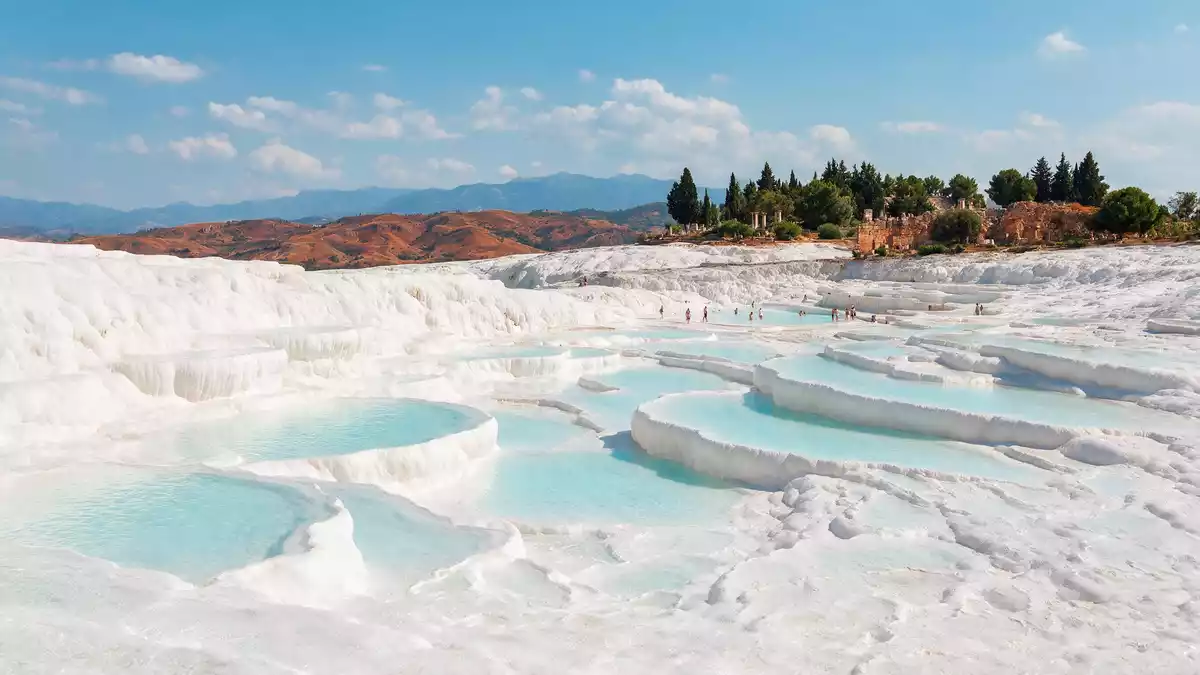
Pamukkale in Denizli is a hillside of white travertine terraces with an ancient city, Hierapolis, spread across the plateau above. The contrast between gleaming mineral formations and stone ruins defines the experience of the site and links a geological process with a long history of settlement in south-western Turkey.
A hillside of travertine and water
Pamukkale is a natural site in Denizli Province in south-western Turkey where thermal spring water has built a broad cliff of travertine above the surrounding plain.natural site in Denizli Province Travertine is a pale, fine-grained limestone deposited when mineral-rich water loses carbon dioxide and leaves calcium carbonate behind, and at Pamukkale this process has created a thick band of rock.
The travertine formation is large enough to read as a landscape feature rather than a single outcrop. It extends for about 2,700 m (8,860 ft) along the slope and reaches around 600 m (1,970 ft) in width, rising to a height of roughly 160 m (525 ft) above the plain below.about 2,700 m long The surface of the cliff is marked by terraces and basins built up from many fine layers of calcium carbonate, giving the hillside its distinctive cotton-white appearance.
Terraces, basins and petrified cascades
The white escarpment at Pamukkale is shaped by flowing thermal water that carries dissolved calcite down the slope. As the water runs across the cliff face it deposits calcium carbonate in overlapping rims and ledges, forming step-like terraces and shallow basins that catch and hold the water.step-like terraces and basins Over time, the build-up of mineral deposits has produced formations that resemble cascades frozen in place.
Individual terraces at Pamukkale are separated by low drops in the travertine, some under a metre high and others several metres tall, so the water advances by short steps rather than a single fall.terraces one to six metres high The result is a sequence of bright, gently tiered pools on the upper part of the slope, backed by bands of travertine that retain the imprint of flowing water in ribs, ripples and rounded edges.
Hierapolis above the white cliff
Above the travertine terraces lies Hierapolis, an ancient city founded in the late second century BC as a Hellenistic spa town in Phrygia.founded at the end of the second century BC The city occupies a plateau of calcareous rock created by the same mineralised waters that built Pamukkale’s cliffs, so its streets and buildings stand directly on the hardened deposits.
Hierapolis developed further under Roman rule, and its surviving remains include a theatre, baths, temples, colonnaded streets and extensive necropolis laid out along the terrace above the travertine slope.theatre, baths and necropolis Walking from the white hillside up into the ruins makes the link between the thermal springs, the travertine plateau and the long history of settlement on this elevated ground.
Hierapolis-Pamukkale as a World Heritage landscape
The travertine terraces and the ruins of Hierapolis together form a single heritage area recognised as Hierapolis-Pamukkale on the UNESCO World Heritage List.Hierapolis-Pamukkale World Heritage The inscription from 1988 records the site as a mixed property with natural and cultural components, reflecting both the geological formations and the ancient city set above them.inscribed in 1988 as mixed property
This combined status underlines how closely the travertine landscape and the human use of the springs are intertwined. The same mineral-rich waters that produce the brilliant white terraces also supplied the pools and baths of Hierapolis, shaping a place where geology and ancient urban fabric remain visibly connected on a single hillside.
Visiting Pamukkale: what travellers from Western Europe should know
- Pamukkale lies north of the city of Denizli in south-western Turkey, on a hillside above the valley of the Çürüksu River, a tributary of the Meander.north of the city of Denizli The site is reached by road from Denizli and other centres in the region.
- The travertine terraces rise in a steep band above the plain and the approach within the site involves walking on sloping ground and negotiating changes in level between terraces and paths.
- The hillside of Pamukkale is part of the foothills of the Cökelez and western Taurus Mountains, and the elevated position of Hierapolis above the cliffs gives wide views across the Çürüksu valley and distant ranges.on the slopes of Cal Da?i
- The official language is Turkish and the currency is the Turkish lira.
- Entry requirements depend on your nationality; UK travellers can check the FCDO travel advice at gov.uk/foreign-travel-advice, Irish travellers the Department of Foreign Affairs at ireland.ie.
Searching for Pamukkale on social platforms
These links open searches for Pamukkale on each platform.Frequently asked questions about Pamukkale
Where is Pamukkale and what kind of place is it?
Pamukkale is a travertine hillside in Denizli Province in south-western Turkey, overlooking the valley of the Çürüksu River and forming part of a wider mountain foothill landscape.situated on a hillside cliff above the valley
What can visitors expect to see at Pamukkale?
Visitors encounter white travertine terraces and basins formed by mineral-rich thermal waters on the slope, together with the ruins of Hierapolis on the plateau above, including baths, temples and a theatre.petrified waterfalls and ancient structures
What makes Pamukkale distinctive among landscapes in Turkey?
Pamukkale is distinctive for its extensive band of bright travertine terraces stretching for kilometres down a steep cliff and for the way this geological feature is directly integrated with an ancient city whose remains still occupy the plateau above.array of white calcite terraces


