
Pamukkale’s white terraces and ancient stone above Denizli
Published on 09/10/2026 at 09:59 | Editorial responsibility: Rafael Müller, Editor-in-Chief AD HOC NEWS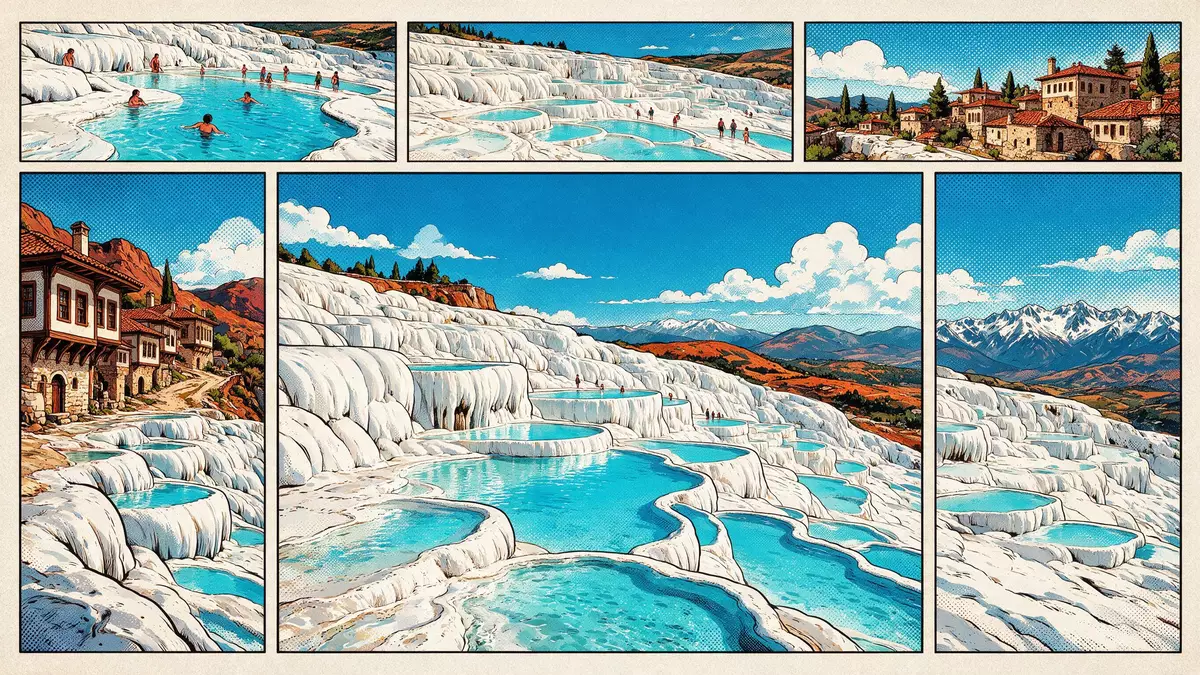
Pamukkale above Denizli in south-west Turkey brings two landscapes together on one limestone slope: bright white travertine terraces stepping down a cliff and the stone streets and monuments of the ancient city of Hierapolis spread across the plateau above. The Turkish name “Pamukkale” means “Cotton Castle”, a description drawn from the way the terraces resemble a frozen cascade of white fabric along the hillside in western Turkey in the Southern Aegean region.Southern Aegean region
Travertine cliffs shaped by mineral springs
The travertine slope of Pamukkale forms one face of a low plateau north of Denizli Province, where thermal springs emerge from faults and fractures in the bedrock and spill over the edge of the cliff. The terraces themselves are built of travertine, a light-coloured form of limestone deposited by mineral-rich hot water as the flow spreads, cools and loses carbon dioxide to the air.terraces are made of travertine Over very long periods this precipitation builds shelves, rims and basins that cling to the slope like a petrified waterfall, with successive ledges and pools following the gradient down from the spring area at the top.petrified waterfall
The cliff face carrying the terraces reaches a height in the order of a couple of hundred metres and presents a wide, pale band easily visible from the surrounding plain.white cliff is over 200 meters high Thermal water travels through channels and rivulets, feeding pools where the rims have grown high enough to hold shallow basins of clear water. In places the travertine forms rounded shelves with small ponds; elsewhere the mineral crust hangs over the underlying slope in thicker deposits with steeper drops. The terrace field occupies part of a designated national park area that focuses on the highest travertine formations on the slope and includes cliffs, waterfalls of white mineral deposits and the spring zone along the foothills of the Çökelez Mountains.Pamukkale National Park
Hierapolis above the terraces
Above the travertine formations the plateau carries the ruins of Hierapolis, a Greco-Roman and later Byzantine city laid out along the flat ground at the top of the slope. Hierapolis was founded during the Hellenistic period, probably under the Pergamene kings and most likely by Eumenes II, anchoring settlement in Phrygia near the hot springs whose waters feed the travertine below.founded during the Hellenistic period The city grew around a main street, public buildings and religious structures, with stone construction that has left long stretches of masonry still visible.
Hierapolis carries a theatre, a broad necropolis of tombs along the approach roads and a range of baths and other structures linked with the town’s role as a spa and religious centre.the theatre and the necropolis Earthquakes in antiquity, including a severe shock under the emperor Nero in the first century AD, damaged the city and led to extensive rebuilding, leaving layers of stonework from different phases in the surviving walls.worst earthquake occurred under Nero Christianity arrived early here; tradition holds that the apostle Philip died at Hierapolis, and a martyrium associated with him stands on the plateau among the ruins.apostle Philip ended his life
A joint cultural and natural World Heritage landscape
The travertine terraces and the archaeological remains together form the property known as Hierapolis-Pamukkale, inscribed on the UNESCO World Heritage List as a mixed site in 1988.inscribed on the UNESCO World Heritage List in 1988 The designated area extends over more than 1,000 hectares, taking in the mineral landscape, the thermal springs that feed it, the plateau above and the urban fabric of Hierapolis.property : 1,077 ha It is one of a limited group of sites recognised both for geological formations and for cultural remains, with its listing reflecting the tight integration between the white terraces and the ancient city that overlooks them.joint cultural-and-natural World Heritage Site
On the slope the interplay of water, stone and ancient construction is visible in the way the travertine field rises towards the plateau, where city walls, gates and colonnades stand above the mineral formations. The hot springs that built the terraces are the same ones that supplied the city’s baths and supported its role as a spa town in antiquity, binding geological processes and human use together on the same hillside.springs that built the terraces Today the wider landscape still shows this relationship between plateau, cliffs and plain: agricultural land and the modern settlement of Pamukkale lie below, with the travertines and ruins rising above them as a single cultural landscape recognised by international heritage bodies.Pamukkale, Denizli, Turkey
Visiting Pamukkale: what travellers from Western Europe should know
- Pamukkale lies in Denizli Province in western Turkey, with the travertine terraces and the ruins of Hierapolis occupying a hillside above the valley north of the city.Location Denizli Province
- The terrain on the travertine slope involves walking across mineral surfaces and up and down gradients between terraces, while the ruins of Hierapolis on the plateau include stone paths and occasional stairways.
- The official language is Turkish and the currency is the Turkish lira.
- Entry requirements depend on your nationality; UK travellers can check the FCDO travel advice at gov.uk/foreign-travel-advice, Irish travellers the Department of Foreign Affairs at ireland.ie.
Searching for Pamukkale on social platforms
These links open searches for Pamukkale on each platform.
Frequently asked questions about Pamukkale
Where is Pamukkale and what kind of place is it?
Pamukkale is a travertine cliff and terrace field with an ancient city above it in Denizli Province in western Turkey, in the Southern Aegean region.village in the Southern Aegean region
What can visitors expect on a visit to Pamukkale?
Visitors encounter white mineral terraces built by thermal springs, with flowing water in some pools, and can walk further uphill to explore the spread-out ruins of Hierapolis on the plateau.
What makes Pamukkale distinctive among sites in Turkey?
Pamukkale combines an extensive travertine landscape with well-preserved Greco-Roman and Byzantine remains of Hierapolis on the same slope, recognised together as a mixed UNESCO World Heritage Site since 1988.Hierapolis-Pamukkale


