
Pamukkale’s white terraces and ancient hillside above Denizli
Published on 09/08/2026 at 15:43 | Editorial responsibility: Rafael Müller, Editor-in-Chief AD HOC NEWS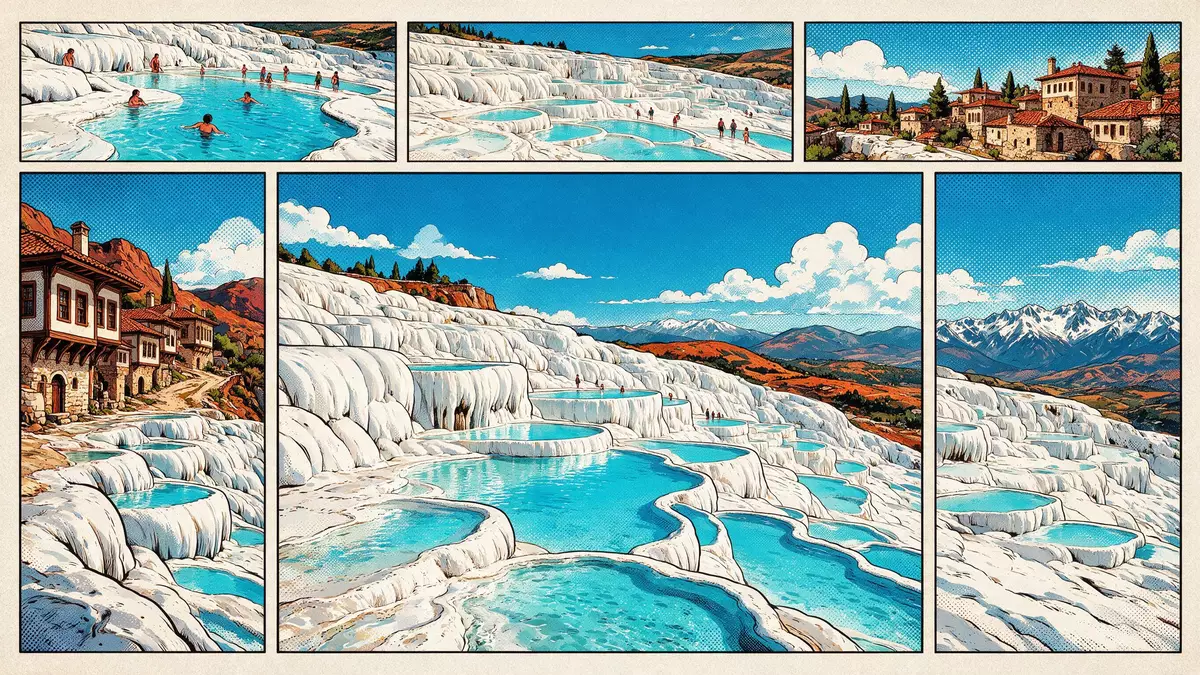
Pamukkale in Denizli Province in southwestern Turkey is a hillside where bright white terraces of mineral-rich water and the ruins of the ancient city of Hierapolis occupy the same broad slope. The combined landscape of travertine and stone is recognised as Hierapolis-Pamukkale on the UNESCO World Heritage List, reflecting both its geological character and its classical remains since its inscription in 1988.
A white hillside built by hot springs
The name Pamukkale means “cotton castle” in Turkish, a reference to the white landscape that rises above the Cürüksu plain when the slope is seen from below.The Turkish name aligns closely with what visitors see: a broad apron of pale terraces and petrified cascades draped across a limestone hill. The hillside is formed by travertine, a type of limestone deposited by hot springs rich in dissolved calcium carbonate, which leaves behind bright, smooth surfaces as the water cools and releases gas.
The travertine formation at Pamukkale stretches for several kilometres along the slope and rises high above the valley floor, reading as a single band of white when seen from the surrounding plain.Satellite imagery of Turkey's cotton castle shows how the terraces fan out across the hillside, with clusters of basins stepping downwards like a frozen cascade. Calcite-laden water emerges from springs near the upper part of the slope and flows across the surface in channels before spilling over the edges of natural rims, gradually building up walls and shelves of travertine.
Hierapolis and the classical city above the terraces
Above the white slopes sits the plateau of Hierapolis, an ancient Greco-Roman and later Byzantine city founded in the late second century BC by Eumenes II of Pergamon.The World Heritage datasheet describes Hierapolis as a “holy city”, a term linked to the presence of many sanctuaries and religious buildings on its plateau. The surviving remains include a theatre built into the hillside, stretches of colonnaded street, monumental gates and an extensive necropolis that runs away from the central core of the town.
Hierapolis stands on a terrace of limestone deposits above the travertine cliffs, placing architecture directly above the mineral landscape that sustained it.The UNESCO listing notes that the hot springs that built the white slopes also supplied water to baths, pools and other spa-related structures in the ancient city. Walking from the travertine edge up towards the ruins reveals how closely the urban fabric and the thermal landscape share the same ground, with stone streets and tombs never far from channels of flowing water.
Hierapolis-Pamukkale as a combined heritage landscape
Hierapolis-Pamukkale was inscribed on the UNESCO World Heritage List in 1988 under both cultural and natural criteria, recognising a single property where geology and urban history are intertwined.The combined designation covers the travertine terraces, the thermal springs that feed them, the plateau and the archaeological remains of Hierapolis. The protected area extends over more than 1,000 hectares, which allows the terrace system, the cliff and the ancient town to be managed as one continuous site rather than as separate attractions.
Descriptions of Pamukkale from geological and heritage bodies emphasise the range of forms created by the hot springs: mineral forests, petrified waterfalls and terraced basins sit side by side on the slope.Accounts of the travertine cliffs highlight cliffs and pools shaped by calcite deposition, while archaeological surveys focus on the baths, temples and streets above. Together, they form a landscape where a living geological process and a long-standing spa town share the same hillside and the same water.
Visiting Pamukkale: what travellers from Western Europe should know
- Pamukkale lies north of Denizli in southwestern Turkey, with the travertine slope and the plateau of Hierapolis rising above the Cürüksu River plain.
- The travertine hillside is steep in sections, and designated walking routes include stretches of bare rock and steps as they climb from the lower terraces up towards the ancient city.
- Hierapolis occupies the plateau above the white slopes, where paths cross uneven archaeological ground between monuments such as the theatre, city gates and necropolis.
- The official language is Turkish and the currency is the Turkish lira.
- Entry requirements depend on your nationality; UK travellers can check the FCDO travel advice at gov.uk/foreign-travel-advice, Irish travellers the Department of Foreign Affairs at ireland.ie.
Searching for Pamukkale on social platforms
These links open searches for Pamukkale on each platform.Frequently asked questions about Pamukkale
Where is Pamukkale and what kind of place is it?
Pamukkale is a travertine hillside with thermal springs and the ancient city of Hierapolis in Denizli Province in southwestern Turkey.
What should visitors expect when exploring Pamukkale?
Visitors encounter white terraces formed by hot springs on the slope and, above them, a plateau with theatres, tombs, streets and other ruins from the Greco-Roman and Byzantine periods.
What makes Pamukkale distinctive among Turkish landscapes?
Pamukkale combines a bright white travertine cliff and terrace system created by calcite-rich water with an ancient spa town built directly above the same thermal springs.


