
Palm Jumeirah, the palm-shaped island reshaping Dubai’s coast
Published on 08/29/2026 at 14:17 | Editorial responsibility: Rafael Müller, Editor-in-Chief AD HOC NEWS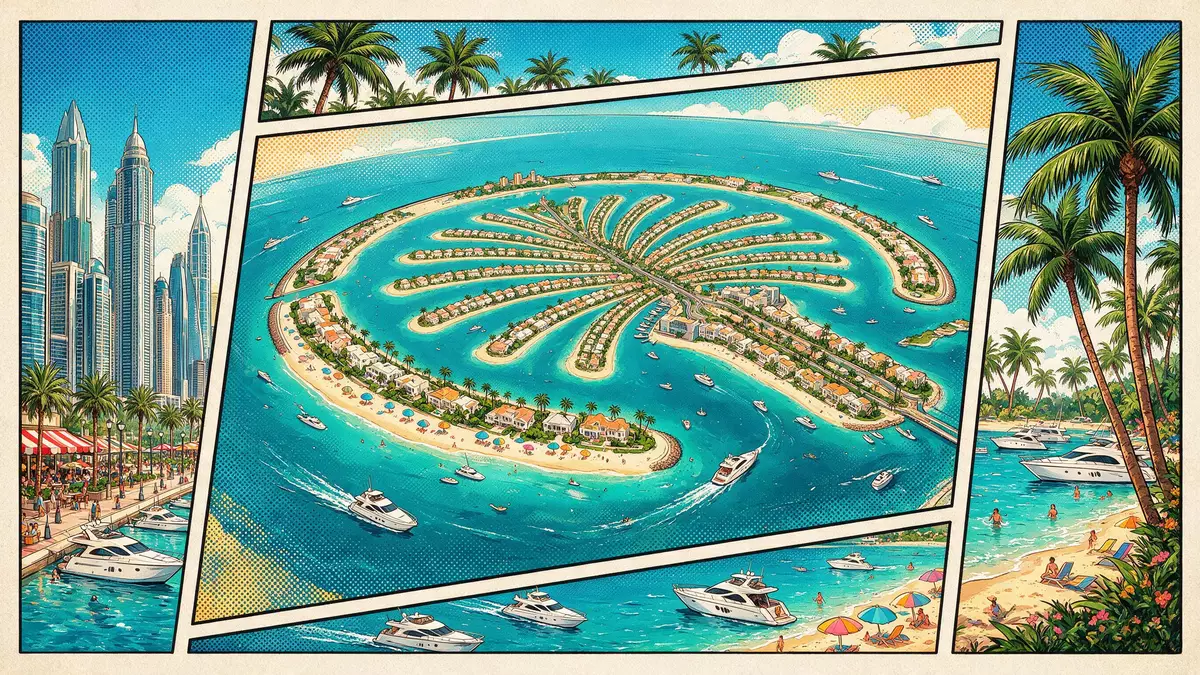
Palm Jumeirah in Dubai is a vast palm-shaped artificial archipelago built off the city’s Jumeirah coastline, extending several kilometres into the Arabian Gulf and adding tens of kilometres of waterfront to the emirate’s shore. Conceived in the early twenty-first century as part of the Palm Islands programme, its marine works began in 2001, turning open water into a new district of beaches, villas, apartments and resorts.
A palm tree drawn in sand and sea
The defining experience of Palm Jumeirah is the way a familiar natural form is scaled up into a whole piece of city. From above, the development reads as a stylised date palm set within a surrounding crescent, with a central trunk, radiating fronds and an outer ring that together form the island’s basic geometry.stylised palm tree within a circle Seen from the ground, that geometry becomes a series of streets, shorelines and waterfront plots, so that walking or driving along the trunk or into the fronds is effectively moving along the outlines of the palm itself.
The palm footprint lies roughly five kilometres out into the Arabian Gulf and sits on reclaimed land shaped by marine engineering rather than concrete slabs.includes a trunk with 17 fronds surrounded by a crescent-shaped breakwater The trunk is a broad spine running from the mainland bridge towards the seaward edge, while the residential fronds branch off it as narrow strips of land with water on both sides. Around them, the crescent acts as a breakwater protecting the inner lagoon, and also as a continuous arc carrying hotels, resorts and leisure facilities facing both out to sea and in towards the palm.
Building a new coastal district for Dubai
Palm Jumeirah is part of a wider family of developments known as the Palm Islands, planned to expand Dubai’s coastline and create new waterfront neighbourhoods in the United Arab Emirates.Palm Islands consist of three artificial archipelagos Construction of Palm Jumeirah itself began in 2001, with the marine reclamation and breakwater works taking around six years before large-scale building on the plots could proceed.Construction of the Palm Jumeirah began in June 2001 The developer behind the project is Nakheel, a Dubai-based real estate company linked to the emirate’s government, which oversaw the transformation from water to inhabitable land.
Once the basic landform and protective crescent were in place, Palm Jumeirah evolved into a mixed-use coastal district. Villas line the fronds, taking advantage of plots with direct access to private shorelines, while apartment towers and complexes cluster along the trunk.Residences are on the fronds, the trunk has apartments, and hotels line the crescent The crescent carries major resort hotels and attractions, including Aquaventure water park and the hotel complex of Atlantis The Palm, which has become one of the most recognisable structures on the outer ring.hotels and resorts across the trunk and crescent, including Atlantis The Palm Together these elements turn the palm outline into a lived-in district of homes, promenades and resort grounds.
Infrastructure, scale and everyday life on the Palm
Beyond its striking plan, Palm Jumeirah functions as an urban extension of Dubai, supported by dedicated infrastructure that ties it back to the mainland. A bridge links the base of the trunk to the city, carrying road traffic out towards the island. Within the development, a subsea tunnel passes beneath the water to connect the trunk with the crescent, allowing vehicles to move between the inner palm and the outer ring without returning to shore.a six-lane subsea tunnel links the trunk to the crescent On the surface, the Palm Jumeirah Monorail runs along the length of the trunk, providing a dedicated rail line from the base of the palm out towards the crescent.
The scale of the project is measured not only in engineering terms but also in its population and waterfront reach. By the early 2020s, tens of thousands of residents were living on Palm Jumeirah across thousands of residential units, making it one of the more densely inhabited artificial islands in the world.approximately 80,000 people live on the Palm Jumeirah across more than 10,000 residential units The reclaimed land area is cited at around 5.72 square kilometres, with the project adding about 56 kilometres (35 miles) of new coastline to Dubai through its lagoons, shorelines and crescent-edge beaches.added 56 kilometers (35 miles) to Dubai’s coastline For visitors, that scale is encountered through long waterfront drives, extended beach promenades and the sense that an entire palm-shaped map has become a lived urban landscape.
Visiting Palm Jumeirah: what travellers from Western Europe should know
- Palm Jumeirah lies off Dubai’s Jumeirah coastal area in the United Arab Emirates, reached from the city by a road bridge onto the trunk and by the Palm Jumeirah Monorail running along the island.
- The terrain is level reclaimed land at sea level, with long stretches of waterfront streets and promenades; distances between points on the trunk, fronds and crescent can be considerable on foot.
- The official language is Arabic and the currency is the United Arab Emirates dirham.
- Entry requirements depend on your nationality; UK travellers can check the FCDO travel advice at gov.uk/foreign-travel-advice, Irish travellers the Department of Foreign Affairs at ireland.ie.
Searching for Palm Jumeirah on social platforms
These links open searches for Palm Jumeirah on each platform.
Frequently asked questions about Palm Jumeirah
Where is Palm Jumeirah and what kind of place is it?
Palm Jumeirah is an artificial palm-shaped archipelago built off the Jumeirah coastal area of Dubai in the United Arab Emirates, forming a large waterfront district on reclaimed land.
What can visitors expect when exploring Palm Jumeirah?
Visitors encounter a combination of residential fronds, a central trunk with apartment towers and transport links, and a crescent lined with resort hotels, beaches and leisure attractions around a protected inner lagoon.
What makes Palm Jumeirah distinctive among coastal developments?
Its plan turns the outline of a date palm into an inhabited landform, combining a trunk, fronds and outer crescent, with infrastructure such as a monorail and subsea tunnel supporting everyday life on the island.


