
Palm Jumeirah’s palm-shaped edge to Dubai’s Arabian Gulf
Published on 09/04/2026 at 12:22 | Editorial responsibility: Rafael Müller, Editor-in-Chief AD HOC NEWS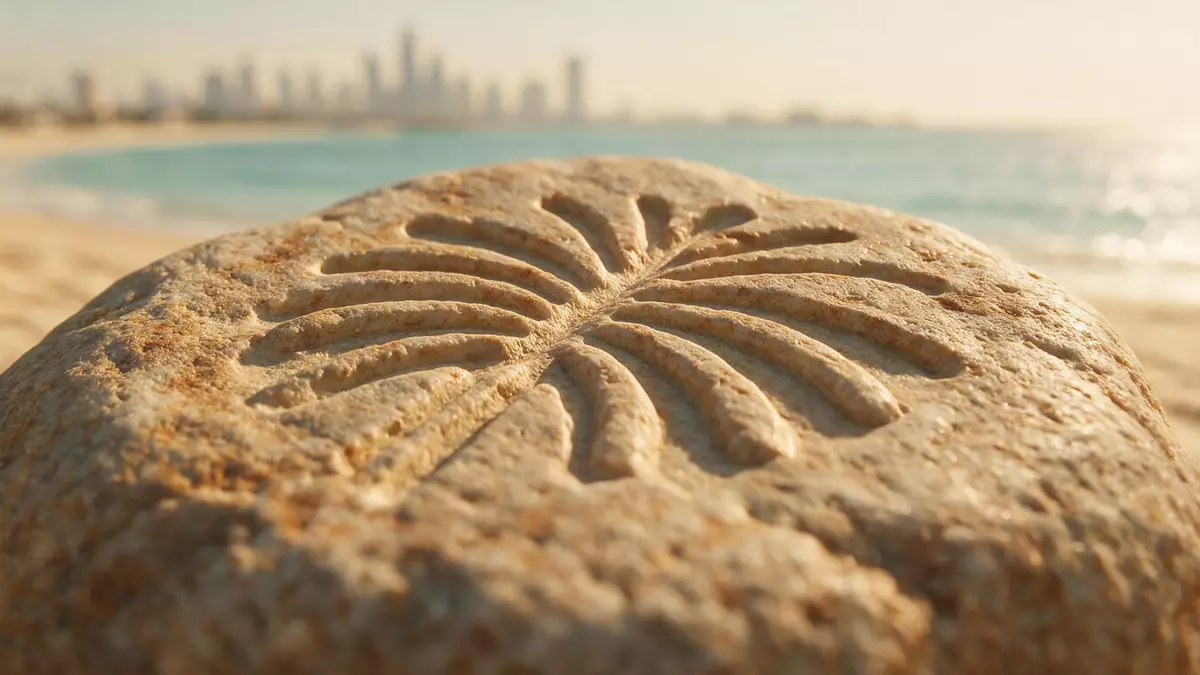
Palm Jumeirah is Dubai’s palm-shaped offshore district in the United Arab Emirates, built on reclaimed land in the Arabian Gulf and laid out as a vast stylised palm within a broad crescent. The artificial archipelago was created in the early twenty-first century under the developer Nakheel, with marine works beginning in 2001 and the new land ready for building around the middle of that decade.
A palm tree drawn at urban scale
Seen from above, Palm Jumeirah reads as a diagram of a date palm, with a central trunk, radiating fronds and an outer crescent that forms a sweeping breakwater against the open water. The overall footprint stretches several kilometres off the Jumeirah coast into the Arabian Gulf, turning what had been an almost straight shoreline into a patterned edge of lagoons, channels and outer seafronts.The archipelago’s palm form within a circle gives the district a geometry that remains legible even at the scale of satellite imagery.
The palm layout is divided into three main parts. The trunk runs out from the mainland and carries apartment buildings, shared spaces and road links. Off this spine, the fronds branch into the water as narrow strips of reclaimed ground lined with waterfront villas and low-rise housing, each separated by channels that bring the sea deep into the plan.An outer crescent-shaped breakwater curves around the tip of the palm, enclosing an inner lagoon while providing plots for resorts and a large water park.
Engineering a new coastline in the Arabian Gulf
Palm Jumeirah was the first of Dubai’s Palm Islands projects to move from concept to completion, transforming shallow Gulf waters off Jumeirah into a new district of land by large-scale sand dredging and rock placement.Work on the Palm Islands began in 2001, with Palm Jumeirah emerging as the completed example while other planned palms remain at different stages of development. The project extended Dubai’s coastline substantially, adding tens of kilometres of waterfront and creating sheltered inner shores behind the crescent.
The reclaimed ground was formed from vast quantities of sand taken from the Gulf seabed and rock quarried from inland ranges, built up into the trunk, fronds and outer sea wall. The crescent itself functions as a long breakwater, its structure protecting the inner lagoon from Gulf swells and prevailing winds while carrying roads and resort plots along its length.Descriptions of Palm Jumeirah’s dimensions and breakwater place the palm within a roughly five-by-five-kilometre envelope of reclaimed land.
A lived-in offshore district of villas and hotels
Two decades after construction began, Palm Jumeirah functions as an inhabited district rather than a single resort, with apartment towers on the trunk, villas on the fronds and large hotels spread across the crescent. Residences on the inner branches look onto narrow sea channels, while properties on the outer edges face the wider Arabian Gulf. Along the crescent, major resorts make use of the continuous waterfront, with Aquaventure water park forming one of the most prominent leisure attractions on the outer arc.Aquaventure on the crescent sits among a cluster of large-scale hotel complexes.
Palm Jumeirah is also integrated into wider Dubai through transport infrastructure on and under the water. A road bridge links the trunk back to the city’s mainland road network, while a subsea tunnel carries traffic between the trunk and the crescent beneath the inner lagoon.The Palm Jumeirah Monorail runs along the length of the trunk and out towards the crescent, offering an elevated line that traces the palm layout and connects the offshore district with stations closer to Dubai’s dense urban spine.
Visiting Palm Jumeirah: what travellers from Western Europe should know
- Palm Jumeirah lies off the Jumeirah coastal area of Dubai in the United Arab Emirates, reached by road links from the mainland and by the Palm Jumeirah Monorail.
- The district spreads across reclaimed ground, with water on several sides and long shorelines; walking routes can involve exposed waterfront promenades and substantial distances along the trunk and fronds.
- The official language is Arabic and the currency is the United Arab Emirates dirham.
- Entry requirements depend on your nationality; UK travellers can check the FCDO travel advice at gov.uk/foreign-travel-advice, Irish travellers the Department of Foreign Affairs at ireland.ie.
Searching for Palm Jumeirah on social platforms
These links open searches for Palm Jumeirah on each platform.
Frequently asked questions about Palm Jumeirah
Where is Palm Jumeirah located?
Palm Jumeirah is an artificial offshore district built on reclaimed land off the Jumeirah coastline of Dubai, projecting into the Arabian Gulf in the United Arab Emirates.
What can visitors expect on a visit to Palm Jumeirah?
Visitors find a large man-made palm-shaped island district with apartment towers, villa-lined fronds, waterfront promenades, resorts on the crescent and views across the inner lagoon and the wider Gulf.
What makes Palm Jumeirah distinctive among waterfront areas?
The district’s defining feature is its palm tree geometry at urban scale, with a trunk, branching fronds and enclosing crescent, all built as reclaimed ground in the Arabian Gulf and occupied by homes and hotels.


