
Palia Poli Rodou, the walled medieval heart of Rhodos
Published on 09/19/2026 at 11:04 | Editorial responsibility: Rafael Müller, Editor-in-Chief AD HOC NEWS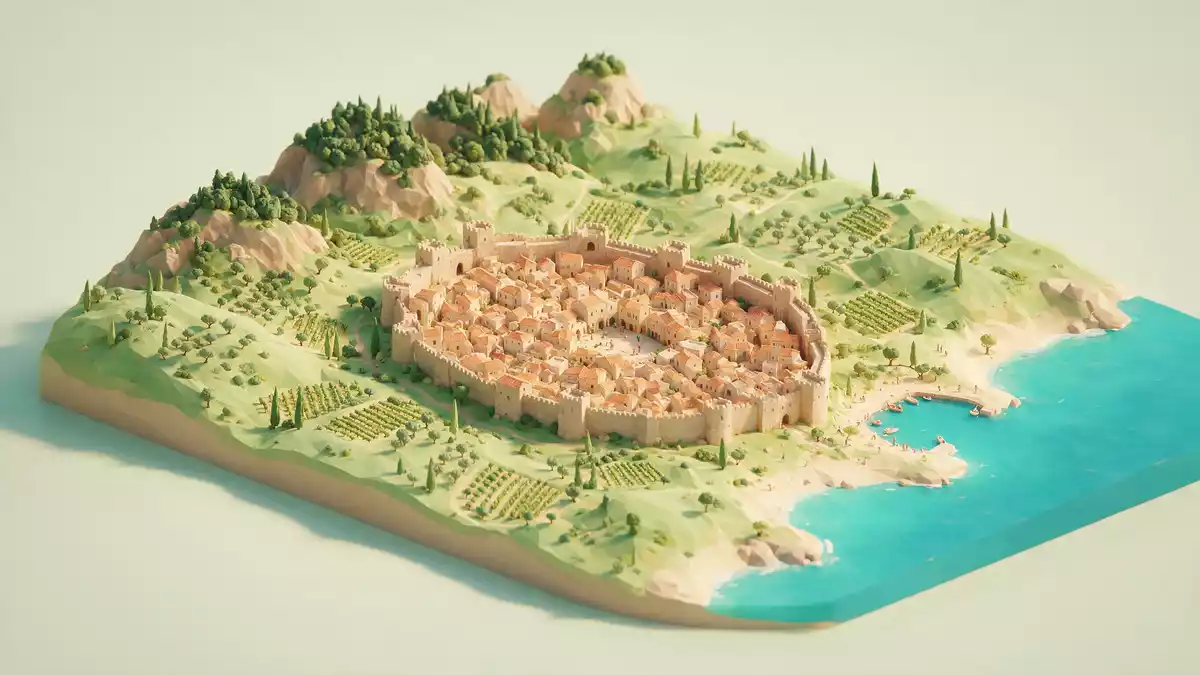
Palia Poli Rodou is the medieval walled old town of the city of Rhodos on the island of Rhodes in Greece, enclosed within a continuous ring of fortifications that still separates the historic core from the newer districts. Within this stone boundary, a dense network of streets, squares and fortifications preserves the form of a fortified city shaped largely under the Knights Hospitaller in the fourteenth and fifteenth centuries and adapted under later rulers.
Fortified walls and the structure of the medieval city
The defining feature of Palia Poli Rodou is the city wall that encircles the medieval quarter in a loop of around 4 km (2.5 miles), punctuated by bastions and gates and bordered for long stretches by a dry defensive moat.the medieval city is located within a 4 km-long wall The fortifications follow the outline of a low ridge near the island’s north-eastern tip, dropping towards the harbour side and rising gently inland, so that the wall and moat form a continuous stone and earth belt around the old town. Along this circuit, towers and angular bastions project from the main curtain wall, giving the fortifications a strongly articulated profile.
Within the walls, the medieval city is traditionally divided into a high town to the north and a lower town towards the south and south-west.it is divided with the high town to the north and the lower town south-southwest The high town concentrates major public buildings and the former headquarters of the Knights Hospitaller, while the lower town holds dense residential quarters, commercial streets and places of worship. Inside the fortifications, successive rulers left structures in stone: Gothic military works associated with the Knights of Saint John, later buildings from the Ottoman period and interventions under Italian administration, all layered within the same bounded urban field.the fortified city centre is located within a 4km long wall
UNESCO recognition and the legacy of the Knights Hospitaller
The medieval city within the walls of Palia Poli Rodou is recognised internationally as the Medieval City of Rhodes and has been inscribed on the UNESCO World Heritage List since 1988.Medieval City of Rhodes The World Heritage designation covers the entire walled quarter, acknowledging it as an exceptional example of a fortified medieval city where the urban plan and architecture reflect the influence of the Knights Hospitaller and subsequent rulers.Inscribed 1988 The reference number 493 in the UNESCO catalogue ties the name “Medieval City of Rhodes” directly to the historic core known locally as Palia Poli Rodou.
The Knights Hospitaller, also called the Knights of Saint John, established their headquarters in Rhodes in the early fourteenth century, after taking control of the island in 1309, and developed the city as a stronghold in the eastern Mediterranean.built by the Christian military order Knights Hospitalers Their rule left a dense legacy of Gothic architecture in the high town, including the palace complex of the Grand Master and a formal processional street. Later, following an Ottoman conquest in the sixteenth century, mosques and other buildings in Ottoman styles appeared among the earlier structures, while still using the same medieval street framework and fortifications.Rhodes Old Town is the fortified medieval heart of Rhodes city, a UNESCO World Heritage site enclosed by the great stone walls of the Knights of Saint John
Streets, palaces and daily life inside the walls
Within Palia Poli Rodou, the street network reflects the dual character of a medieval fortress and an inhabited town. In the high town, the Street of the Knights runs as a straight stone-paved ascent lined with austere façades and former inns that once housed different national branches of the order.Street of the Knights This route leads to the Palace of the Grand Master, a large fortified residence that served as the administrative centre of the Knights.the Palace of the Grand Master was once the administrative seat of the Knights Hospitaller Around these formal buildings, smaller lanes and steps connect terraces, courtyards and squares.
The lower town spreads towards the harbour side with irregular, narrower streets, residential clusters and religious buildings from different periods. Here, Gothic structures associated with the Knights coexist with buildings in Ottoman styles and later interventions, giving the enclosed city a layered character that reflects changing rule while retaining the same fortified outline.massive stone fortifications and a dry moat The proximity of the harbour just outside the walls means that gates such as St Paul’s Gate open towards quays and waterfront streets, linking the enclosed medieval fabric to the modern port and coastal roads.St. Paul's Gate near the commercial harbour
Visiting Palia Poli Rodou: what travellers from Western Europe should know
- Palia Poli Rodou occupies the historic core of the city of Rhodos at the north-eastern tip of Rhodes, immediately inland from the main harbour area, and is reached on foot from the waterfront streets and modern districts that ring the fortifications.
- The enclosed medieval quarter is surrounded by substantial stone walls and a dry moat, and movement within the high town includes stretches of cobbled streets and stepped passages that climb and descend along the ridge.
- The island of Rhodes lies in Greece; the official language is Greek and the currency is the euro.
- Entry requirements depend on your nationality; UK travellers can check the FCDO travel advice at gov.uk/foreign-travel-advice, Irish travellers the Department of Foreign Affairs at ireland.ie.
Searching for Palia Poli Rodou on social platforms
These links open searches for Palia Poli Rodou on each platform.Frequently asked questions about Palia Poli Rodou
Where is Palia Poli Rodou located?
Palia Poli Rodou is the medieval old town of the city of Rhodos at the north-eastern end of the island of Rhodes in Greece, enclosed within a continuous ring of fortifications near the main harbour.
What should visitors expect inside the walls?
Visitors encounter a fortified medieval city with a 4 km (2.5 miles) wall, bastions, a dry moat, a formal high town with the Street of the Knights and the Palace of the Grand Master, and a lower town of dense streets and mixed-period buildings.
What makes Palia Poli Rodou distinctive compared with other historic towns?
Palia Poli Rodou combines a largely intact circuit of medieval fortifications, a clearly structured division between high town and lower town, and a long history as a headquarters of the Knights Hospitaller, all recognised in its UNESCO inscription as the Medieval City of Rhodes.


