
Palazzo Ducale in Venedig and the power architecture of a republic
Published on 09/15/2026 at 12:14 | Editorial responsibility: Rafael Müller, Editor-in-Chief AD HOC NEWS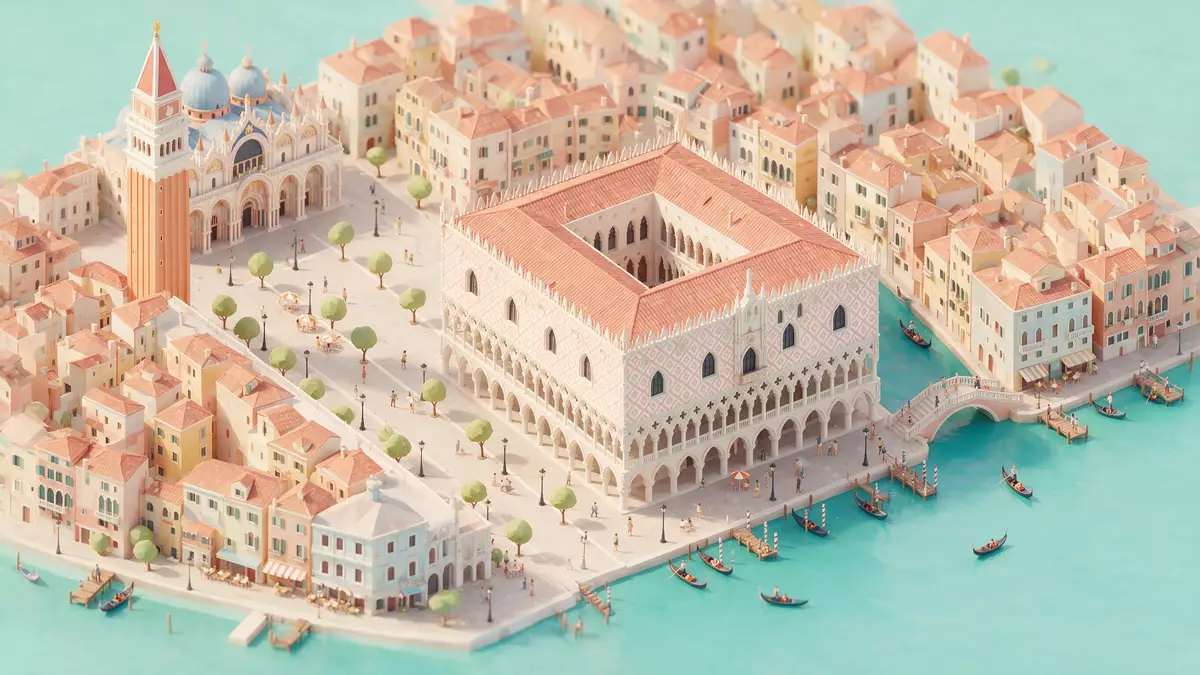
Palazzo Ducale in Venedig, known in English as the Doge’s Palace, is the former seat of the Venetian Republic and a vast palace wrapped around courtyards beside St Mark’s Basilica. The building combines Venetian Gothic façades with Renaissance and later Mannerist interiors, and the present complex took shape mainly between the fourteenth and sixteenth centuries.
Gothic stone and the palace on the water’s edge
Seen from the Bacino di San Marco, Palazzo Ducale presents long waterfront façades of pale Istrian stone beneath patterned bands of pink Verona marble, a composition identified as a masterpiece of Venetian Gothic architecture.Venetian Gothic façades in stone and marble Above open arcade levels with pointed arches and tracery, the upper walls rise like a masonry screen, pierced by windows and crowned by a parapet with ornamental cresting.
The palace stands at the south-eastern corner of Piazza San Marco, bounded by the square on one side and the St Mark’s Basin on the other, with the Molo and Piazzetta forming stone quays around it.facades facing the Molo and Piazzetta Three principal wings define the exterior: the oldest towards the Bacino di San Marco containing the Sala del Maggior Consiglio, a later wing facing the square, and a Renaissance canal-side wing housing the Doge’s apartments and government offices.three large wings around the core
From ninth-century origins to a fourteenth-century palace
The origins of Palazzo Ducale lie in the ninth century, when Venice was emerging as an autonomous centre and built an early palace for its Doge beside the lagoon.origins in the ninth century That early complex was repeatedly enlarged and rebuilt, and major fires in the late first millennium and later centuries destroyed parts of it, prompting reconstructions that gradually brought the palace towards its present form.fires and rebuilding campaigns
The wing towards the Bacino di San Marco was rebuilt from 1340 and marks the beginning of the palace in its fourteenth-century Gothic form, while the wing towards Piazza San Marco reached its present configuration from 1424.rebuilding from 1340 and 1424 Between 1483 and 1565 the canal-side wing was reconstructed with Renaissance architecture, giving the Doge residences and offices along the water.Renaissance canal-side wing The main gateway, the Porta della Carta, was designed in the fifteenth century by Giovanni and Bartolomeo Bon, whose sculpted portal ties the palace visually to nearby buildings such as Ca’ d’Oro.Porta della Carta by Giovanni and Bartolomeo Bon
Government, justice and pageantry in one building
For centuries Palazzo Ducale served as the central complex of the Venetian Republic, bringing together the Doge’s residence, the major councils, administrative offices, law courts and prisons in a single architectural whole.seat of Venetian government The Doge, elected as the highest magistrate of Venice, lived in suites within the palace, and councils met in great halls that opened from internal courtyards.
The Sala del Maggior Consiglio, housed in the wing facing the water, formed one of the largest assembly spaces in the palace and was used for meetings of the Great Council, while other chambers accommodated more restricted bodies such as the Council of Ten.council halls and governing bodies Staircases such as Antonio Rizzo’s Scala dei Giganti introduced Renaissance stonework into these ceremonial routes, carrying processions between the courtyard and upper floors.Scala dei Giganti by Antonio Rizzo Over time, fires in 1483, 1574 and 1577 destroyed sections of the building and damaged paintings by artists including members of the Bellini family and Titian, and subsequent rebuilding campaigns inserted new ceilings and canvases into the surviving Gothic shell.fires and new interiors
Visiting Palazzo Ducale: what travellers from Western Europe should know
- Palazzo Ducale stands on Piazza San Marco in Venedig, beside St Mark’s Basilica and facing the Bacino di San Marco, and is reached on foot from the surrounding alleys and campi.
- The palace complex is arranged around courtyards and upper halls, and visiting the historic interiors involves staircases and passages that require steady walking.
- Venedig is in Italy; the official language is Italian and the currency is the euro.
- Boat traffic in the St Mark’s Basin brings views of the waterfront façades from vaporetto routes and other lagoon services passing the Molo and Piazzetta.
Searching for Palazzo Ducale on social platforms
These links open searches for Palazzo Ducale on each platform.
Frequently asked questions about Palazzo Ducale
Where is Palazzo Ducale located in Venedig?
Palazzo Ducale stands on Piazza San Marco in Venedig, between the square and the Bacino di San Marco at the entrance to the Grand Canal.
What can visitors expect inside Palazzo Ducale?
Visitors encounter courtyards, great council halls, staircases and historic rooms that once housed the Doge, the main councils of the Venetian Republic, its law courts and prisons.
What makes Palazzo Ducale distinctive among Venetian buildings?
Palazzo Ducale combines long Gothic façades of stone and marble, Renaissance staircases and suites, and centuries of governmental history in a single palace beside the lagoon.


