
Palau de la Musica Catalana and its glass-lit concert hall
Published on 09/09/2026 at 17:59 | Editorial responsibility: Rafael Müller, Editor-in-Chief AD HOC NEWS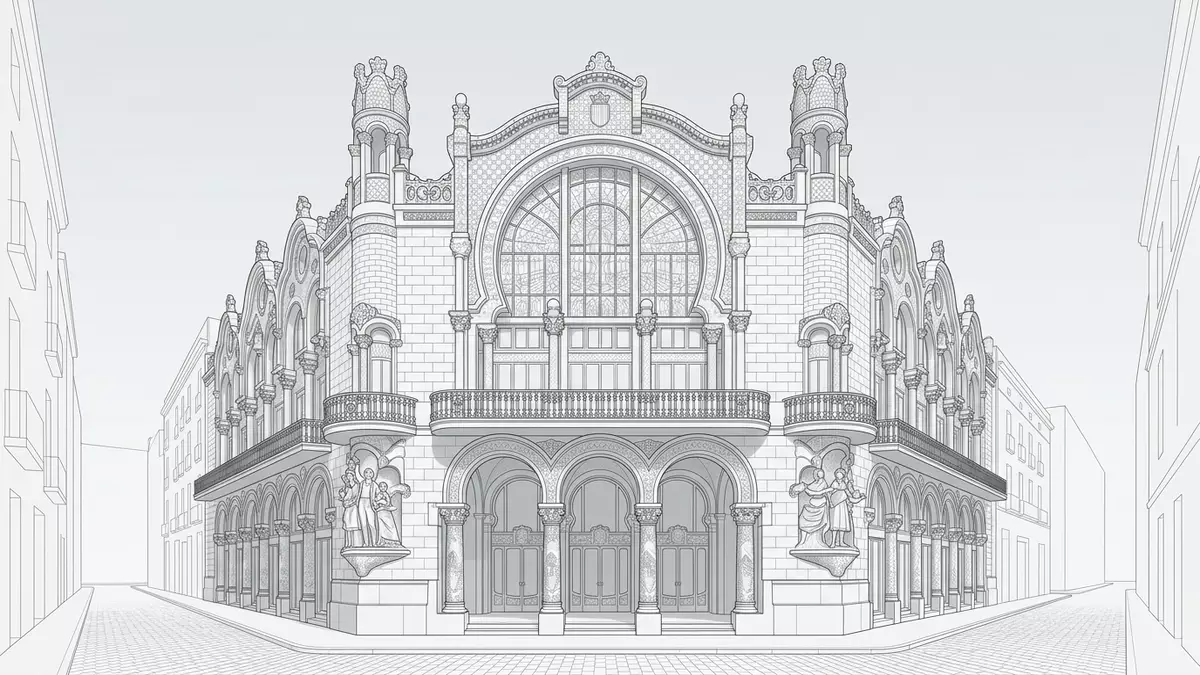
Palau de la Musica Catalana in Barcelona is a concert hall where music and architecture merge in an exuberant display of Catalan Modernisme, with a vast stained glass ceiling flooding the auditorium with coloured light. Built in the early twentieth century for the choral society Orfeó Català under architect Lluís Domènech i Montaner, it remains a landmark of Catalan cultural life and a showcase of applied arts worked directly into the structure.
A Modernisme palace for music and craft
The core identity of Palau de la Musica Catalana lies in its role as a purpose-built concert hall in the Catalan Modernisme style, designed by Lluís Domènech i Montaner between 1905 and 1908 for the choral society Orfeó Català. Built between 1905 and 1908 by architect Lluís Domènech i Montaner, the building gave this choir, founded in 1891, a permanent home in the historic Sant Pere district near the old La Ribera neighbourhood.
Domènech i Montaner, whose work helped define Catalan Modernisme in the late nineteenth and early twentieth centuries, shaped Palau de la Musica Catalana as a synthesis of architecture and applied arts. The hall combines structural brickwork and stone with mosaic, ceramics, stained glass, sculpted figures and wrought iron, turning its surfaces into an intricate three-dimensional ornament. In this it echoes his other major Barcelona work, the Hospital de Sant Pau, which together with the concert hall forms a shared UNESCO World Heritage listing recognising his contribution to Catalan Modernisme. Palau de la Música Catalana and the Hospital de Sant Pau are jointly inscribed on the UNESCO World Heritage List, highlighting the exuberant regional Art Nouveau variant developed in Catalonia.
The great concert hall under glass
Inside, the main auditorium is dominated by a large stained glass feature in the ceiling that curves down towards the seating, bringing daylight into the space in a way that is integral to the experience of performances. The building is described as a concert venue that can be lit entirely by natural light through this inverted stained glass dome, which sits at the centre of the hall and creates a gradation of colour overhead. The spectacular inverted stained glass dome at the centre of the ceiling has become one of the best-known elements of the building, a visual symbol of the hall’s fusion of art and engineering.
Around the audience, mosaic-clad columns line the side walls and windows, each column decorated with floral motifs and patterns that continue the Modernisme vocabulary of plant forms and bright colours. Sculptural reliefs frame the stage, where carved figures, musical instruments and emblematic themes emerge from the proscenium, making the platform a crafted focal point rather than a purely functional surface. The main organ stands as a layered backdrop behind the stage, part of the integrated composition of the hall. This integration of structure, sculpture and surface decoration marks Palau de la Musica Catalana as one of the most representative buildings of Catalan Art Nouveau in Barcelona, a status reflected in descriptions of it as an “architectural jewel” and a total artwork of Modernisme. The concert hall is widely recognised as an architectural jewel of Catalan Art Nouveau.
World Heritage recognition and the urban setting
Palau de la Musica Catalana stands in the Sant Pere area of central Barcelona, close to the boundary of the Gothic Quarter and within the dense street network of the historic city. Descriptions of its location place it a short walk north-east of Plaça de Catalunya, in streets that connect the older La Ribera neighbourhood to the core of the modern city. The building rises in the Sant Pere area, near Plaça de Catalunya and the Gothic Quarter, anchoring Modernisme architecture amid medieval and nineteenth-century fabric.
The building’s international profile stems in part from its status as a UNESCO World Heritage Site, a distinction granted in 1997 alongside Hospital de Sant Pau. Within this listing, Palau de la Musica Catalana is described as an unparalleled example of a public concert hall with symbolic, artistic and historical value and is singled out as the only concert hall to appear on the World Heritage List. In 1997 Palau de la Música Catalana was inscribed as the only concert hall listed as a World Heritage Site, which underscores the way its architecture, musical function and Catalan identity are treated as a single cultural ensemble.
Visiting Palau de la Musica Catalana: what travellers from Western Europe should know
- Palau de la Musica Catalana stands on Carrer del Palau de la Música in the Sant Pere neighbourhood of Barcelona, within walking distance of Plaça de Catalunya and the Gothic Quarter.
- The interior includes staircases with several flights, passages between seating rows and changes in level between foyers and the main auditorium, so visitors encounter steps in multiple parts of the building.
- Guided and unguided access routes focus on the principal concert hall and selected circulation spaces, with viewpoints towards the stained glass ceiling, the mosaic-clad columns and the sculptural stage front.
- The official language is Spanish and the currency is the euro.
Searching for Palau de la Musica Catalana on social platforms
These links open searches for Palau de la Musica Catalana on each platform.Frequently asked questions about Palau de la Musica Catalana
Where is Palau de la Musica Catalana located in Barcelona?
Palau de la Musica Catalana is situated on Carrer del Palau de la Música in the Sant Pere neighbourhood of central Barcelona, close to Plaça de Catalunya and the Gothic Quarter.
What can visitors expect on a visit to Palau de la Musica Catalana?
Visitors encounter an ornate Modernisme concert hall with a stained glass ceiling, mosaic-covered columns, sculptural stage reliefs and carefully detailed foyers, viewed either during performances or on organised visits.
What makes Palau de la Musica Catalana distinctive among concert halls?
Its distinction lies in the way architecture, stained glass, sculpture and mosaic are combined into a single Modernisme composition, recognised by UNESCO as the only concert hall on the World Heritage List.


