
Palau de l'Almudaina, Palma’s stone palace above the harbour
Published on 08/27/2026 at 20:58 | Editorial responsibility: Rafael Müller, Editor-in-Chief AD HOC NEWS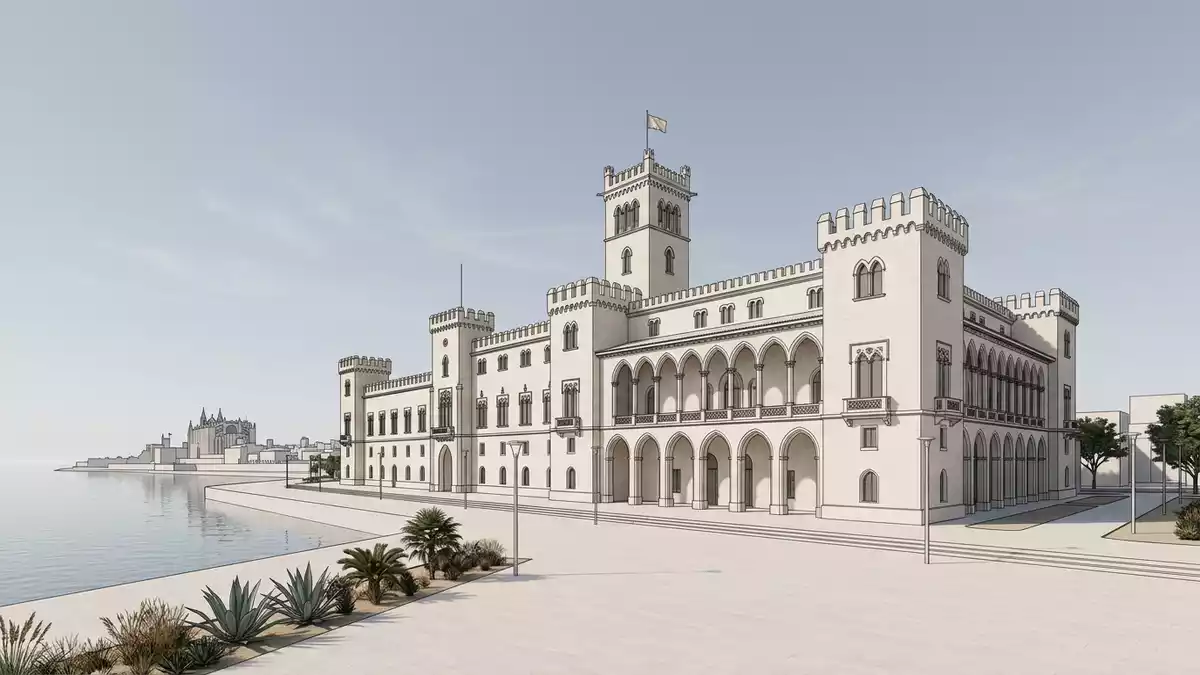
Palau de l'Almudaina is the royal palace that overlooks the waterfront of Palma in Spain, facing the famous cathedral and the harbour beyond. The complex stands on a site with Roman and Islamic roots, yet its present appearance is shaped above all by Gothic rebuilding in the early fourteenth century under King James II of Majorca. The palace still serves as an official residence for the Spanish monarch during ceremonies on Mallorca, and its stone walls, towers and courtyards form one of the most distinctive silhouettes in the city’s historic centre.
From Muslim fortress to Gothic royal palace
The story of Palau de l'Almudaina begins with a fortified complex that took shape under Muslim rule in the tenth century, when Palma was known as Madina Mayurqa and the walis governed from a stone citadel near the sea. Remains of this fortress survive within the palace fabric, including arches and masonry that recall the alcázar which once controlled approaches to the harbour.The Almudaina Royal Palace
The Christian transformation began after King Jaume I of Aragon conquered Mallorca in 1229, paving the way for the Kingdom of Majorca to establish its seat here. Between 1305 and 1314, during the reign of James II, the complex was rebuilt in a Gothic style, with rectangular towers, rib-vaulted halls and a new palatial chapel dedicated to Santa Anna that dates to the early fourteenth century.the castle constructed at the beginning of the 14th century Later monarchs of Majorca, Aragon and Spain adapted the palace for courts, viceroys and military command, but the Gothic core laid out under James II remains central to its identity.
Architecture of stone, towers and ceremonial rooms
The architecture of Palau de l'Almudaina is defined by robust stone construction, angular towers and a sequence of ceremonial interiors arranged around courtyards. The complex integrates a towered wing known as the palace of the king, a corresponding wing for the queen, and large reception spaces such as the Tinell hall, all set within a rectangular outline that expresses its dual role as palace and fortress.the tower and palatial wings Gothic windows, carved portals and battlements give the exterior a rhythmic profile against the skyline of Palma’s old town.
Inside, the Santa Anna chapel exemplifies Levantine Gothic detail, with sculpted tympanum, corbels and keystones attributed to craftsmen such as Pierre de Guines and the Campredon workshop.the Santa Ana palatial chapel The upper floor, completed in the first half of the sixteenth century under Charles V, adds another historical layer with additional rooms and vantage points over the city. Throughout the building, stone staircases link halls, galleries and royal apartments, while interior furnishings and heraldic decoration evoke different phases of the palace’s life.
Palace, harbour edge and royal gardens
Palau de l'Almudaina occupies a prominent position above Palma’s waterfront, forming a stone terrace that stands beside the cathedral of La Seu and looks towards the harbour. Historic gardens associated with the palace, including the area known as S'Hort del Rei, extend below the walls and incorporate elements such as an arch from a former Muslim pier, which hints at the site’s maritime connections in earlier centuries.S'Hort del Rei arch and gardens Water features, planting and paved walks create a transition between the massive stone of the palace and the urban fabric that surrounds it.
Within the complex, courtyard spaces offer views of the towers and facades from different angles, and long external walls align with streets such as Carrer del Palau Reial, marking the edge of the historic centre. The relationship with the sea has changed as land has been reclaimed and the harbour reconfigured, yet the palace’s elevated position still relates closely to Palma’s maritime setting. As an official royal residence used for ceremonies and receptions, the building also continues to connect Mallorca’s present-day institutions with its layered past as Roman site, Muslim alcázar and Gothic palace.official residence for ceremonies
Visiting Palau de l'Almudaina: what travellers from Western Europe should know
- Palau de l'Almudaina stands in Palma’s historic centre on Carrer del Palau Reial, beside the cathedral and above the waterfront, and is reached on foot from the surrounding streets.
- The palace complex includes stone staircases, towers and courtyards, so a visit involves walking over paved surfaces and climbing interior and exterior flights of steps.
- The official language is Spanish and the currency is the euro.
- Entry requirements depend on your nationality; UK travellers can check the FCDO travel advice at gov.uk/foreign-travel-advice, Irish travellers the Department of Foreign Affairs at ireland.ie.
Searching for Palau de l'Almudaina on social platforms
These links open searches for Palau de l'Almudaina on each platform.
Frequently asked questions about Palau de l'Almudaina
Where is Palau de l'Almudaina located?
Palau de l'Almudaina stands in Palma, the capital of Mallorca in Spain, beside the cathedral and close to the harbour at Carrer del Palau Reial.
What can visitors expect inside the palace?
Visitors encounter stone-built halls, towers, courtyards and the Gothic Santa Anna chapel, along with interiors reflecting the palace’s role as a royal and ceremonial residence.
What makes Palau de l'Almudaina distinctive among Palma’s landmarks?
Its layered history from Muslim fortress to Gothic royal palace, prominent waterfront position and continuing role as an official residence give it a distinctive presence in Palma’s historic centre.


