
Palau de l'Almudaina: layers of power above Palma’s harbour
Published on 08/18/2026 at 13:43 | Editorial responsibility: Rafael Müller, Editor-in-Chief AD HOC NEWS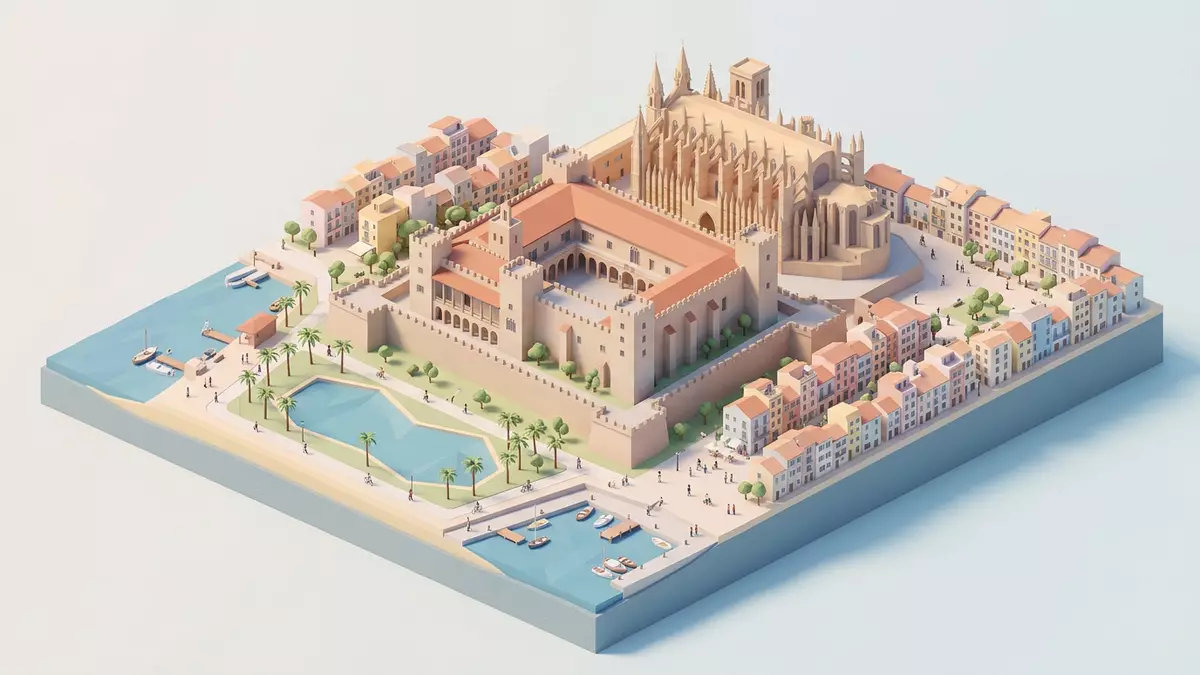
Palau de l'Almudaina rises on the seafront terrace of Palma, directly opposite the great cathedral, with its stone walls telling the story of successive rulers. Built on earlier Roman and Islamic fortifications and reshaped in the early fourteenth century for the kings of Mallorca, it remains an official residence of the Spanish royal family.
A royal palace shaped by three cultures
Palau de l'Almudaina is part of a long chain of power on Mallorca, from Roman settlement through Muslim rule to the Christian kingdom of Mallorca. The site formed a fortified complex by the twelfth and thirteenth centuries, when Muslim governors of Madina Mayurqa used it as their stronghold and residence, incorporating earlier Roman structures into an Islamic alcázar.During the 12th and 13th centuries it was the fortress of the Muslim walis The name “Almudaina” itself derives from an Arabic term for a fortified citadel, underlining this origin.The term recalls its role as a political and military centre before it became a Christian royal palace
After James I of Aragon conquered Palma in 1229, the complex entered a new phase as a seat of Christian power. Major alterations began in 1305 under King James II of Majorca, turning the former Muslim citadel into a Gothic royal palace that served as residence and court for the kings of Mallorca in the fourteenth century.James II rebuilt the alcázar into a royal palace from 1305 The resulting palace later passed to the Crown of Aragon under Peter IV in 1349, binding it into the wider history of the Crown’s Mediterranean realms.La Almudaina became part of the Crown of Aragon in 1349
Gothic stone, Islamic traces and royal chapels
From the outside, Palau de l'Almudaina appears as a robust Gothic fortress-palace set on a bastioned terrace above the waterfront. Its thick stone walls and towers follow the line of the earlier Muslim fortress, while pointed arches and crenellations express the fourteenth-century transformation into a residence for Christian monarchs.The imposing structure visible today is largely the result of Jaime II’s works between 1305 and 1314 Facing inland, the palace fronts the cathedral square; facing seaward, it overlooks gardens and the harbour.
Within the walls, later interventions layered new rooms onto the medieval core without erasing it. On the upper floor, works ordered by Charles V in the first half of the sixteenth century added new spaces to the existing palace.The upper floor was built in the first half of the sixteenth century under Charles V Among the most striking elements is the Gothic chapel of Sant Anna, a Christian place of worship built within a complex that retains clear Islamic and earlier references.The palace includes the Gothic chapel of Sant Anna
A working residence on Palma’s ceremonial terrace
Palau de l'Almudaina is not only an historic monument but also one of the official residences of the Spanish royal family, used for ceremonies and receptions linked to the island.It is one of the official residences of the Spanish royal family This status places it alongside other royal sites managed as national heritage, while its location beside Palma Cathedral makes it part of a monumental ensemble instantly recognisable from the sea and the waterfront promenade.
The surrounding area reinforces its character as a ceremonial terrace above the harbour. Directly below the palace lie gardens known as S’Hort del Rei, while the main façade faces the Parc de la Mar and the Mediterranean. Visitors moving between the cathedral and the waterfront encounter the palace as a constant backdrop, its mix of Gothic profiles and fortified outlines mirroring the layered history of the island’s rulers.The palace is described as the alcazar of Palma with a mixture of Gothic and Moorish architectural styles
Visiting Palau de l'Almudaina: what travellers from Western Europe should know
- Palau de l'Almudaina stands in central Palma on the island of Mallorca, directly opposite the cathedral and close to the Parc de la Mar on the seafront terrace.
- The approach from the city side involves climbing exterior steps to the terrace level, and movement inside the palace includes staircases between the main floors.
- The palace is set beside the Parc de la Mar and above the waterfront, so routes on foot between the palace, the cathedral and the promenade are straightforward within the historic centre.
- The official language in this part of Spain is Spanish, and the currency is the euro.
- Entry requirements depend on your nationality; UK travellers can check the FCDO travel advice at gov.uk/foreign-travel-advice, Irish travellers the Department of Foreign Affairs at ireland.ie.
Searching for Palau de l'Almudaina on social platforms
These links open searches for Palau de l'Almudaina on each platform.
Frequently asked questions about Palau de l'Almudaina
Where is Palau de l'Almudaina?
Palau de l'Almudaina stands in Palma on the island of Mallorca, Spain, on a seafront terrace opposite Palma Cathedral and close to the Parc de la Mar.
What can visitors expect inside Palau de l'Almudaina?
Visitors encounter a historic royal residence combining Gothic halls, a royal chapel and traces of earlier Islamic architecture within a fortified stone palace overlooking the harbour and gardens.
What makes Palau de l'Almudaina distinctive among Mediterranean palaces?
Its distinction lies in the way Roman, Islamic and medieval Christian phases coexist in one working royal residence, set beside Palma Cathedral above the city’s maritime edge.


