
Palatul Parlamentului, Bukarest’s monumental seat of power
Published on 09/16/2026 at 14:49 | Editorial responsibility: Rafael Müller, Editor-in-Chief AD HOC NEWS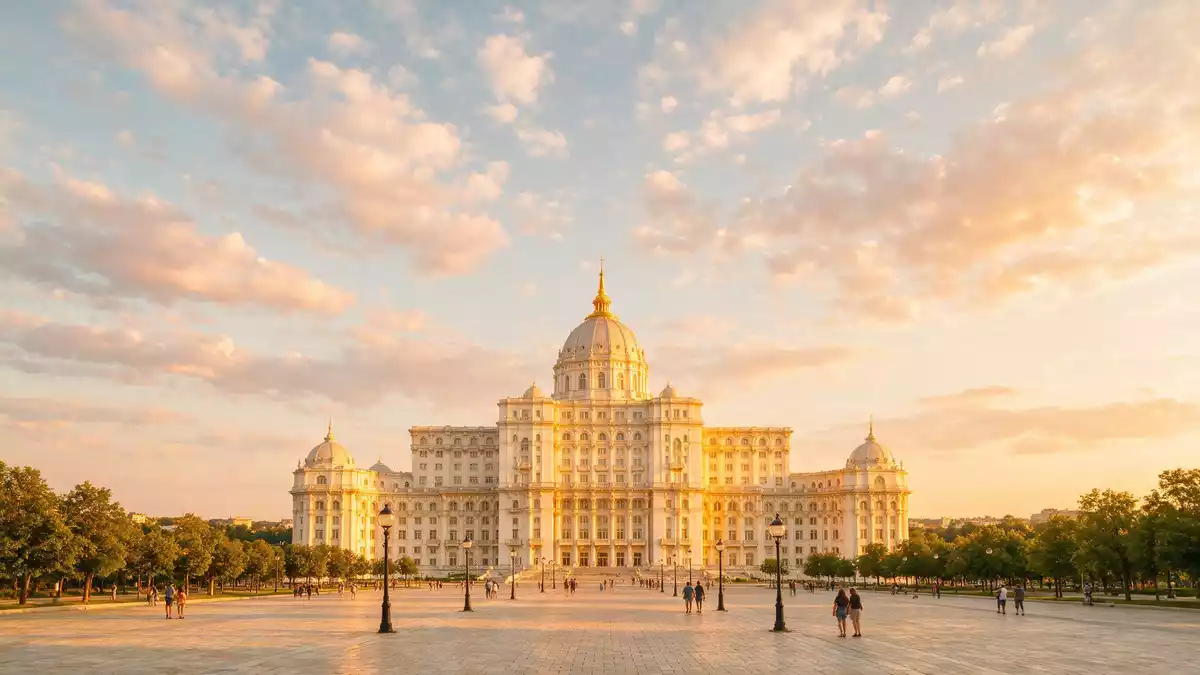
Palatul Parlamentului in Bukarest is Romania’s colossal parliamentary complex, rising over the city on Dealul Arsenalului with a footprint and mass that rank among the largest government buildings in the world.Developed area figures The project was begun under Nicolae Ceau?escu in the 1980s as Casa Poporului and today houses the Senate and Chamber of Deputies in a single sprawling structure.Palatul Parlamentului history
Scale written in stone and crystal
The sheer size of Palatul Parlamentului is its defining feature: the building extends roughly 270 m in length and around 245 m in width, with its main volume rising about 84 m above ground and several levels sunk below the plateau.Length, width and height Figures published for its developed area reach hundreds of thousands of square metres, placing it just behind the Pentagon in global rankings for governmental floor space.Second-largest government building
Inside, the number of rooms runs into the thousands, including vast halls, grand staircases and long ceremonial corridors that emphasise repetition and symmetry.Extensive interior spaces The structure is built predominantly from Romanian materials: published data mention enormous quantities of marble and wood, thousands of chandeliers and extensive carpets and crystal, all contributing to a dense, heavyweight interior aesthetic.Romanian materials and finishes
From Casa Poporului to parliamentary seat
Construction of Palatul Parlamentului began in 1984 under the communist regime, with architect Anca Petrescu as chief designer following a competition earlier in the decade.Chief architect and regime The building was known during that period as Casa Poporului and, in some references, Casa Republicii, reflecting its intended role as a centralised seat for major state institutions.Earlier names and functions
After the 1989 revolution and the end of Ceau?escu’s rule, the complex took on its present parliamentary role, housing the two chambers of the Romanian Parliament and associated bodies in spaces that had been planned for a wider array of communist-era institutions.Present-day institutions Guides and official descriptions describe it as a symbol of democracy anchored in an architecture that still carries the monumental, postmodern language of its original conception.From totalitarian project to democratic symbol
Palatul Parlamentului in Bukarest’s urban landscape
Palatul Parlamentului stands in central Bukarest on the plateau known as Dealul Arsenalului, west of Pia?a Unirii and framed by major boulevards including Bulevardul Na?iunile Unite, Bulevardul Libert??ii and Calea 13 Septembrie.Position within Bukarest Its main elevation faces east along Bulevardul Unirii, where broad perspectives were laid out to emphasise the palace’s presence at the end of the axis.
The building’s terraces and façades rise above Izvor Park on the northern side, where visitors approaching from the riverside or from Bulevardul Na?iunile Unite encounter its layered profiles and long horizontal lines.Northern side near Izvor Park From surrounding districts the palace reads as a continuous block of stone and glass, dominating sightlines across the central city and forming a constant backdrop to Bukarest’s everyday traffic and neighbourhood streets.
Visiting Palatul Parlamentului: what travellers from Western Europe should know
- Palatul Parlamentului stands in Sector 5 of Bukarest on Dealul Arsenalului, with main approaches from Bulevardul Unirii and Bulevardul Na?iunile Unite, and Izvor Park along its northern side.
- The interior route for visitors typically involves lifts and long corridors, but guided tours also include ceremonial staircases with many steps and large halls where groups move through expansive spaces.
- The plateau of Dealul Arsenalului lies above the lower streets and parks nearby, so reaching external viewing points involves gentle gradients on surrounding roads rather than steep mountain terrain.
- Bukarest is served by Henri Coand? International Airport north of the city, and Palatul Parlamentului is accessible from central transport hubs using urban buses, trams or the metro network.
- Romania’s official language is Romanian and the national currency is the leu; English is encountered in many visitor-facing contexts within Bukarest.
Searching for Palatul Parlamentului on social platforms
These links open searches for Palatul Parlamentului on each platform.
Frequently asked questions about Palatul Parlamentului
Where is Palatul Parlamentului located in Bukarest?
Palatul Parlamentului stands in central Bukarest on Dealul Arsenalului in Sector 5, framed by major boulevards and close to Pia?a Unirii.
What can visitors expect inside Palatul Parlamentului?
Visitors on guided routes encounter large marble halls, ceremonial staircases, extensive corridors and conference rooms, together forming a sequence of grand interior spaces.
What makes Palatul Parlamentului distinctive among European landmarks?
Its vast dimensions, heavy use of Romanian materials and origins in the 1980s communist period combine to create a single complex that dominates Bukarest’s cityscape and national political life.


