
Palatul Parlamentului, Bukarest’s monumental parliament building
Published on 09/18/2026 at 22:48 | Editorial responsibility: Rafael Müller, Editor-in-Chief AD HOC NEWS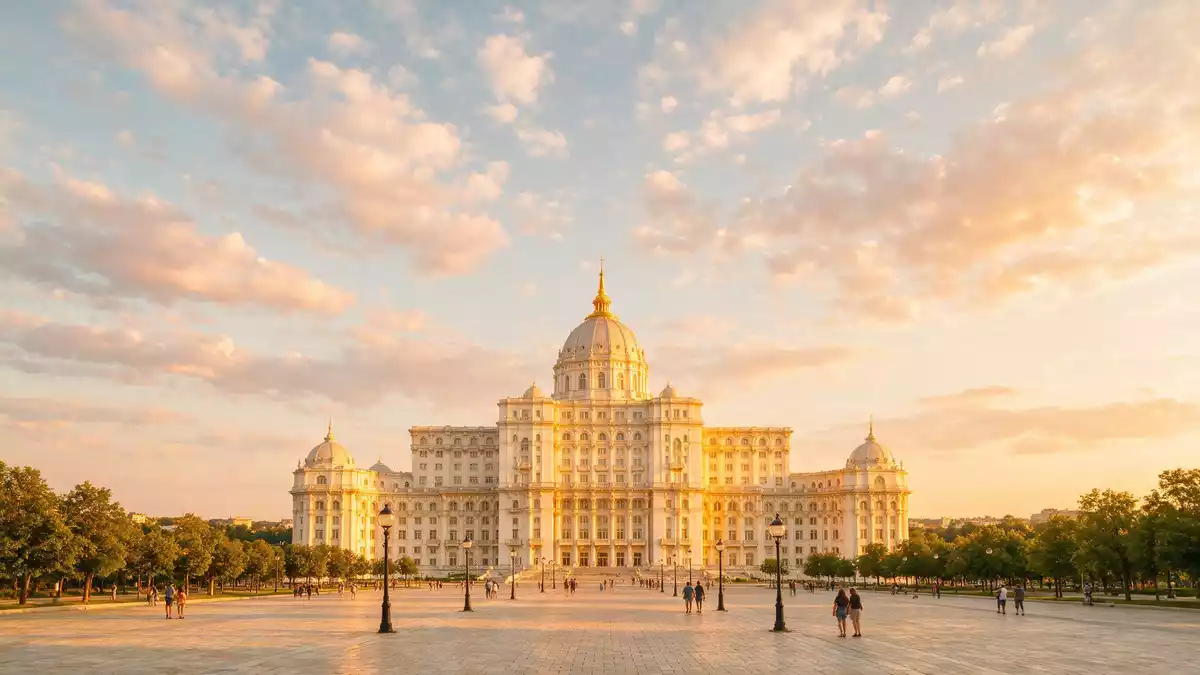
Palatul Parlamentului in Bukarest is a monumental parliament building rising over Dealul Spirii, its neoclassical façades and colossal footprint making it one of the defining structures of Romania’s capital. Conceived under the leadership of Nicolae Ceau?escu in the 1980s and brought into its present parliamentary role in the 1990s, it gathers the Senate and Chamber of Deputies in a single administrative complex.
A city-scale palace of power
Palatul Parlamentului occupies a vast rectangle on the western side of central Bukarest, set on the height known as Dealul Spirii and aligned along Strada Izvor 2–4 in Sector 5.Dealul Spirii site From street level its terraces and long wings rise above the surrounding districts in a series of stepped volumes, emphasising the building’s mass and axial symmetry. The palace extends to a length of around 270 m (886 ft) and a width of around 245 m (804 ft), dimensions that give it a floor area of roughly 365,000 m² (3,930,000 sq ft) and place it among the largest administrative buildings in the world.overall dimensions
Seen from Constitution Square, the building reads as a long, horizontally layered block, articulated by repeated window bays and pilaster rhythms in a style linked to socialist neoclassicism.socialist neoclassical style It is widely noted for its extraordinary structural weight, with records describing it as the heaviest building in the world thanks to the volumes of stone, concrete, steel and decorative materials concentrated on the hill.heaviest building record
From Casa Poporului to parliamentary seat
The palace’s origins lie in the late communist period, when Nicolae Ceau?escu initiated a remade civic district on Dealul Spirii and commissioned a new seat of power originally known as Casa Poporului, the People’s House.Casa Poporului name Construction began in the early 1980s, with a ceremonial foundation stone laid in 1984, and extended across that decade under his rule.1984 foundation stone Following the revolution of 1989, the project continued, and by the mid-1990s the building took on its present function as the Palace of the Parliament, housing Romania’s main legislative bodies in its grand halls and office suites.parliamentary role in the 1990s
The architectural conception is linked to Romanian architect Anca Petrescu, who coordinated a large team of designers on the scheme.Anca Petrescu as architect Her design divides the building into zones for representative halls and galleries, office areas for the parliamentary apparatus, and upper belvedere levels, all threaded by extensive corridors and staircases.functional zoning Over time, beyond the Chamber of Deputies and Senate, parts of Palatul Parlamentului have accommodated institutions such as the Constitutional Court and various international cooperation initiatives, giving the complex a layered administrative life while retaining its primary role as Romania’s parliamentary seat.constitutional and institutional uses
Materials, interiors and spatial experience
Behind its exterior rows of windows and colonnades, Palatul Parlamentului contains a dense sequence of interiors on multiple levels, with recorded figures speaking of hundreds of rooms distributed across storeys above ground and further levels below.rooms and levels Representative halls occupy the central axes and upper floors, hosting parliamentary sessions, conferences and ceremonial gatherings, while side wings and deeper areas house offices and service spaces. Long corridors link clusters of rooms, and monumental staircases rise through key volumes, reinforcing the impression of a building planned on a grand civic scale.representative halls
The interior finishes make extensive use of Romanian materials. Accounts of the construction mention vast quantities of marble, different kinds of wood, crystal and metals, with figures reaching around 1,000,000 m³ of marble, 900,000 m³ of wood and thousands of tonnes of crystal, steel and bronze employed in the building.marble and crystal quantities Chandeliers, decorative ceilings, carpets and carved doors repeat across the halls, creating a sequence of ornate rooms that continue the neoclassical vocabulary of the façades into the interior, while reflecting the ambitions and aesthetic preferences of the late socialist period.
Visiting Palatul Parlamentului: what travellers from Western Europe should know
- Palatul Parlamentului stands on Dealul Spirii in Sector 5 of Bukarest, with its main approaches along Strada Izvor and broad views towards Pia?a Constitu?iei.
- The building occupies a large elevated plot with expansive terraces; moving through the complex involves long corridors and staircases rather than short level transitions.
- Bukarest is served by Henri Coand? International Airport to the north of the city, with urban roads and public transport links leading towards the parliamentary district around Palatul Parlamentului.
- The official language is Romanian and the currency is the leu.
- Entry requirements depend on your nationality; UK travellers can check the FCDO travel advice at gov.uk/foreign-travel-advice, Irish travellers the Department of Foreign Affairs at ireland.ie.
Searching for Palatul Parlamentului on social platforms
These links open searches for Palatul Parlamentului on each platform.Frequently asked questions about Palatul Parlamentului
Where is Palatul Parlamentului located in Bukarest?
Palatul Parlamentului stands on Dealul Spirii in Sector 5, with its official address on Strada Izvor 2–4 and broad views over the surrounding central districts.
What should visitors expect inside Palatul Parlamentului?
Visitors encounter a sequence of large halls, corridors and staircases finished with Romanian marble, wood and crystal, reflecting the building’s neoclassical and late socialist architectural character.
What makes Palatul Parlamentului distinctive among parliament buildings?
Its combination of huge footprint, recorded structural weight, socialist neoclassical façades and origins as Casa Poporului in the 1980s makes Palatul Parlamentului a singular parliament complex in Europe.


