Palatul Parlamentului and the scale of Ceau?escu’s Bucharest
Published on 08/09/2026 at 15:07 | Editorial responsibility: Rafael Müller, Editor-in-Chief AD HOC NEWS
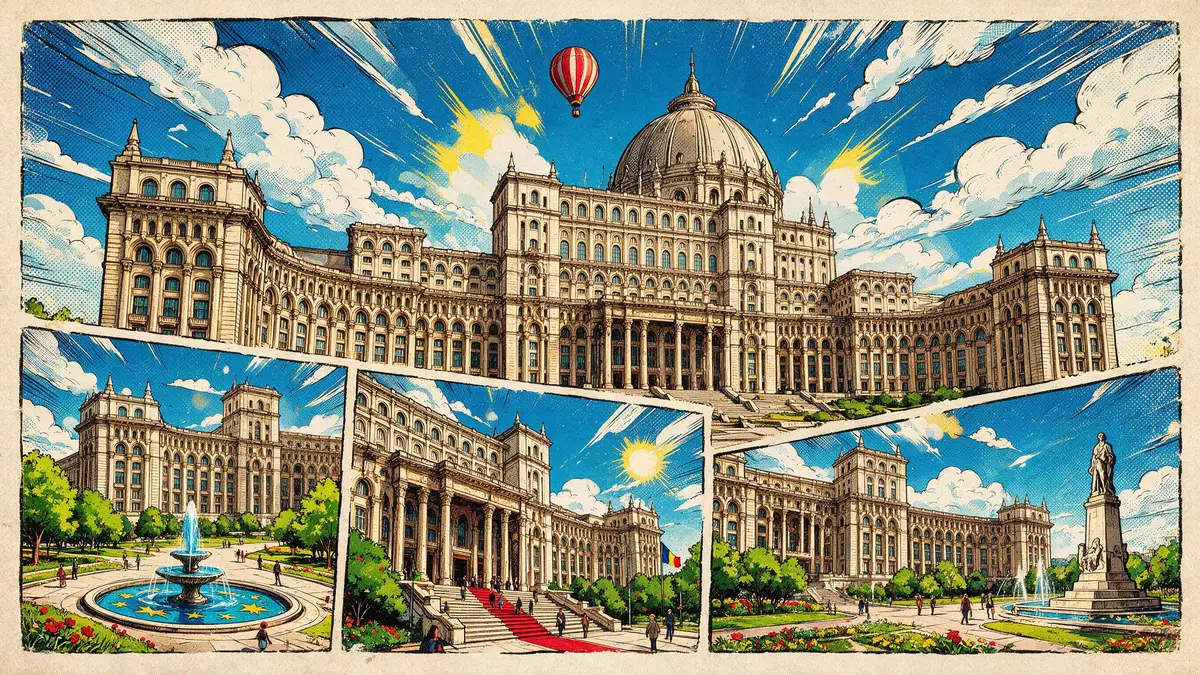
Palatul Parlamentului in Bukarest is a vast late twentieth-century government building linked to Nicolae Ceau?escu and the communist period in Romania. Its long façades, heavy stone surfaces and strict symmetry make the building’s scale visible long before any interior room is reached.
A monumental face in stone
The building rises as a mass of pale stone, with rows of windows, deep shadows and long horizontal lines. From the outside, it reads less like a single palace than an ordered complex compressed into one structure.
Its dimensions place it among the largest administrative buildings in Europe, and the bulk of the facade is part of its identity. The massing is severe rather than delicate, and the stonework gives the whole complex a heavy, formal presence.
Ceau?escu, communism and the late twentieth century
Palatul Parlamentului belongs to the final decades of Nicolae Ceau?escu’s rule, when grand state architecture became part of the political landscape of Bucharest. The building is one of the most recognisable survivals of that period.
It is also a product of the Romanian communist era in a city shaped by repeated large-scale interventions. The palace stands as a material reminder of a political system that favoured monumentality, ceremonial space and administrative centrality.
Interiors of scale and repetition
Inside, the building is known for long corridors, ceremonial rooms and extensive use of marble, wood and decorative detail. The interior sequence feels formal and deliberate, with repeated surfaces and a strong sense of procession.
The size of the rooms and corridors is part of the experience. Even without counting them, the stairways, halls and connecting spaces create a sense of a building organised on an imperial scale.
Visiting Palatul Parlamentului: what travellers from Western Europe should know
- Palatul Parlamentului stands in central Bukarest and is reached by road and public transport from the city centre.
- Admission arrangements and opening hours are set by the site's operator and change with the season; the official website is the only binding source.
- Steady weather suits a visit, because the building’s scale is best appreciated from the approaches and exterior forecourt.
- The site involves long corridors, stairs and extensive indoor walking, so comfortable shoes are useful.
- Romania uses the leu, and card payment is common in the city, though some smaller services may prefer cash.
- Entry requirements depend on your nationality. UK travellers should check the FCDO travel advice at gov.uk/foreign-travel-advice; Irish travellers the Department of Foreign Affairs at ireland.ie; EU and EEA citizens their own national foreign ministry.
Searching for Palatul Parlamentului on social platforms
These links open searches for Palatul Parlamentului on each platform.
Frequently asked questions about Palatul Parlamentului
Where is Palatul Parlamentului?
It stands in central Bukarest, in Romania, within one of the city’s major administrative districts. The building is an unmistakable landmark in the urban fabric around it.
What should visitors expect?
Expect a large-scale government palace with long interior routes, formal rooms and substantial stone architecture. It rewards visitors who are interested in civic architecture and twentieth-century political history.
What makes it distinctive?
Its distinction lies in the combination of sheer bulk, late communist-era origin and ceremonial interior space. The building’s presence is immediate from the approach and remains strong inside.