
Palatul Parlamentului and the scale of Bucharest
Published on 08/30/2026 at 10:02 | Editorial responsibility: Rafael Müller, Editor-in-Chief AD HOC NEWS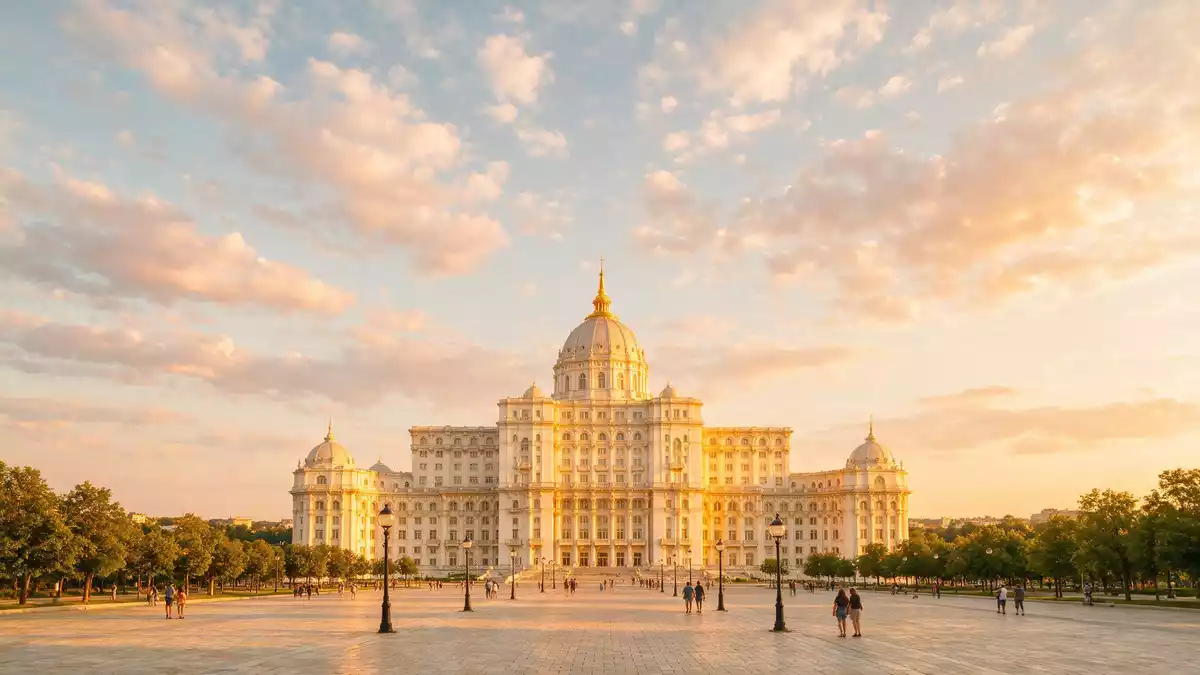
Palatul Parlamentului rises over Bukarest as a vast, severe block of stone-coloured surfaces and long façades. It is the seat of Romania’s Parliament and one of the city’s most imposing landmarks.
Palatul Parlamentului and Ceau?escu’s grand scale
The building is closely tied to Nicolae Ceau?escu and the late communist period in Romania, when it was conceived under the name Casa Poporului. Its monumental form and scale make that period visible in the city fabric, with the palace occupying a commanding position above Dealul SpiriiPalace of the Parliament.
Palatul Parlamentului is recorded as having been built between 1984 and 1997, and it remains one of the best-known works associated with Ceau?escu’s rulebuilt between 1984 and 1997. The name Palatul Parlamentului is the Romanian form, while the building’s earlier public identity as the People’s House still frames much of its historical meaning.
Inside a palace of extreme dimensions
The structure is defined by sheer mass: a length of 270 m (886 ft), a width of 245 m (804 ft), and a height of 84 m (276 ft) above groundlength of 270 mheight of 84 m. That scale gives the exterior a disciplined, almost austere rhythm, with repetitive windows and long horizontal lines.
Its recorded floor area is 365,000 m², which places it among the largest administrative buildings in the world365,000 m². The palace also extends deep below ground, where the building continues through underground levels rather than ending at street level.
Marble, crystal and the language of monumentality
The building’s material palette helps explain its visual force. Marble, steel, wood, glass and crystal appear in its recorded construction materials, giving the interior and structural fabric a heavy, formal characterconstruction materials.
Even without entering every chamber, the palace reads as a project of state scale rather than domestic scale. Long corridors, large halls and a dense internal arrangement reinforce the impression of a building made for institutions, not for private life.
Visiting Palatul Parlamentului: what travellers from Western Europe should know
- The palace stands in central Bukarest on Strada Izvor, close to Dealul Spirii and Constitution Square.
- The building extends through underground levels below the visible mass, so its scale is as vertical as it is horizontal.
- English-language visits are part of the building’s public life, and the palace serves as the seat of Romania’s Parliament.
- The official language is Romanian and the currency is the Romanian leu.
Searching for Palatul Parlamentului on social platforms
These links open searches for Palatul Parlamentului on each platform.
Frequently asked questions about Palatul Parlamentului
Where is Palatul Parlamentului?
It stands in central Bukarest on Dealul Spirii, close to Strada Izvor and Constitution Square.
What should a visitor expect?
A visit means a huge institutional building with long corridors, large halls and a strong sense of scale. The structure extends above and below ground.
What makes Palatul Parlamentului distinctive?
Its combination of size, formal geometry and late communist history makes it immediately recognisable. The palace is also linked to Nicolae Ceau?escu and the years 1984 to 1997.


