
Palati tou Megalou Magistrou, the fortress palace of medieval Rhodos
Published on 09/17/2026 at 14:08 | Editorial responsibility: Rafael Müller, Editor-in-Chief AD HOC NEWS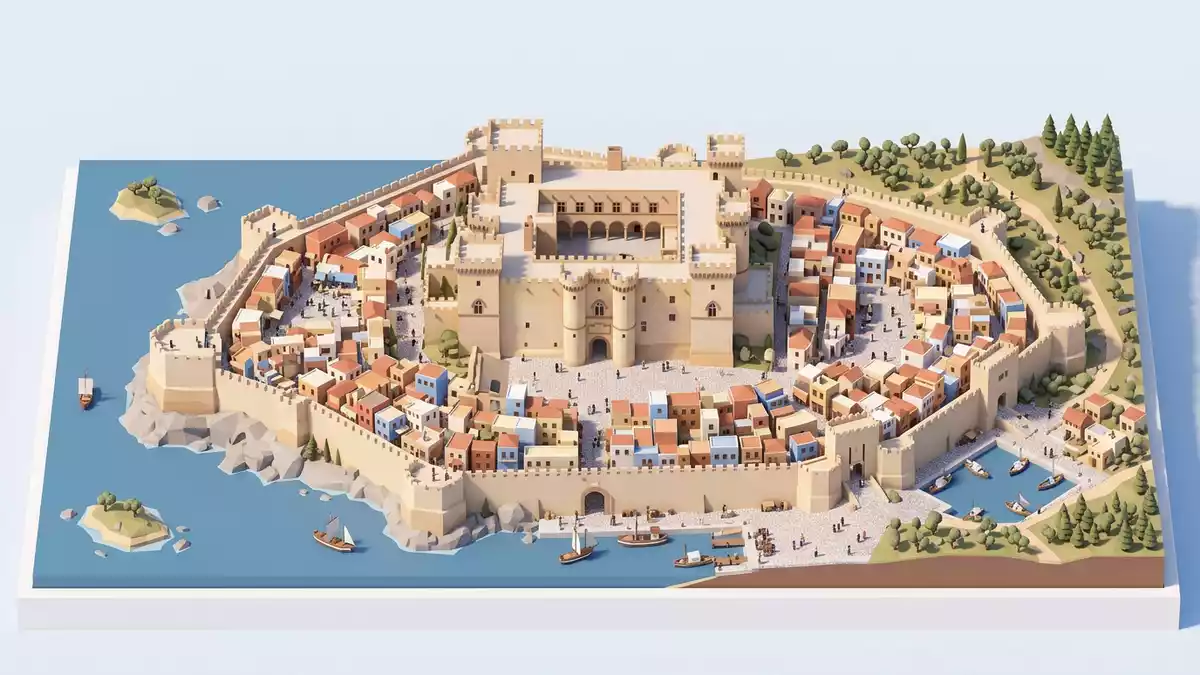
Palati tou Megalou Magistrou, known in English as the Palace of the Grand Master of the Knights of Rhodes, dominates the medieval town of Rhodos on the island of Rhodes in Greece as a fortified palace with a broad internal courtyard and towered walls that close the vista of the cobbled Street of the Knights.
A Gothic palace on Byzantine foundations
The palace stands within the Medieval City of Rhodes, a walled ensemble on the northern tip of the island that preserves layers of Byzantine, crusader and later architecture in close succession.Medieval City of Rhodes Behind its crenellated outer front lies an arrangement of halls and courtyards raised on the site of an earlier Byzantine stronghold that is dated to the seventh century AD.earlier Byzantine acropolis
The Knights Hospitaller, also known as the Order of St John, took control of Rhodes in 1309 and developed the complex into the residence of their Grand Master and the administrative centre of their island state.Knights Hospitaller ruled Rhodes from 1309 In the fourteenth century the palace acquired the Gothic character that visitors recognise, with robust masonry, arcaded walkways and defensive towers that tie it visually to the surrounding fortification walls.built in the fourteenth century AD
From Hospitaller seat to twentieth?century reconstruction
Between 1309 and 1522 Palati tou Megalou Magistrou served as the residence of successive Grand Masters and as the political and administrative centre of the Knights’ realm on Rhodes, housing the order’s governing elite and acting as a refuge in times of danger within the fortified town.residence and administrative centre from 1309 to 1522 When Ottoman forces captured the island in 1522 the complex lost its original function, and parts of it were later adapted for uses including imprisonment under the new authorities.Ottoman capture and later prison use
A major turning point came in 1856, when an explosion of stored ammunition beneath the building severely damaged much of the structure.destruction in 1856 After the Kingdom of Italy assumed control of the Dodecanese in 1912, Italian authorities undertook an extensive restoration and reconstruction programme between 1937 and 1940 under governor Cesare Maria De Vecchi, reshaping the palace with a pronounced medieval aesthetic and reusing it as the governor’s headquarters and as a seasonal residence for figures such as King Victor Emmanuel III and Benito Mussolini.Italian restoration between 1937 and 1940
A museum within a UNESCO?listed medieval town
When the Dodecanese islands were annexed by Greece in 1948, the palace entered a new phase as a cultural institution and exhibition space under Greek administration, with parts of the upper level arranged as a museum that presents the history and artefacts of Rhodes and the surrounding region.museum use after annexation by Greece Today Palati tou Megalou Magistrou forms part of the Medieval City of Rhodes ensemble recognised by UNESCO as a World Heritage Site, tying its reconstructed halls and historical displays to the circuit of walls, bastions and gates that enclose the old town.UNESCO World Heritage inscription
The approach to the palace along Ippoton, the Street of the Knights, leads past stone facades that once housed the various langues of the order, culminating at the palace’s front where the mass of the building closes the perspective of the rising street.Ippoton, the Street of the Knights Inside, visitors encounter a sequence of large halls, smaller chambers and open courtyards, with stone staircases, colonnades and decorative elements that reflect both the medieval heritage of the Knights and the interpretation introduced during the Italian restoration.
Visiting Palati tou Megalou Magistrou: what travellers from Western Europe should know
- Palati tou Megalou Magistrou stands in the medieval town of Rhodos on the island of Rhodes in Greece, at the upper end of Ippoton, the Street of the Knights, reached on foot through the old town’s network of cobbled lanes.
- The complex occupies raised ground within the fortifications, and a visit involves walking on uneven stone surfaces both in the approach and inside the courtyards, as well as ascending and descending stone staircases between exhibition levels.
- Rhodes lies in Greece, where the official language is Greek and the currency is the euro.
Searching for Palati tou Megalou Magistrou on social platforms
These links open searches for Palati tou Megalou Magistrou on each platform.
Frequently asked questions about Palati tou Megalou Magistrou
Where is Palati tou Megalou Magistrou located?
Palati tou Megalou Magistrou stands in the medieval town of Rhodos on the island of Rhodes in Greece, at the upper end of Ippoton, the Street of the Knights.
What can visitors expect inside the palace?
Visitors encounter fortified outer walls, a large courtyard, stone staircases and a series of museum halls and chambers that present the history and artefacts of Rhodes.
What makes Palati tou Megalou Magistrou distinctive among Rhodes landmarks?
Its combination of Byzantine foundations, fourteenth?century Hospitaller development and twentieth?century Italian reconstruction within a UNESCO?listed medieval town gives the palace a layered character distinct from other sites on the island.


