
Palati tou Megalou Magistrou, the fortress-palace crowning medieval Rhodos
Published on 09/14/2026 at 07:19 | Editorial responsibility: Rafael Müller, Editor-in-Chief AD HOC NEWS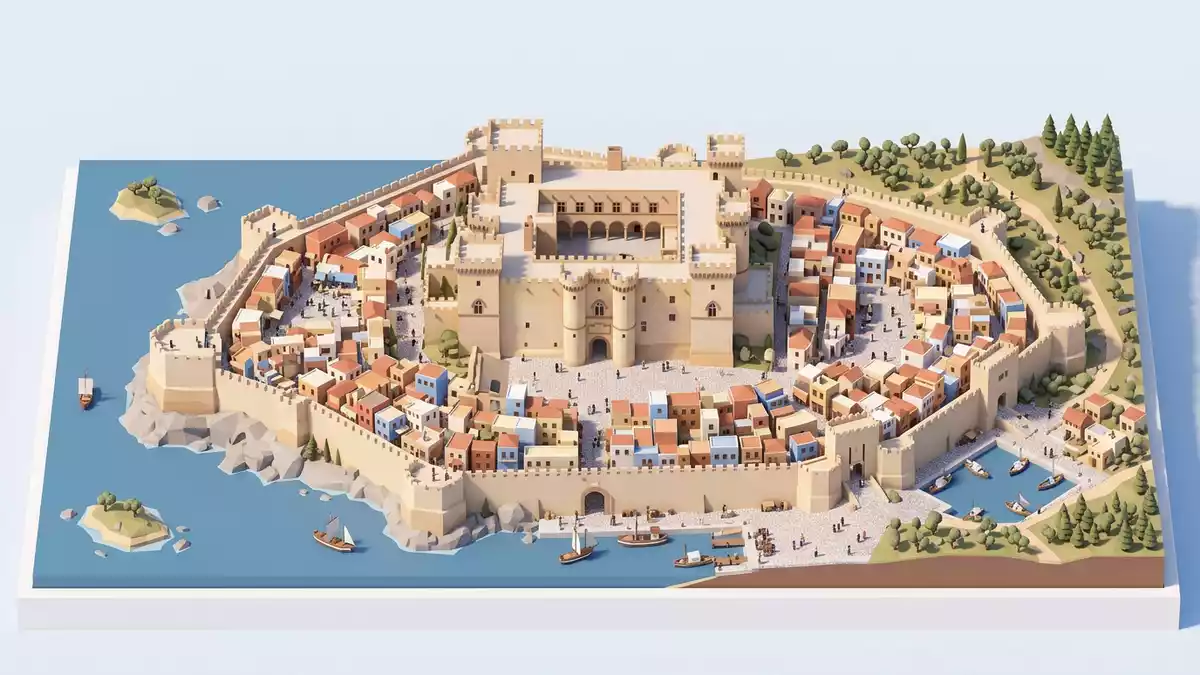
Palati tou Megalou Magistrou, better known in English as the Palace of the Grand Master of the Knights of Rhodes, rises over the medieval town of Rhodos as a fortified Gothic palace with a vast internal courtyard. Built and expanded by the Knights Hospitaller from the early fourteenth century, it later became a museum that anchors the island’s story of crusading orders and Mediterranean trade.
A fortress that became a palace and museum
The palace occupies the north-western corner of the walled medieval town of Rhodos, at the top of the Street of the Knights, on one of the highest points within the fortifications.The palace stands at the top of the Street of the Knights Its origins lie in a Byzantine stronghold, later transformed by the Knights of Saint John after they established their headquarters on Rhodes in 1309 under Grand Master Foulques de Villaret.the Knights Hospitaller established their headquarters on the island in 1309
The complex developed into the residence of successive Grand Masters and the administrative centre of the Knights’ island-state between 1309 and 1522, when Ottoman forces expelled the order and its leadership moved to Malta.the palace was the residence of the Grand Master and the administrative and political centre from 1309 to 1522 In its present form it functions as a museum within the Rhodes medieval town ensemble, which is recognised as a UNESCO World Heritage Site for its concentration of crusader-period fortifications and civic buildings.the Grand Master’s Palace of Rhodes is part of a UNESCO World Heritage Site
Gothic military architecture around a grand courtyard
Architecturally, Palati tou Megalou Magistrou is closer to a fortified citadel than a courtly residence, with a nearly rectangular plan of around 80 m by 80 m organised around a central open courtyard.the building is about 80 by 80 metres Its outward walls are thick, crenellated and punctuated by towers, reflecting the Gothic military architecture familiar from southern France and recalling other Papal and crusader strongholds.its architecture is described as Gothic Provencal with crenellated walls and towers
Inside, colonnaded arcades frame the courtyard, and rooms on the upper levels display mosaics transferred from sites such as Kos, carved stone doorways and period furnishings that evoke the blend of Byzantine, Gothic and later influences on Rhodes.today the palace houses museum exhibitions Walking through the halls and staircases gives a sense of how the building functioned both as a residence and as part of a wider defensive system, physically linked to the town walls and integrated into the Collachium, the fortified northern district reserved for the Knights.the palace is a medieval castle within the city walls of Rhodes
Rhodos, the Knights and later restorations
The presence of the Knights Hospitaller on Rhodes formed part of a wider pattern in the eastern Mediterranean after the loss of crusader territories in the Levant, with the order using the island as a base to control sea routes and support pilgrims and traders.the fortress-palace has witnessed centuries of conquest and conflict Their architectural legacy is visible not only in Palati tou Megalou Magistrou but also in the street plan, the inns and the churches that surround it.
In later centuries the palace suffered damage, including a major explosion linked to stored munitions, and underwent reconstruction under different regimes, leaving a building that combines original medieval fabric with twentieth-century restoration work.the palace is a reconstructed medieval castle The museum layout highlights Rhodes’s ancient and medieval past, and the position of Palati tou Megalou Magistrou at the end of the Street of the Knights makes it a natural end-point for a walk through the walled town’s cobbled lanes.the Grand Master’s Palace is located at the end of the Ippoton Knights’ Road
Visiting Palati tou Megalou Magistrou: what travellers from Western Europe should know
- Palati tou Megalou Magistrou stands in the north-western part of Rhodes Old Town, at the upper end of the cobbled Street of the Knights, a short walk from Mandraki harbour.
- The approach from the town side involves walking on uneven stone and cobbles, with staircases inside the palace and upper rooms reached by climbing substantial flights of steps.
- Rhodos is on the island of Rhodes in Greece; the official language is Greek and the currency is the euro.
- Within the medieval town, Palati tou Megalou Magistrou is surrounded by high fortification walls, gates and narrow lanes, so navigation relies more on landmarks than on wide modern streets.
Searching for Palati tou Megalou Magistrou on social platforms
These links open searches for Palati tou Megalou Magistrou on each platform.
Frequently asked questions about Palati tou Megalou Magistrou
Where is Palati tou Megalou Magistrou located in Rhodos?
Palati tou Megalou Magistrou stands in the north-western part of Rhodes Old Town, at the top of the Street of the Knights within the medieval fortifications.
What should visitors expect inside the palace?
Visitors encounter a fortified Gothic palace organised around a large courtyard, with museum rooms displaying mosaics, carved stonework and exhibits on the history of Rhodes.
What makes Palati tou Megalou Magistrou distinctive among Rhodes landmarks?
Its role as the former headquarters of the Knights Hospitaller, its Gothic military architecture and its position dominating the medieval town together give the palace a defining presence on Rhodos.


