
Palais Bahia in Marrakesch and its mosaic of courtyards
Published on 09/09/2026 at 21:40 | Editorial responsibility: Rafael Müller, Editor-in-Chief AD HOC NEWS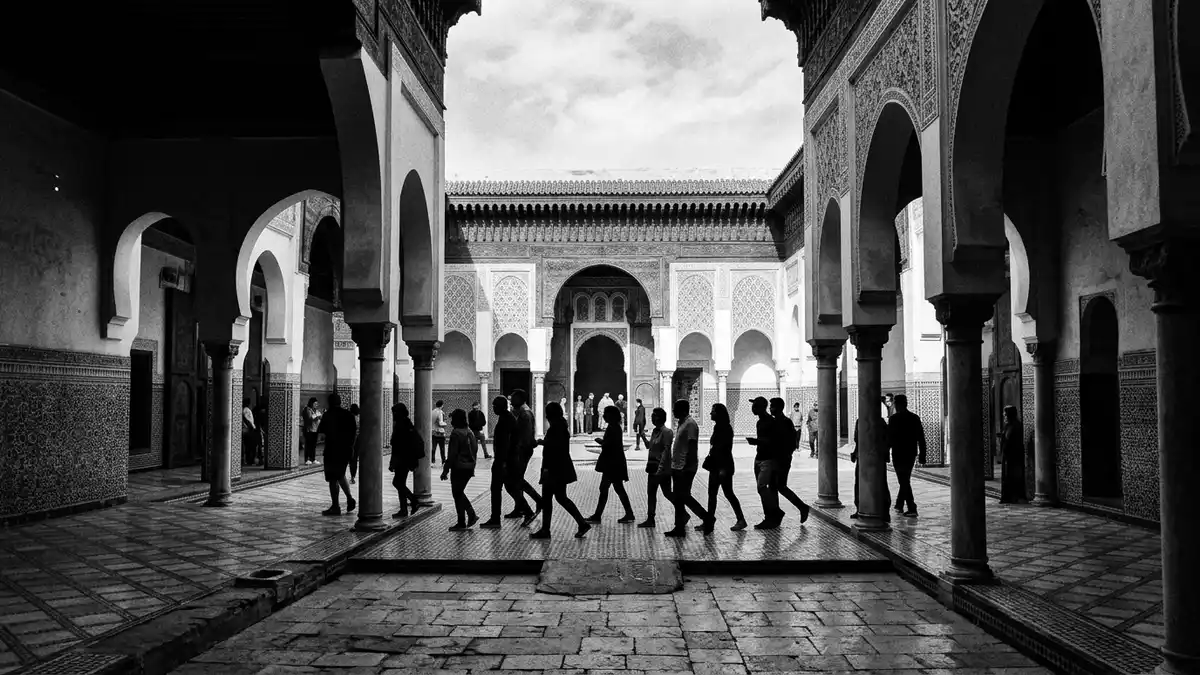
Palais Bahia in Marrakesch is a nineteenth-century palace complex where rooms, courtyards and gardens unfold one after another, each wrapped in dense Moroccan ornament and quiet enclosed space. Built over several decades by powerful viziers of the Alaouite dynasty, it turns an official residence into an intimate maze of zellige, carved cedar and painted ceilings.
A nineteenth-century palace of Alaouite power
Palais Bahia is a mid to late nineteenth-century palace in the medina of Marrakesch, created as a residence for Si Moussa, grand vizier under the Alaouite sultans, and expanded later by his son Ba Ahmed.mid to late nineteenth-century palace The complex lies along the edge of the former Jewish quarter, the Mellah, in the southern part of the old city, close to the dense network of streets around Jemaa el-Fna.located in the medina of Marrakech Its name, “Bahia”, is often glossed as “the beautiful” or “the brilliant”, a title that suits a residence intended to display the wealth and rank of those who lived within its walls.name meaning the brilliant
The palace complex grew in stages during the second half of the nineteenth century, with building work beginning around 1859 and continuing into the last years of the century under Ba Ahmed.built between 1859 and 1900 Over time it accumulated a large number of rooms, reportedly around 150, spread across an area of about eight hectares, including residential quarters, reception rooms and gardens.nearly 150 rooms over eight hectares The Alaouite court used the palace as a centre of government and as a place to receive delegations, and later, after Moroccan independence in the twentieth century, the complex took on the role of a museum under the Ministry of Culture.protected heritage site managed by the Ministry of Culture
Architecture in tile, plaster and carved wood
The architecture of Palais Bahia combines Moroccan, Moorish, Islamic and Andalusian elements, with decoration that covers floors, walls and ceilings almost continuously.Moroccan and Islamic style Zellige tilework spreads across pavements and lower wall zones, forming geometric patterns in glazed ceramic. Above it, carved and painted stucco frames doorways and niches, with vegetal motifs and script panels woven into the surface. Many ceilings are made of cedar wood, cut and assembled into coffers and beams, then painted in strong colours and gold.
The layout is structured around riads and courtyards, with rooms opening directly onto planted squares and paved quadrangles. One of the best known spaces is the large courtyard of the Grand Riad, where a rectangle of paving is bordered by rooms with doors and arcades, and surrounded by garden plots planted with trees. Elsewhere, more intimate courtyards are edged by galleries supported on slender columns, creating shaded circulation between chambers. The contrast between enclosed interior rooms with plain white walls and the heavy ornament of ceremonial halls is part of the palace’s character, reflecting different degrees of formality and display across the complex.fine example of Moroccan architecture
Courtyards and gardens within the medina
Courtyards and gardens are central to Palais Bahia, giving the palace its distinctive sequence of open-air spaces. The complex occupies about eight hectares, divided between built structures and planted ground, including ornamental gardens and areas that historically functioned as a vegetable garden, or agdal.built on 2 hectares plus 6 hectares of Agdal In the Grand Riad and other garden courts, orange trees, palms and other species rise from regular beds, with paths laid out in straight lines between them. Water basins, channels and fountains introduce a further layer of geometry and reflection.
Inside the medina, the palace’s gardens form a dense block of greenery within the wider fabric of houses and streets. High outer walls separate the complex from the surrounding neighbourhood, so the courtyards feel enclosed from the city beyond. Within those walls, however, the arrangement of gardens and riads is varied: some are almost entirely paved, emphasising tilework and symmetry; others have more planting and water, producing a different balance between architecture and landscape. The way these gardens are threaded together, each approached through corridors and gateways, gives a visit to Palais Bahia a particular rhythm of narrow passage and sudden open space.
Visiting Palais Bahia: what travellers from Western Europe should know
- Palais Bahia stands in the southern part of the Marrakesch medina, near the Mellah; approaches on foot commonly use Rue Riad Zitoun el Jdid from the area around Jemaa el-Fna.
- The palace complex consists of multiple courtyards, riads and halls linked by corridors; visiting involves walking on stone paving and passing through a sequence of stair-free but sometimes uneven surfaces.
- The site lies within the low-rise historic fabric of Marrakesch at modest altitude; temperatures can be high under summer sun, with shade provided mainly by galleries and trees inside the courtyards.
- The official language is Arabic and the currency is the Moroccan dirham.
- Entry requirements depend on your nationality; UK travellers can check the FCDO travel advice at gov.uk/foreign-travel-advice, Irish travellers the Department of Foreign Affairs at ireland.ie.
Searching for Palais Bahia on social platforms
These links open searches for Palais Bahia on each platform.
Frequently asked questions about Palais Bahia
Where is Palais Bahia located in Marrakesch?
Palais Bahia stands in the medina of Marrakesch, close to the Mellah in the southern part of the old city, a short walk south-east from Jemaa el-Fna.
What can visitors expect inside Palais Bahia?
Visitors walk through linked courtyards, riads and halls, seeing extensive zellige tilework, carved stucco, painted wood ceilings and planted gardens within the palace walls.
What makes Palais Bahia distinctive among Moroccan palaces?
Its large scale, multi-stage nineteenth-century construction under Si Moussa and Ba Ahmed, and dense combination of ornamented architecture with enclosed gardens give Palais Bahia a distinctive character among Moroccan palatial complexes.


