
Palais Bahia in Marrakesch and its labyrinth of courtyards
Published on 08/26/2026 at 22:21 | Editorial responsibility: Rafael Müller, Editor-in-Chief AD HOC NEWS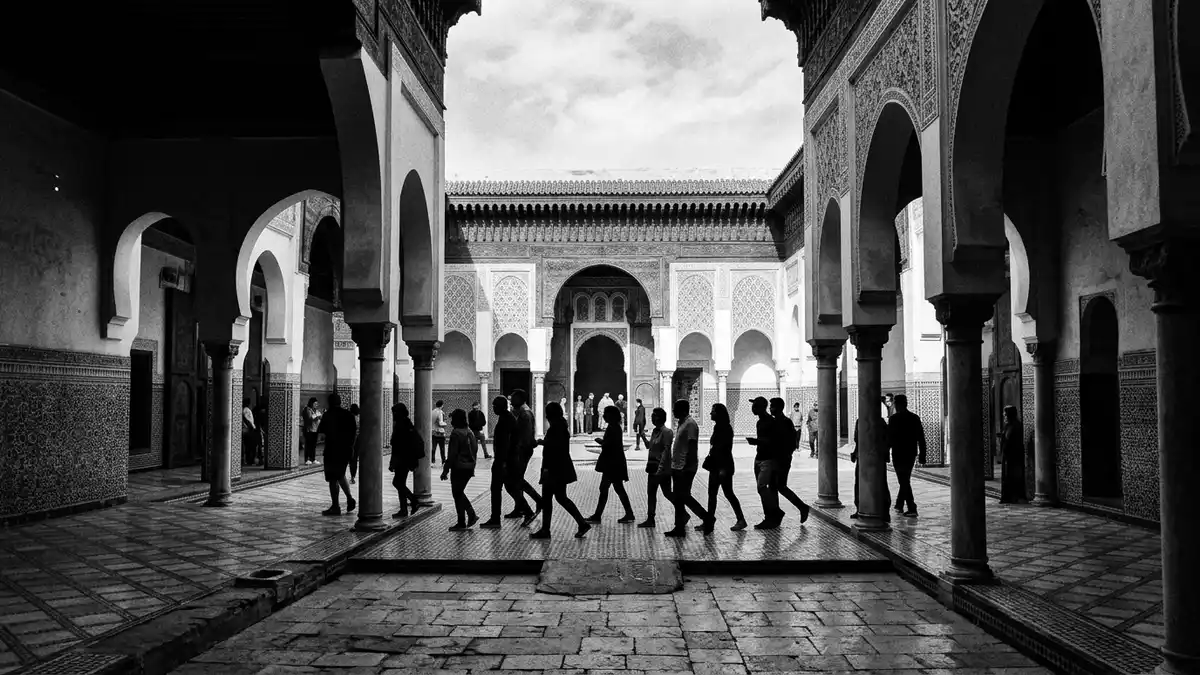
Palais Bahia in Marrakesch is a late nineteenth-century palace complex where courtyards, gardens and richly decorated rooms unfold one after another in a deliberate architectural maze. Built under the Alawi dynasty and completed around 1900, it condenses a chapter of Morocco’s political and artistic history into timber, plaster and tile.
The viziers’ residence in the Marrakesch medina
Palais Bahia stands in the southern part of the Marrakesch medina, close to the historic Mellah, the city’s Jewish quarter, and reached along Rue Riad Zitoun el Jedid and neighbouring streets.the medina location The palace’s name, meaning “brilliance” in Arabic, reflects its status as a showcase for nineteenth-century craftsmanship and courtly life.Bahia, meaning brilliance
Construction began in the 1860s under Si Moussa, grand vizier to the Alawi sultan Muhammad ibn Abd al-Rahman, who commissioned a residence that later became known as Dar Si Moussa.Si Moussa in the 1860s Between 1894 and 1900 his son Ba Ahmed ibn Musa, grand vizier under Sultan Moulay Abdelaziz, enlarged and embellished the complex to form the palace visitors walk through today.Ba Ahmed’s expansion
Courtyards, riads and the famous grand patio
Palais Bahia is laid out as a sequence of riads, reception rooms and private quarters around planted courtyards, with circulation winding through narrow passages and sudden open spaces. The overall complex extends across several hectares within the dense urban fabric, creating a self-contained world of gardens and built volumes.extent of the palace grounds
One of its most striking spaces is the large central courtyard often called the Court of Honour, paved, framed by arcades and opening onto former reception rooms and a harem quarter.Court of Honour and harem Smaller courtyards elsewhere in the palace combine planted beds, fountains and surrounding rooms, creating alternating sequences of enclosed interiors and outward-facing spaces that give the visit its rhythm.
Craftsmanship in wood, plaster and zellij
The architecture of Palais Bahia is generally described as Moorish within the Alawi period, drawing on forms and techniques across Moroccan and wider Islamic traditions.Moorish Alawi style Structural walls are finished with elaborate carved and painted plaster, while floors in principal rooms and courtyards are laid with zellij, the characteristic geometric mosaic tile of Morocco.zellij and plaster decoration
Cedar wood plays a central role in ceilings and doors, which are carved with vegetal and geometric motifs and painted in strong colours that contrast with white plaster surfaces. In formal apartments and salons, timber ceilings rise above wall panelling, with calligraphic friezes and patterned beams marking the hierarchies of space. Decorative programmes continue into more intimate rooms, where patterned tiles, carved plaster and latticework maintain the sense of enclosure and privacy expected of a nineteenth-century palace.
From royal residence to cultural monument
Palais Bahia’s political history mirrors shifts in Morocco’s status. After its use as the seat of grand viziers, the palace later accommodated French authorities during the Protectorate, including Marshal Lyautey’s offices.French Protectorate offices Following independence in 1956, it served as a royal residence before passing to the Moroccan Ministry of Culture as a historic monument open to visitors.transfer to Ministry of Culture
The palace forms part of the wider ensemble of Marrakesch recognised through documentation at the UNESCO World Heritage Centre, which records its significance within the medina’s urban fabric.UNESCO World Heritage documentation Visitors encounter it today as a museum-like environment where circulation focuses on key courtyards, state rooms and garden areas, highlighting architectural features rather than reproducing historical domestic arrangements.
Visiting Palais Bahia: what travellers from Western Europe should know
- Palais Bahia lies in the south of the Marrakesch medina, close to the Mellah and reached on foot from central landmarks such as Jemaa el-Fnaa via Rue Riad Zitoun el Jedid.
- Within the palace complex, movement between courtyards and rooms involves a series of thresholds, occasional changes in level and stone paving that can be uneven underfoot.
- The climate of Marrakesch brings marked seasonal contrasts; in the palace, exposed courtyards and planted gardens sit alongside shaded interior rooms and arcaded galleries.
- The official language is Arabic and the currency is the Moroccan dirham.
- Entry requirements depend on your nationality; UK travellers can check the FCDO travel advice at gov.uk/foreign-travel-advice, Irish travellers the Department of Foreign Affairs at ireland.ie.
Searching for Palais Bahia on social platforms
These links open searches for Palais Bahia on each platform.
Frequently asked questions about Palais Bahia
Where is Palais Bahia located in Marrakesch?
Palais Bahia stands in the southern part of the Marrakesch medina, near the Mellah and along streets such as Rue Riad Zitoun el Jedid.
What can visitors expect inside Palais Bahia?
Visitors walk through a sequence of courtyards, gardens and richly decorated rooms, with carved cedar ceilings, zellij floors and elaborate plasterwork.
What makes Palais Bahia distinctive among Moroccan palaces?
Its late nineteenth-century Moorish architecture, association with grand viziers Si Moussa and Ba Ahmed, and extensive courtyards within the medina give it a distinctive character.


