
Palais Bahia in Marrakesch: a nineteenth?century maze of courtyards and gardens
Published on 09/12/2026 at 22:43 | Editorial responsibility: Rafael Müller, Editor-in-Chief AD HOC NEWS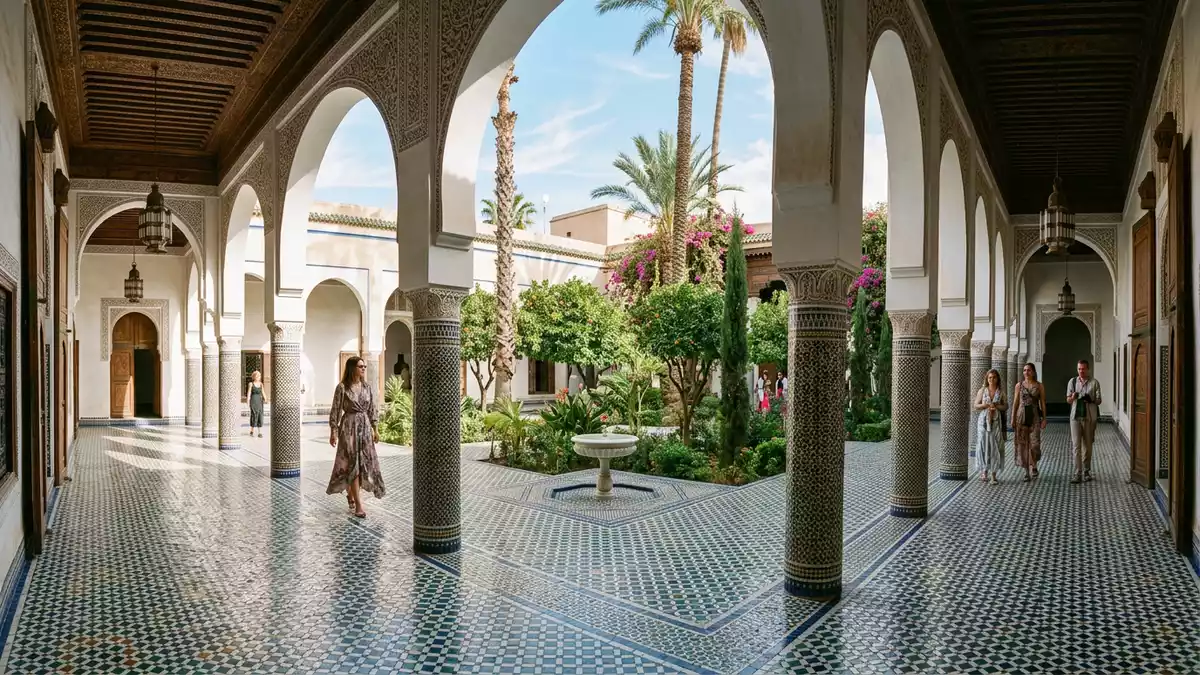
Palais Bahia in Marrakesch is a sprawling nineteenth?century palace complex where courtyards, salons and gardens flow into one another, creating an intricate domestic world behind plain medina walls. Its rooms and open spaces were assembled over the second half of the nineteenth century for powerful viziers of Morocco, and the palace remains one of the most elaborate surviving residences from that era.
A viziers’ palace of the late nineteenth century
Palais Bahia is a mid to late nineteenth?century palace in Marrakesch, built for the grand vizier Si Moussa and expanded under his son Ahmed ben Moussa, widely known as Ba Ahmed.Mid to late nineteenth?century palace The complex lies in the southern part of the medina, along the northern edge of the Mellah, the historic Jewish quarter, close to the present?day Royal Palace.Located by the Mellah The name “Bahia”, often translated as “the beautiful” or “the brilliant”, is linked to Arabic and Moroccan usage and underlines the palace’s association with refinement.Name meaning “the beautiful”
The palace grew over time as successive owners added new wings and courts, forming a dense patchwork of spaces rather than a single monumental facade.Complex extended under Ba Ahmed It extends over about eight hectares (19.8 acres), with a significant built area and many rooms opening onto inner courtyards and gardens.About eight hectares In the twentieth century the Moroccan state took over the palace, maintaining it as a historic monument and using parts of it for official receptions of foreign dignitaries.Used to receive foreign dignitaries
Arab?Andalusian architecture in rooms and courtyards
Palais Bahia is known for Arab?Andalusian and Hispano?Moorish architecture, weaving zellige tilework, chiselled stucco and painted cedarwood into almost every surface.Arab?Andalusian architecture Floors are laid in patterned tiles, walls carry carved plaster panels and ceilings are built in timber and repeatedly painted, so that even relatively modest rooms are richly finished.Rooms with stuccos and mosaics Many salons open onto planted courtyards where orange trees, fountains and paved walks are framed by arcades.
The palace is laid out as a sequence of residential quarters and reception areas, each gathered around its own courtyard or garden, with passages linking them into a continuous route. Some sections are intimate, with low rooms arranged around small patios, while others are more ceremonial, including larger halls and grand courts. The architect Mohammed al?Makki is associated with the design of the complex, reflecting the work of Moroccan craftsmen in the later nineteenth century.Design attributed to Mohammed al?Makki Across these areas, decoration varies between fine marquetry, painted wood and marble paving, creating a detailed record of elite domestic architecture in Marrakesch.
Gardens, medina setting and heritage status
Beyond its built rooms, Palais Bahia is distinguished by its extensive gardens, which are integrated into the palace complex rather than standing apart as a separate park.Eight?hectare palace and gardens These gardens combine paved routes with planted areas, creating shaded spaces within the medina’s dense urban fabric. The palace sits in the Riad Zitoun Jdid area of the old city, in a district long associated with royal and aristocratic residences.Located in palace district High walls mark the outer boundary, while within, courtyards and gardens bring light and greenery into the residence.
Palais Bahia is part of the wider medina of Marrakesch, which is inscribed on the UNESCO World Heritage List for its architecture and urban heritage.Within the UNESCO?listed medina As one of the major palatial complexes inside this historic centre, it stands alongside religious buildings, markets and other houses, revealing how elite domestic life was organised in the city. Parts of the palace function as a museum space, presenting architecture and decorative arts from the nineteenth century to visitors.Current use as museum
Visiting Palais Bahia: what travellers from Western Europe should know
- Palais Bahia stands in the southern part of the Marrakesch medina, near the Mellah and the Kasbah, with access from streets such as Rue Riad Zitoun El Jedid.
- The palace complex includes multiple courtyards, gardens and interior rooms connected by passages, and exploring it involves walking over paved surfaces and stepping through a series of doorways.
- The surrounding district is part of the historic centre of Marrakesch, with narrow streets and traditional buildings forming the urban setting around the palace.
- The official language is Arabic and the currency is the Moroccan dirham.
Searching for Palais Bahia on social platforms
These links open searches for Palais Bahia on each platform.
Frequently asked questions about Palais Bahia
Where is Palais Bahia located in Marrakesch?
Palais Bahia is in the southern part of the Marrakesch medina, near the Mellah and Kasbah districts, reached from streets such as Rue Riad Zitoun El Jedid.
What can visitors expect when exploring Palais Bahia?
Visitors walk through a series of courtyards, gardens and richly decorated rooms, seeing Arab?Andalusian architecture with zellige, carved plaster and painted cedar ceilings.
What makes Palais Bahia distinctive among Marrakesch’s historic buildings?
Its extensive late nineteenth?century palace complex, combining many residential quarters, reception spaces and integrated gardens over about eight hectares, makes Palais Bahia distinctive within the medina.


