Palais Bahia in Marrakesch: a labyrinth of courtyards and craftsmanship
Published on 09/11/2026 at 13:59 | Editorial responsibility: Rafael Müller, Editor-in-Chief AD HOC NEWS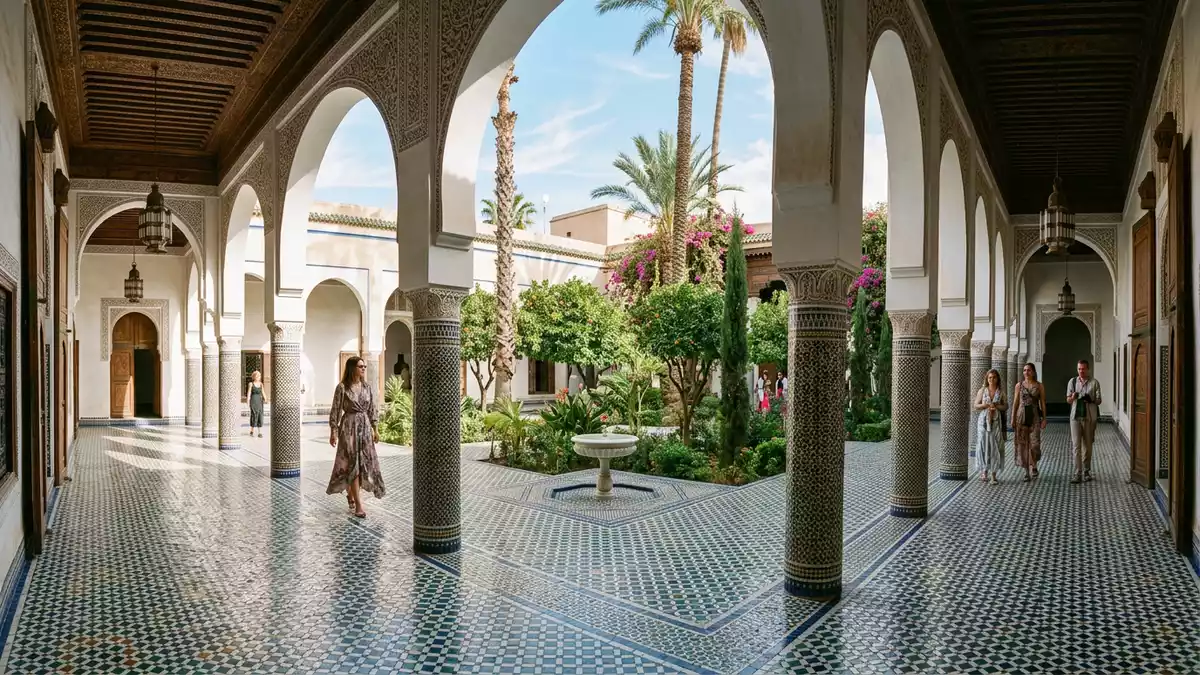
Palais Bahia in Marrakesch is a sprawling 19th?century palace where courtyards, salons and gardens link together in an intricate sequence of spaces, each richly decorated yet carefully contained. Built in phases by the grand viziers Si Moussa and his son Ba Ahmed during the later nineteenth century, it presents Moroccan craftsmanship in wood, plaster, stone and tile on a scale that turns a private residence into an entire architectural landscape.
A palace grown over decades
Palais Bahia is a mid to late nineteenth?century palace complex in the medina of Marrakesch, developed over several decades rather than appearing in a single campaign of construction.mid to late nineteenth?century palace The first phase is closely associated with Si Moussa, a powerful grand vizier under Alawi sultan Muhammad ibn Abd al?Rahman, who commissioned his residence in the 1860s within the historic city.commissioned in the 1860s Later, his son Ba Ahmed, grand vizier to Sultan Moulay Abdelaziz, expanded the complex between 1894 and 1900, knitting together houses and gardens into what became known as Palais Bahia.expanded between 1894 and 1900
The name “Bahia” is linked with the Arabic idea of brilliance or beauty, a label that suits a residence conceived as a showcase for Moroccan courtly life.name meaning brilliance in Arabic Over the second half of the nineteenth century the palace grew to cover several hectares, its rooms and courtyards arranged in an irregular plan that reflects its piecemeal growth rather than a rigid geometric scheme.area of 8 hectares The complex later served as a residence for the French Resident General during the Protectorate period and has since become a museum under the Moroccan Ministry of Culture, but its nineteenth?century layers remain legible in the way the spaces connect.museum under Moroccan Ministry of Culture
Courtrooms, riads and gardens as a walking sequence
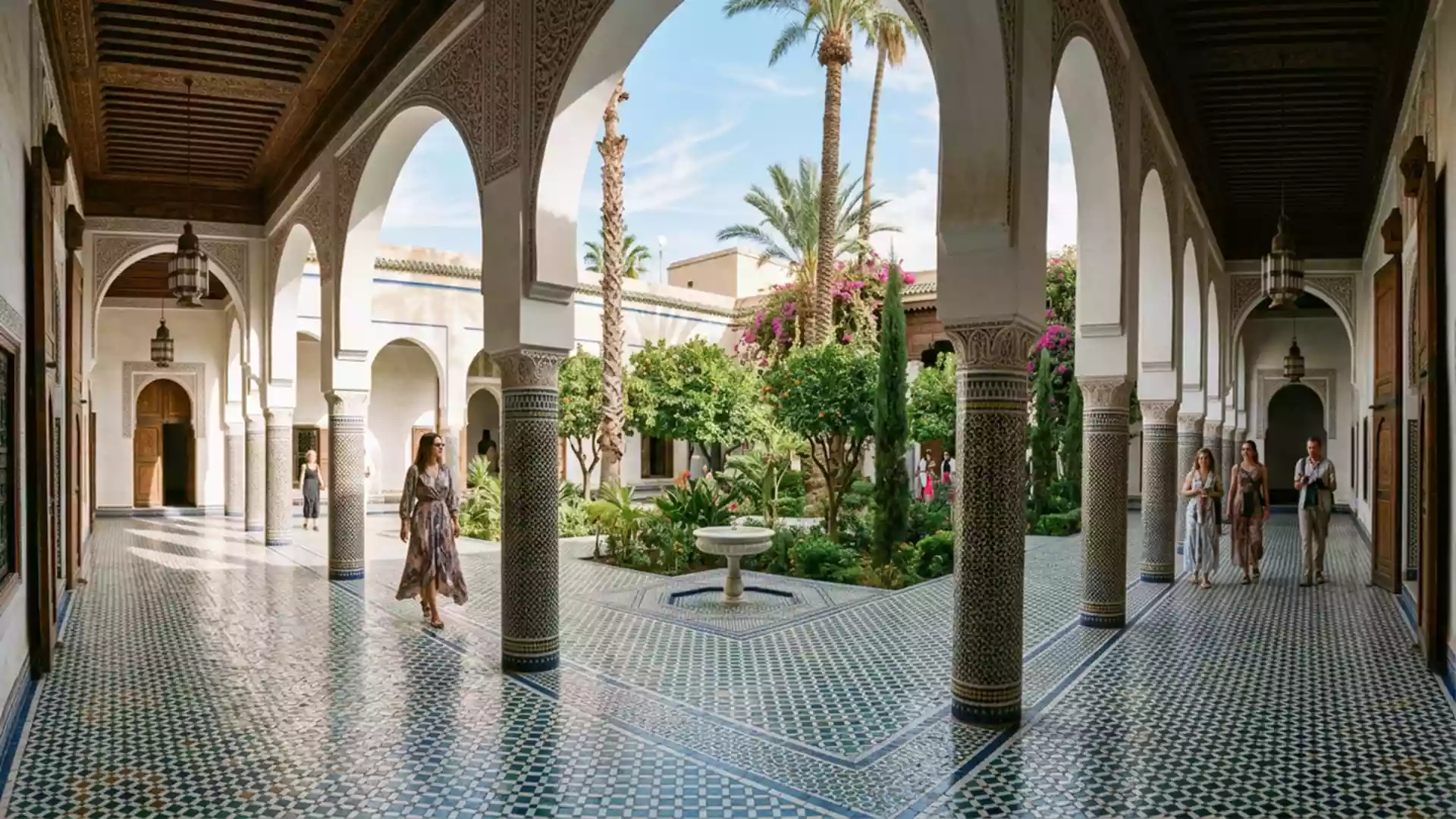
Rather than a single grand hall, Palais Bahia unfolds as a sequence of courtyards, riads and salons, each with its own character yet linked by passages and galleries. Visitors move between planted enclosures and paved courts, with living quarters gathered around them in a pattern rooted in Moroccan domestic architecture.series of courtyards, gardens and salons One part of the complex, known as Dar Si Moussa, reflects the earlier residence of Si Moussa, while later additions by Ba Ahmed extend the ensemble with larger ceremonial spaces and an expanded harem quarter.
The gardens within the palace grounds follow an Andalusian and Moroccan pattern, combining geometric beds, trees and water channels within enclosed walls.gardens covering 8,000 square metres Paths run alongside planted areas, leading towards courts paved in stone where marble fountains and tiled floors create a cooler, shaded atmosphere without relying on overt monumentality. The palace complex has several main courtyards, including a large court flanked by reception rooms and more intimate riad gardens enclosed by galleries; this variety in scale makes walking through Palais Bahia feel like passing through successive thresholds.
Moorish ornament in wood, tile and plaster
The architecture of Palais Bahia is firmly rooted in Moroccan Islamic and Moorish traditions, with extensive use of carved wood, zellij tilework and stucco relief across ceilings, walls and doorways.Moorish and Islamic architecture In the main salons, painted wooden ceilings display complex star patterns and floral motifs in strong colours, while the walls below carry bands of geometric tiles framed by plaster carving. Doors and shutters are made from timber panels, often painted or carved, and mashrabiya screens of delicate latticework divide certain spaces without blocking them entirely.
Materials shift between marble paving, decorative stone elements and brightly coloured ceramic surfaces, but the overall effect remains cohesive because traditional Moroccan craft techniques run through the entire complex.marble, moucharabieh, zellij and stucco Many ceilings and upper walls feature painted woodwork attributed to craftsmen brought from other Moroccan cities such as Fez, integrating regional skills into the viziers’ residence.craftsmen from Fez Ornament extends to the smallest details, from carved inscriptions to floral stucco panels, and frames views out into the courtyards and gardens, where orange trees and other planting form a living counterpart to the geometric decoration.
Visiting Palais Bahia: what travellers from Western Europe should know
- Palais Bahia stands within the historic medina of Marrakesch, south of the main axis linking Jemaa el?Fna with the former Jewish quarter, and is reached on foot through narrow streets.
- Inside the complex, moving between the different courtyards involves walking along stone?paved paths and through galleries, with occasional changes in level and steps between sections.
- The palace lies within Morocco, where the official language is Arabic and the currency is the Moroccan dirham.
- Several other historic sites in Marrakesch’s medina, including the Mellah district and the ruins of the El Badi Palace, stand within walking distance of Palais Bahia.
Searching for Palais Bahia on social platforms
These links open searches for Palais Bahia on each platform.
Frequently asked questions about Palais Bahia
Where is Palais Bahia located in Marrakesch?
Palais Bahia stands within the medina of Marrakesch in Morocco, in the Riad Zitoun area south of Jemaa el?Fna and near the former Mellah.
What should visitors expect inside Palais Bahia?
Visitors encounter a sequence of courtyards, riad gardens and salons, with extensive Moroccan ornament in carved wood, zellij tilework and stucco across ceilings, walls and floors.
What makes Palais Bahia distinctive among Moroccan palaces?
Its development over the later nineteenth century by Si Moussa and Ba Ahmed, its irregular plan of linked courtyards and gardens, and its concentrated Moorish craftsmanship give Palais Bahia a distinctive character.