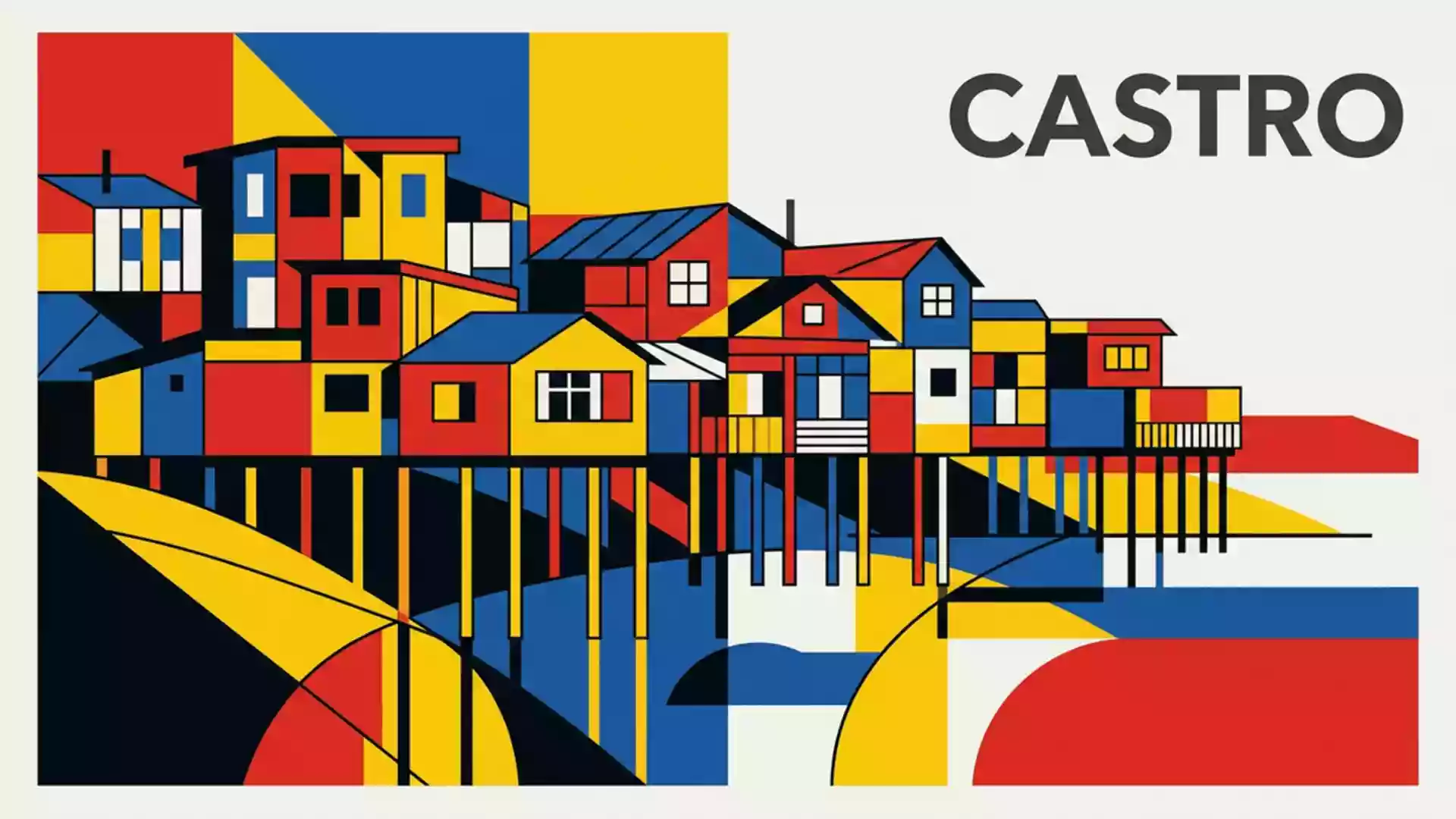
Palafitos de Chiloe, Castro’s timber houses on tidal stilts
Published on 08/28/2026 at 08:28 | Editorial responsibility: Rafael Müller, Editor-in-Chief AD HOC NEWS
Along the shoreline of Castro on the Isla Grande de Chiloé in southern Chile, Palafitos de Chiloe form a continuous band of timber houses raised on wooden piles where the city meets the tides. Emerging in the nineteenth century on this Pacific archipelago, these stilted dwellings turn the edge of Castro into a lived-in waterfront, with homes that look both towards the street grid and towards the channels of Chiloé.
Timber on piles between street and sea
Palafitos de Chiloe are wooden houses set on closely spaced piles driven into the shoreline, creating a pier-like platform that carries entire rows of dwellings above the tidal reach of the water. Their walls and roofs use local timber, including boards and larch tiles, bringing the texture of Chiloé’s forests into an urban waterfront of simple gabled forms.wooden houses and larch tiles From the street, each palafito presents a façade reached by a narrow bridge or walkway crossing the strip of land and services between pavement and piles, so that the house appears almost detached from the conventional block.
On the water side, the houses open towards the canal with an upper terrace that functions as a patio and a lower level aligned with the boats moored beneath the piles, a configuration that has long served fishing work around the changing tides.terrace towards the canal At low tide the piles stand high above exposed ground or mud, emphasising the elevation of the houses, while at high tide the same terraces hang above water in which small boats rise and fall against the timber uprights. The result is a waterfront where living rooms, workshops and balconies sit directly above the tidal zone rather than behind a conventional quay.
Chilote coastal architecture and nineteenth-century origins
The palafito typology belongs to the broader coastal architecture of the Chiloé Archipelago, where wooden construction has developed in dialogue with heavy rainfall, maritime livelihoods and the sheltered inlets that cut into the shores of Isla Grande. In Castro, the capital of the province of Chiloé, these stilt houses gained prominence in the late nineteenth century, when rural communities from the island interior sought space along the urban shoreline and extended the settlement out over the shallow bays.popularised in the late nineteenth century Their structure of piles, beams and timber cladding echoes the techniques used in other Chilote buildings, including churches built in the same period, but here the emphasis is on reaching the water.
These houses relate to a cultural landscape shaped over centuries by indigenous Huilliche communities, Spanish colonisation and later settlers from different nationalities, all linked to fishing, shellfish gathering and coastal trade around Chiloé.houses built over the sea on wooden pillars As timber settlements that sit partly above the sea, palafitos connect their inhabitants directly with the boats tied to the piles, making the step from kitchen or workshop to skiff only a short descent down a ladder. In Castro this relationship between house and water has become part of the city’s identity, reinforcing its role as a coastal centre on the island.
Gamboa, Pedro Montt and the colours of the waterfront
In Castro the Palafitos de Chiloe form recognisable groups along the tidal inlets, particularly in the Gamboa neighbourhood and around Pedro Montt Street and nearby areas such as Lillo.Gamboa and Pedro Montt neighbourhoods The stretch from the port area along the waterfront to the bridge over the Gamboa river carries many of these houses on piles, producing a long sequence of façades above the shoreline. In Gamboa, the stilt houses can be seen across the river from the opposite bank, giving a broad view of their rhythm of roofs and balconies stepping along the water’s edge.
Many palafitos in Castro are painted in strong colours, forming bands of red, green, yellow and other hues that mark each dwelling as distinct along the shared platform above the tide.multicoloured wooden houses on stilts Some of these houses remain private homes for local residents, while others have been converted into small hotels, hostels, cafés, craft shops and restaurants, extending their role from working fishermen’s dwellings to mixed-use waterfront buildings. This combination of elevated timber construction, tidal setting and colour gives the shoreline of Castro a distinctive character when seen from boats, opposite banks or steep streets descending towards the water.
Visiting Palafitos de Chiloe: what travellers from Western Europe should know
- Palafitos de Chiloe stand along the tidal shoreline of Castro on the Isla Grande de Chiloé in southern Chile, with notable clusters in the Gamboa area and around Pedro Montt Street.
- Access to the stilt-house districts involves walking along streets that descend towards the waterfront and along narrow walkways or bridges leading out to the houses above the shoreline.
- Castro lies on the Chiloé Archipelago south-west of Puerto Montt; the town is reached overland and by ferry before continuing by road onto the island.
- English is not an official language in Chile and the currency is the Chilean peso.
- Entry requirements depend on your nationality; UK travellers can check the FCDO travel advice at gov.uk/foreign-travel-advice, Irish travellers the Department of Foreign Affairs at ireland.ie.
Searching for Palafitos de Chiloe on social platforms
These links open searches for Palafitos de Chiloe on each platform.
Frequently asked questions about Palafitos de Chiloe
Where are Palafitos de Chiloe located?
Palafitos de Chiloe stand along the tidal shoreline of Castro on the Isla Grande de Chiloé in southern Chile, particularly in the Gamboa and Pedro Montt areas.
What should visitors expect when walking among the stilt houses?
Visitors encounter rows of timber houses on piles with street-side walkways and water-facing terraces, reached by steep streets and narrow bridges above the shoreline.
What makes Palafitos de Chiloe distinctive compared with other coastal settlements?
Their combination of nineteenth-century timber construction, dual orientation to street and sea, and colourful façades elevated above the tides gives Castro a characteristic lived-in waterfront.