
Osun-Osogbo Sacred Grove, Nigeria’s forest of shrines
Published on 09/10/2026 at 10:47 | Editorial responsibility: Rafael Müller, Editor-in-Chief AD HOC NEWS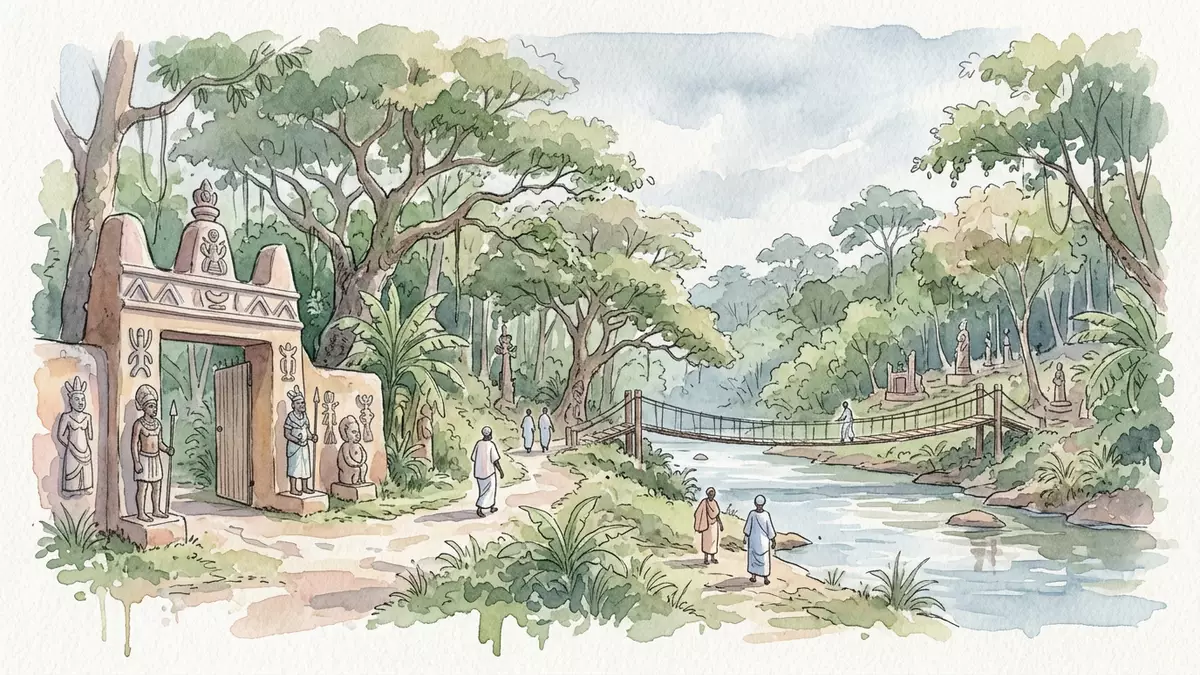
On the outskirts of Osogbo in southwestern Nigeria, Osun-Osogbo Sacred Grove forms a band of riverine forest where shrines, sculptures and footpaths weave through tall trees. Recognised as a UNESCO World Heritage Site in 2005, it is a protected cultural landscape along the Osun River that preserves living Yoruba religious traditions in a dense, undisturbed woodland.
Forest sanctuary along the Osun River
Osun-Osogbo Sacred Grove occupies a stretch of mature forest beside the Osun River just outside Osogbo, the capital of Osun State in southwest Nigeria. The grove extends over about 75 ha (185 acres) of land, bordered and protected as a sacred zone where the river flows through a canopy of native trees.about 75 hectares Within this enclosed forest, footpaths lead from clearings near the entrance down towards the riverbanks, passing shrines, sculptures and ritual spaces set among thick vegetation.
The grove is regarded as the abode of Osun, the Yoruba goddess associated with fertility and fresh water, and as a major shrine for other Yoruba deities. Sacred structures and earthworks are arranged along the river and within the forest, forming a continuous sequence of courtyards, altars and sculptural ensembles that mark the relationship between the river, the trees and Yoruba belief.abode of the goddess of fertility Osun
Yoruba heritage and World Heritage recognition
Osun-Osogbo Sacred Grove lies in territory historically shaped by the Yoruba people and their religious practices, and the site is closely tied to Osogbo’s identity. The grove is several centuries old and belongs to a wider tradition of sacred forests that once ringed many Yoruba settlements at their edges, forming zones of ritual and protection separate from the urban core.several centuries old Osogbo itself is described as having been founded around four centuries ago, and the grove has remained a focus of religious life through the city’s growth.founded some 400 years ago
In 2005, Osun-Osogbo Sacred Grove was inscribed on the UNESCO World Heritage List as a cultural site under criteria (ii), (iii) and (vi), recognising its role in sustaining Yoruba traditions and its combination of natural forest and built shrines.inscribed as a UNESCO World Heritage Site in 2005 This designation highlights the grove as one of Nigeria’s few World Heritage properties and emphasises both the tangible elements – sculptures, sanctuaries and paths – and the intangible practices that continue there.
Shrines, sculptures and ritual spaces
The forest of Osun-Osogbo Sacred Grove is punctuated by shrines built in earth, stone and concrete, many adorned with sculpted figures that draw on Yoruba iconography and more recent artistic collaboration. Within the protected area, shrines and sanctuaries dedicated to Osun and other deities stand along the riverbank and within clearings, some enclosed by low walls or framed by sculptural gateways.shrines, sculptures and sanctuaries Paths and small bridges cross the river at certain points, linking groups of structures and making the water a central axis of movement.
Artworks within the grove include large-scale sculptures integrated into the landscape as guardians, markers or embodiments of particular deities. Some sculptural ensembles frame processional routes or entrances, while others rise among the trees, their forms echoing human and animal shapes known from Yoruba tradition. Fishing, farming and hunting are forbidden within the sacred area, preserving the forest canopy and its fauna and allowing ritual use and artistic expression to remain at the centre.fishing, farming and hunting are forbidden
Visiting Osun-Osogbo Sacred Grove: what travellers from Western Europe should know
- Osun-Osogbo Sacred Grove lies on the outskirts of Osogbo in southwestern Nigeria, along the Osun River and is reached by local roads from the city centre.
The grove is separate from the urban area, with its own entrance near the edge of the forest. - Inside the grove, paths cross uneven ground and run through forest, with steps and short slopes in places.
Some shrines and sculptures sit away from the main routes, requiring walking on natural surfaces. - The official language is English and the currency is the Nigerian naira.
- Entry requirements depend on your nationality; UK travellers can check the FCDO travel advice at gov.uk/foreign-travel-advice, Irish travellers the Department of Foreign Affairs at ireland.ie.
Searching for Osun-Osogbo Sacred Grove on social platforms
These links open searches for Osun-Osogbo Sacred Grove on each platform.
Frequently asked questions about Osun-Osogbo Sacred Grove
Where is Osun-Osogbo Sacred Grove located?
Osun-Osogbo Sacred Grove is beside the Osun River on the outskirts of Osogbo in Osun State, in southwestern Nigeria.
What can visitors expect inside the grove?
Visitors encounter forest paths, shrines and large sculptures arranged along and above the river, creating a continuous sacred landscape under tall trees.
What makes Osun-Osogbo Sacred Grove distinctive?
The grove combines undisturbed riverine forest with active Yoruba religious shrines and art, recognised internationally as a UNESCO World Heritage cultural landscape.


