
Osun-Osogbo Sacred Grove and the forest of Yoruba spirits
Published on 09/12/2026 at 16:17 | Editorial responsibility: Rafael Müller, Editor-in-Chief AD HOC NEWS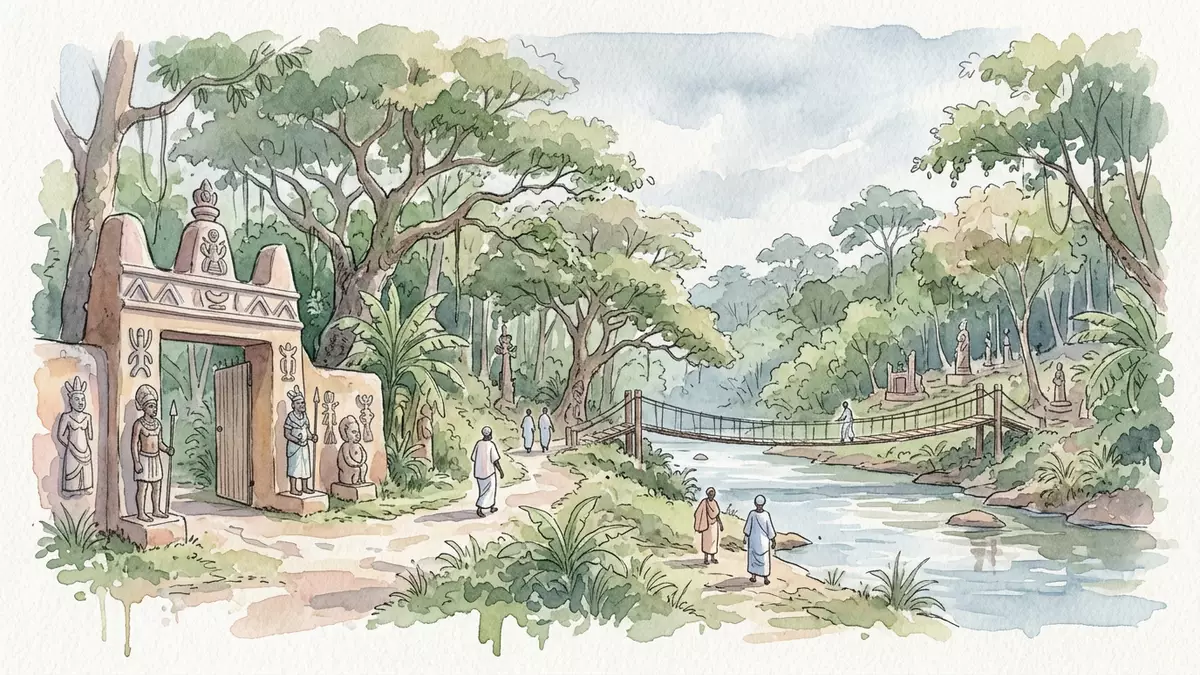
On the outskirts of Osogbo in south-western Nigeria lies Osun-Osogbo Sacred Grove, a ring-fenced stretch of forest along the Osun River where shrines, sculptures and thick vegetation form a single sacred landscape. The grove is recognised as a cultural landscape under the World Heritage Convention and was inscribed on the UNESCO World Heritage List in 2005, reflecting its importance for Yoruba religion and the conservation of primary forest in southern Nigeria.UNESCO World Heritage List entry
Forest, river and sacred groves
Osun-Osogbo Sacred Grove occupies a band of forest along the Osun River, with the river meandering through dense trees and undergrowth on the edge of the city. The protected area covers around 75 ha of ring-fenced forest, with a buffer zone of further land around it, giving the grove a defined boundary within Osogbo’s urban fringe.Osun sacred Grove covers 75 ha Within this forest, paths lead towards clearings where shrines and sanctuaries stand close to the water and among the trees, and the Osun River acts as a central axis around which worship sites are arranged.ring-fenced forest alongside the Osun River
The grove is regarded as the abode of Osun, a Yoruba goddess associated with fertility and the life-giving qualities of water, and many shrines are dedicated to her and other deities from the Yoruba pantheon.abode of Osun, the goddess of fertility The forest itself preserves some of the last remnants of primary high forest in southern Nigeria, with mature canopy, undergrowth and riverbank habitats forming a rare pocket of relatively undisturbed vegetation within a settled region.mature forest canopy covering about 75 hectares
Sculptures, shrines and Yoruba sacred art
Among the trees and along the river, Osun-Osogbo Sacred Grove is marked by shrines, altars and sculptural ensembles that embody Yoruba cosmology in built form. Concrete and other durable materials shape figures of deities, guardian beings and symbolic forms, many of them created during the twentieth century when a wave of artistic activity revived and extended the grove’s sacred structures.sacred grove along the banks of the Osun river The sculptures stand within the forest and beside shrines, integrating contemporary sacred art into an older landscape of ritual sites and river crossings.primary forest that sustains living Yoruba cultural traditions
One of the key figures in this artistic phase was the Austrian-born artist Susanne Wenger, who settled in Osogbo and, together with local collaborators, developed a group of monumental sculptures and shrine complexes within the grove. Her work, sometimes referred to as New Sacred Art, strengthened the physical expression of Yoruba religious ideas along the river, combining sculptural forms, ritual spaces and pathways to reconnect forest, water and worship.Susanne Wenger and New Sacred Art movement These interventions did not replace older shrines but stand alongside them, contributing to the layered character of Osun-Osogbo Sacred Grove as both historical site and continuing place of ritual.
World Heritage status and living traditions
Osun-Osogbo Sacred Grove was inscribed on the UNESCO World Heritage List in 2005 as a cultural landscape under criteria (ii), (iii) and (vi), recognising its combination of forest conservation, artistic creativity and enduring religious practice.inscription in 2005 under criteria (ii)(iii)(vi) The designation identifies the grove as a site where Yoruba traditions remain active, rather than a purely historical monument, and notes both its cultural importance and its environmental significance as protected forest in southern Nigeria.UNESCO World Heritage Site approved in 2005
The grove lies just outside Osogbo, capital of Osun State, in south-western Nigeria, and is reached through access routes from the city towards the riverine forest.Osogbo, Osun State, Nigeria Within its boundaries, ritual specialists, worshippers and visitors share paths and open spaces, and the grove forms part of a wider religious landscape that links the city to ancestral practices along the Osun River. Its recognition as a World Heritage cultural landscape underscores that the combination of sacred forest, river and shrines constitutes a single piece of heritage, connecting ecological conservation with the continuity of Yoruba religious life.organically evolved cultural landscape
Visiting Osun-Osogbo Sacred Grove: what travellers from Western Europe should know
- Osun-Osogbo Sacred Grove lies on the outskirts of Osogbo in south-western Nigeria, with access routes leading from the city towards the forested banks of the Osun River.
- Inside the grove, many paths are unpaved and pass through forest terrain, with uneven ground, roots and occasional steps around shrines and river crossings.
- The Osun River runs through the grove, and several ritual areas and shrines stand close to the water, so some parts of a visit involve walking near riverbanks.
- The official language is English and the currency is the Nigerian naira.
- Entry requirements depend on your nationality; UK travellers can check the FCDO travel advice at gov.uk/foreign-travel-advice, Irish travellers the Department of Foreign Affairs at ireland.ie.
Searching for Osun-Osogbo Sacred Grove on social platforms
These links open searches for Osun-Osogbo Sacred Grove on each platform.
Frequently asked questions about Osun-Osogbo Sacred Grove
Where is Osun-Osogbo Sacred Grove located?
Osun-Osogbo Sacred Grove lies on the outskirts of Osogbo, capital of Osun State in south-western Nigeria, along the banks of the Osun River.
What can visitors expect inside the grove?
Visitors encounter forest paths, shrines and sculptural ensembles among mature trees and along the river, with ritual spaces integrated into the natural landscape.
What makes Osun-Osogbo Sacred Grove distinctive?
Its combination of primary forest, active Yoruba religious practice and twentieth-century sacred sculptures, recognised as a UNESCO World Heritage cultural landscape, makes it distinctive.


