
Osaka-jo: stone walls and a reconstructed keep above Osaka
Published on 08/31/2026 at 15:15 | Editorial responsibility: Rafael Müller, Editor-in-Chief AD HOC NEWS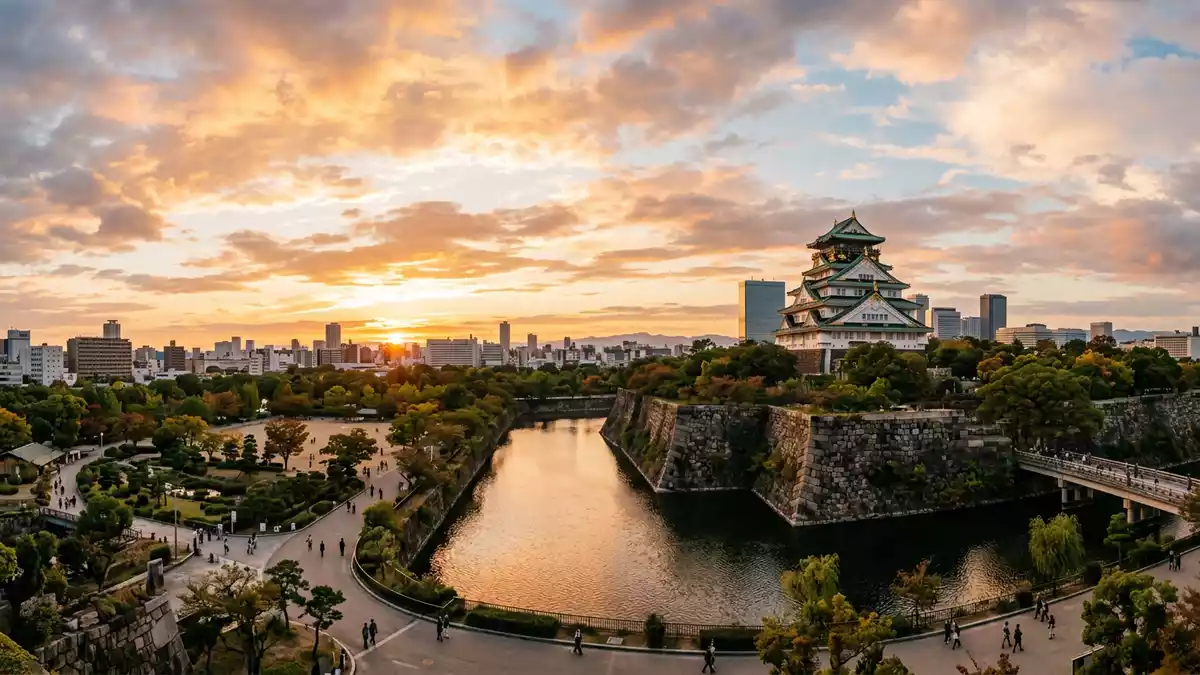
Osaka-jo, better known in English as Osaka Castle, is a historic fortress in central Osaka whose massive stone walls and reconstructed main tower rise above a wide expanse of moats and parkland. The castle traces its origins to Toyotomi Hideyoshi in 1583, yet the main tower visitors see is a ferroconcrete reconstruction completed in 1931 that anchors the surrounding grounds.
Osaka-jo on the Uemachi Plateau
Osaka-jo stands on the Uemachi Plateau in Ch??-ku, slightly east of Osaka’s modern commercial core, on a site that has been central to the city’s history for centuries.Uemachi Plateau in Ch??-ku The plateau lifts the castle above the low-lying districts around it, giving the stone ramparts and green interior an elevated setting in the urban landscape. Around the fortress spreads Osaka Castle Park, a public green space covering more than 100 hectares, enclosed by moats and stone walls that form a clear boundary between the historic core and the city streets beyond.park covering 105.6 hectares
The location once belonged to Ishiyama Hongan-ji, a temple complex associated with the J?do Shinsh? Buddhist sect, before warrior leaders turned it into a stronghold.site of the present Osaka Castle Toyotomi Hideyoshi chose this ground when he began building his new fortress in 1583, seeking a central base for his authority in a Japan moving towards political unification.commenced construction of Osaka Castle in 1583 The choice left the castle close to river routes and coastal access while still physically distinct from the surrounding town.
From Toyotomi fortress to Tokugawa stone walls
The first Osaka-jo was the work of Toyotomi Hideyoshi, the sixteenth-century warlord who helped unify Japan after the turbulence of the Sengoku period.Toyotomi Hideyoshi commenced construction Construction began in 1583 and produced a flatland castle with a multi-storey main keep, inner compounds on raised terraces and moats encircling the complex.Toyotomi Hideyoshi built Osaka-jo in 1583 For a time the Toyotomi stronghold stood as one of the most elaborate fortresses in the country, with high walls and guarded approaches that made direct assault difficult.
Osaka-jo later became a focal point in the conflicts that established the Tokugawa shogunate, and the original Toyotomi keep fell in the fighting of 1615.fell to the Tokugawa forces in 1615 Tokugawa Hidetada, the second shogun, oversaw a major reconstruction in the early Edo period, enlarging the moats and stone walls and rebuilding the main keep to create an even grander castle.constructed in the era of Edo That seventeenth-century keep was destroyed by lightning and fire in 1665, leaving the castle without a central tower for many years while its gates, turrets and stone ramparts continued to define the site.struck by lightning and burned to the ground
The 1931 main tower and museum
The main tower visitors recognise at Osaka-jo is a twentieth-century reconstruction in ferroconcrete, completed in 1931 and restored internally in the 1990s.Year Reconstructed 1931 (concrete) It rises above the inner bailey with five visible levels and additional stories within, crowned by green roofs and gilded ornamental elements that echo the decoration of earlier keeps.Japanese castle in Ch??-ku Inside, the tower functions as a museum devoted to Toyotomi Hideyoshi and the castle’s history, with exhibits arranged floor by floor up a combination of staircases and lifts.
Beneath and around the tower, the Edo-period stone structures remain integral to the character of Osaka-jo. The complex retains multiple yagura (turrets), gates such as Otemon and Sakuramon, storehouses and wells that date to the seventeenth century and are designated Important Cultural Properties.Important Cultural Properties Visitors move from broad open courts into more confined passages between high walls, passing over bridges that span water-filled moats towards the central keep. The combination of older stonework and the 1931 tower gives the castle a layered profile, with distinct periods of Japanese history visible in a single walk across the grounds.
Visiting Osaka-jo: what travellers from Western Europe should know
- Osaka-jo stands at 1-1 Osakajo in Ch??-ku, Osaka, and is reached by local rail lines at Osakajokoen Station on the JR Osaka Loop Line and by Osaka Metro stations including Tanimachi 4-chome and Morinomiya.
- Reaching the inner areas of Osaka-jo involves crossing bridges over moats, walking on stone and paved surfaces and, for the main tower, climbing internal staircases between museum floors.
- The official language is Japanese and the currency is the yen.
- Entry requirements depend on your nationality; UK travellers can check the FCDO travel advice at gov.uk/foreign-travel-advice, Irish travellers the Department of Foreign Affairs at ireland.ie.
Searching for Osaka-jo on social platforms
These links open searches for Osaka-jo on each platform.
Frequently asked questions about Osaka-jo
Where is Osaka-jo and what surrounds it?
Osaka-jo is in Ch??-ku, Osaka, Japan, set within a large park bordered by moats and stone walls east of the city’s main commercial districts.
What can visitors expect on a visit to Osaka-jo?
Visitors encounter high stone ramparts, bridges over moats, Edo-period gates and turrets, and a 1931 ferroconcrete main tower that houses a museum across several floors.
What makes Osaka-jo distinctive among Japanese castles?
Osaka-jo combines Toyotomi and Tokugawa-era stone fortifications with a twentieth-century reconstructed keep, presenting multiple historical layers within a single castle complex in central Osaka.


