
Orszaghaz and the neo-Gothic parliament on the Danube
Published on 09/14/2026 at 09:19 | Editorial responsibility: Rafael Müller, Editor-in-Chief AD HOC NEWS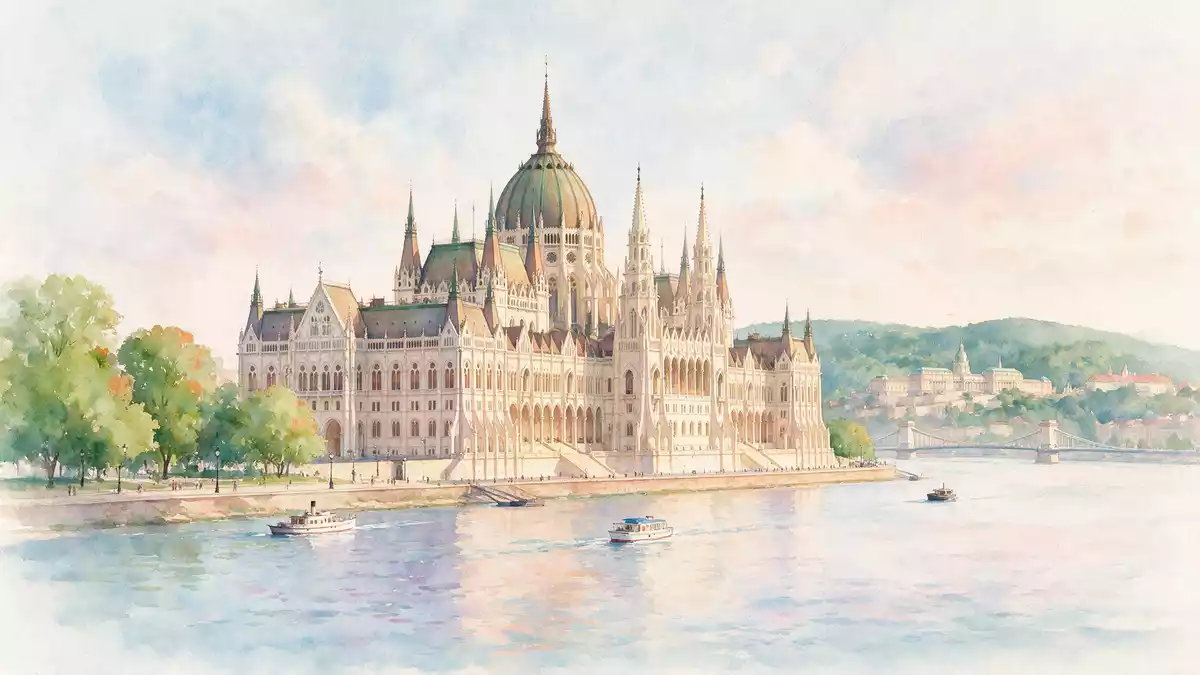
Orszaghaz, the Hungarian Parliament Building in Budapest, turns Hungary’s seat of legislature into a monumental neo-Gothic complex aligned with the Danube embankment. Completed in the early twentieth century and designed by the Hungarian architect Imre Steindl, it anchors Kossuth Lajos tér on the Pest bank of the river as a stone landmark tied to the city’s riverfront panorama.
Neo-Gothic stone, dome and riverfront
Orszaghaz stands on the eastern bank of the Danube in Budapest, its long front facing the water and forming part of the urban panorama recognised as a World Heritage river landscape.Hungarian Parliament Building The building occupies Kossuth Lajos tér in the historic district of Lipótváros, set parallel to tram tracks and promenades that follow the line of the embankment.Orszaghaz leží v Budapešti
In architectural terms Orszaghaz is a neo-Gothic structure with an eclectic composition, tying pointed detailing and a rhythm of towers to a centrally placed dome that rises above the surrounding wings.neogótikus, eklektikus The building is constructed in stone and laid out with symmetrical fronts along the river and the square, giving the seat of the National Assembly a monumental presence on the Pest side of Budapest.Completed in 1902 and designed by Imre Steindl
A late nineteenth-century seat of the National Assembly
Construction of Orszaghaz began in 1885, during the late nineteenth century, when Budapest was taking shape as a capital city on the Danube.Construction began in 1885 Work on the complex ran into the twentieth century, and the building was completed and opened for parliamentary use in 1902, giving Hungary a purpose-built legislative home in stone at the edge of the river.???1902?
Imre Steindl, the architect behind Orszaghaz, worked within a European context that drew on Gothic revival precedents while combining them with Baroque planning and Neo-Renaissance elements.Stylistically, the exterior facade is heavily influenced by Neo-Gothic architecture The result is a parliament that functions as the seat of the National Assembly of Hungary, with debating chambers, committee rooms and offices arranged within its extensive wings and under its central dome.home to Hungary’s legislative body
Square, river and national symbols inside
Orszaghaz occupies the northern side of Kossuth Lajos tér, a civic square framed by government buildings and cultural institutions on the Pest side of Budapest.Kossuth Lajos Square location The square opens out towards the riverfront, where the building’s long facade faces across the Danube to the Buda Castle area and the hills beyond, tying the country’s legislative seat to a wider cityscape of bridges, slopes and historic quarters.Parlamentsgebäude in Budapest
Within Orszaghaz, parliamentary functions share space with symbols of state. The building houses the debating chambers of the National Assembly, meeting rooms and offices, and also keeps the Hungarian Holy Crown under guarded display inside its interior.the Holy Crown Together these elements turn Orszaghaz into both a working parliament and a repository of national heritage, set along the Danube where its dome and towers are visible from many points across Budapest.
Visiting Orszaghaz: what travellers from Western Europe should know
- Orszaghaz stands on Kossuth Lajos tér on the Pest bank of the Danube in central Budapest, reached by tram routes along the riverfront and by metro line M2 at Kossuth Lajos tér station.
- The building fronts the river with a broad paved embankment and occupies a city square, so approaches on foot involve urban pavements, steps around the terraces and level routes across Kossuth Lajos tér.
- Nearby landmarks include the Buda Castle area across the Danube and other government buildings and museums around Kossuth Lajos tér on the Pest side.
- The official language is Hungarian and the currency is the forint.
Searching for Orszaghaz on social platforms
These links open searches for Orszaghaz on each platform.
Frequently asked questions about Orszaghaz
Where is Orszaghaz located in Budapest?
Orszaghaz stands on Kossuth Lajos tér in the Lipótváros district on the Pest side of Budapest, on the eastern bank of the Danube.
What can visitors expect when they come to Orszaghaz?
Visitors encounter a large neo-Gothic parliament complex with a central dome, stone facades along the river and a civic square framed by government buildings.
What makes Orszaghaz distinctive among European parliaments?
Its combination of neo-Gothic architecture, a prominent riverside setting on the Danube and its role as the seat of Hungary’s National Assembly gives Orszaghaz a distinctive profile.


