
Opera Garnier, Paris’s gilded opera palace
Published on 09/18/2026 at 13:26 | Editorial responsibility: Rafael Müller, Editor-in-Chief AD HOC NEWS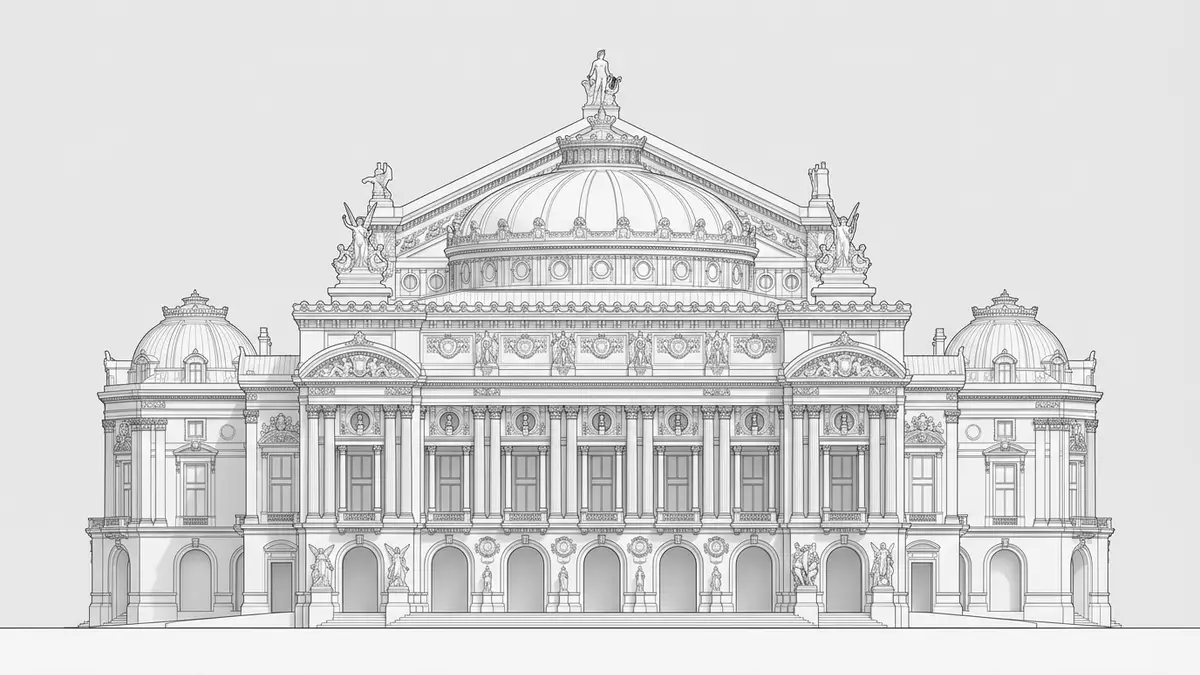
Opera Garnier, also known as the Palais Garnier, is the grand nineteenth?century opera house that anchors Place de l’Opéra in central Paris. Designed by Charles Garnier and inaugurated in 1875, its gilded interiors and theatrical spaces turn a working theatre into a palace of performance and promenade.
Napoleon III’s opera house and Charles Garnier’s design
The story of Opera Garnier begins under the Second Empire, when Emperor Napoleon III commissioned a new opera house as part of Baron Haussmann’s remaking of Paris in the mid?nineteenth century.Napoleon III ordered its construction An open competition launched in 1861 selected the young architect Charles Garnier, whose winning design combined an innovative iron framework with a richly historicist envelope.Charles Garnier won the competition in 1861
Construction of the new opera house extended from the early 1860s until its official opening in January 1875, delayed by technical challenges and the political upheavals of the Franco?Prussian War and the fall of the Empire.The building opened on 5 January 1875 Opera Garnier’s style is often described as eclectic, drawing on Baroque, Renaissance and classical references within the broader Napoleon III and Second Empire idiom.Its architecture belongs to the Napoleon III style
Facade, auditorium and stage: a theatre as monument
Approached from the surrounding boulevards, Opera Garnier presents a deep facade articulated by paired columns, sculpted groups and allegorical figures, crowned by its distinctive dome and flanking pavilions.The opera house stands at Place de l’Opéra The exterior’s gilded elements and statuary signal the building’s dual identity as both a national institution and a showpiece of Second Empire architecture.
Inside, the main auditorium follows the Italian horseshoe tradition, with tiers of boxes and balconies focusing attention on the stage.The theatre has an Italian?style stage At the time of its construction this stage was among the largest in the world, measuring around 49 m (161 ft) in width and 26 m (85 ft) in depth, with a height of about 72 m (236 ft) from the stage to the roof.The stage dimensions underline its scale Beneath and behind it lie extensive back?of?house spaces, reflecting the building’s role in staging opera and ballet on a grand scale.
The Grand Staircase and the gilded foyer
For many visitors, the ceremonial route into Opera Garnier is as memorable as any performance. The Grand Staircase rises within a volume of marble, sculpture and balustrades, framed by clustered columns and richly painted surfaces.The building was conceived as a total work of art This space emphasises procession, providing vantage points from landings and galleries where visitors can look across the hall and into adjoining salons.
Above the main level runs the Grand Foyer, a long gilded hall often compared in ambition to the Hall of Mirrors at Versailles.The Grand Foyer is a gilded hall It measures about 54 m (177 ft) in length, 13 m (43 ft) in width and 18 m (59 ft) in height, occupying the full width of the building’s main level.Its dimensions are precisely documented Mirrors, chandeliers and painted ceilings line this room, turning intermissions and intervals into occasions for strolling and conversation.
Opera Garnier in the fabric of Paris
Opera Garnier stands in the 9th arrondissement of Paris, on Place de l’Opéra, at the meeting point of several Haussmann?era boulevards.Its address is Place de l’Opéra, 75009 Paris The urban setting reflects the same nineteenth?century transformation as the building itself, with broad streets framing long views towards its facade and dome.
Since the opening of Opéra Bastille in 1989, Opera Garnier has hosted opera less frequently, serving largely as a venue for ballet and as a historic building open for visits.Its role shifted after Opéra Bastille opened For travellers, this shift means the building can be experienced both as a functioning theatre and as an architectural landmark where the foyers, staircases and auditorium are central attractions.
Visiting Opera Garnier: what travellers from Western Europe should know
- Opera Garnier stands on Place de l’Opéra in the 9th arrondissement of Paris and is reached easily by Paris Métro services that stop at Opéra station.
- Inside, the ceremonial route up the Grand Staircase includes broad flights and landings; some upper foyers and boxes are reached by additional staircases without lifts.
- The building’s location amid Haussmann?era boulevards places it within walking distance of the Galeries Lafayette and Printemps department stores and the Théâtre des Bouffes?Parisiens.
- France’s official language is French and the currency is the euro.
Searching for Opera Garnier on social platforms
These links open searches for Opera Garnier on each platform.
Frequently asked questions about Opera Garnier
Where is Opera Garnier in Paris?
Opera Garnier stands on Place de l’Opéra in the 9th arrondissement, a central district of Paris shaped by Haussmann?era boulevards.
What can visitors expect inside Opera Garnier?
Visitors encounter grand ceremonial spaces such as the marble Grand Staircase, the gilded Grand Foyer and an Italian?style auditorium with elaborate decoration.
What makes Opera Garnier distinctive among opera houses?
Its combination of Second Empire eclectic architecture, large nineteenth?century stage dimensions and richly gilded interiors gives Opera Garnier a palace?like character.


