
Opera Garnier and the theatre of Parisian colour
Published on 09/23/2026 at 18:03 | Editorial responsibility: Rafael Müller, Editor-in-Chief AD HOC NEWS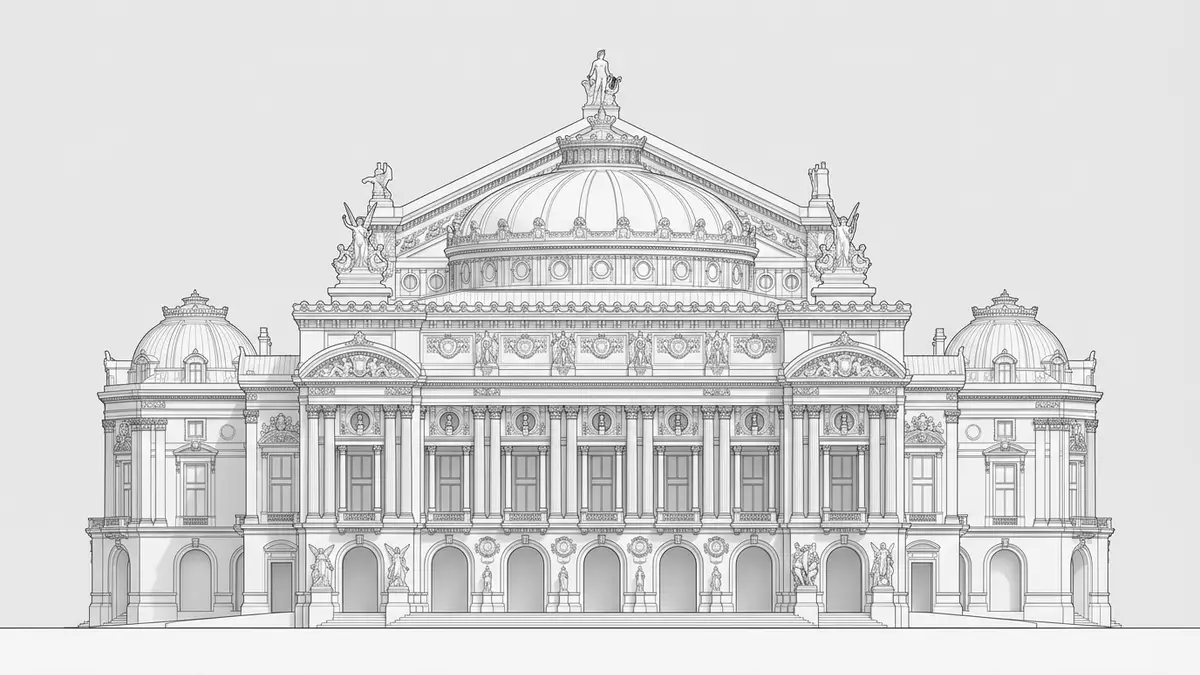
Opera Garnier rises at Place de l’Opéra as a theatre whose public rooms are almost as elaborate as its auditorium. Designed by Charles Garnier and inaugurated on 5 January 1875, it is a defining building of nineteenth-century Paris.
Its architecture brings together grand staircases, marble, gilded ornament, sculpture and painted surfaces. The stage is only one part of the building’s visual composition.
Opera Garnier as an architectural composition
Charles Garnier won the competition for the new Paris Opera in 1861. The building belongs to the Second Empire tradition and is associated with the Beaux-Arts style, combining classical planning with Baroque, Renaissance and other historical references.
Its exterior presents a broad stone façade with columns, sculptures and coloured materials. The central entrance is framed by an elaborate arrangement of architectural detail, while the roof carries sculptural groups and a golden figure of Apollo with a lyre.
The Opera Garnier’s scale is substantial. The building measures about 173 metres in length and 125 metres in width, with a total area of roughly 11,237 square metres. building dimensions are part of its architectural identity.
From grand staircase to painted ceiling
The interior is organised around ceremonial spaces, including the Grand Foyer, the Grand Staircase, salons and the auditorium. The Grand Staircase uses different marbles, balustrades and sculptural decoration across a large vertical hall.
At the top, the Grand Foyer extends as a long gallery lined with mirrors, gilded surfaces, chandeliers and painted panels. Its decoration belongs to the theatrical culture of the Second Empire, when an opera house also functioned as a formal public interior.
The auditorium has a horseshoe plan, red seating and a large painted ceiling. The ceiling painting seen above the audience was created by Marc Chagall in 1964, placing a twentieth-century work within Garnier’s nineteenth-century decoration.
The contrast between the older architectural envelope and Chagall’s vivid colours is one of the building’s clearest visual features. Opera Garnier therefore contains several artistic periods without losing the unity of its theatrical design.
A Paris opera house with several lives
The theatre opened under the French Third Republic, although its project began during the reign of Napoleon III. Charles Garnier supervised the building work through a period that included the Franco-Prussian War, political upheaval and the transition from Empire to Republic.
Opera Garnier was created for the Paris Opera and remains connected with opera, ballet and concerts. Its spaces also include a museum-library, rehearsal areas and workshops, giving the building functions beyond the auditorium.
The theatre entered literary culture through Gaston Leroux’s 1910 novel The Phantom of the Opera. The novel’s setting is fictional, but its use of the opera house helped attach subterranean passages, boxes and hidden rooms to the building’s public image.
The building’s historical importance lies in the combination of performance and architecture. A visit concerns the auditorium, yet also the staircase, foyer, decorative programme and the relationship between movement and display across the interior.
Visiting Opera Garnier: what travellers from Western Europe should know
- Opera Garnier is at Place de l’Opéra in the ninth arrondissement of Paris. Paris Métro stations Opéra, Havre-Caumartin and Madeleine serve the surrounding district.
- The building is in a dense central neighbourhood, with pavements, road crossings and a large interior staircase. Much of the visit takes place on foot across marble floors and between different levels.
- The official language is French and the currency is the euro.
- Nearby landmarks include the Boulevard Haussmann department stores, Place Vendôme and the Tuileries district.
Searching for Opera Garnier on social platforms
These links open searches for Opera Garnier on each platform.
Frequently asked questions about Opera Garnier
Where is Opera Garnier?
Opera Garnier is at Place de l’Opéra in central Paris, within the ninth arrondissement. The building stands close to the Boulevard Haussmann shopping district.
What can visitors expect inside?
The interior includes a grand staircase, the Grand Foyer, salons and an ornate auditorium. Marble, gilding, sculpture, mirrors and painted decoration appear throughout the public rooms.
What makes Opera Garnier distinctive?
Its distinctive character comes from the scale of its theatrical interiors and the combination of Charles Garnier’s nineteenth-century design with Marc Chagall’s 1964 ceiling painting.


