
Opera Garnier and the spectacle of Second Empire Paris
Published on 08/31/2026 at 17:45 | Editorial responsibility: Rafael Müller, Editor-in-Chief AD HOC NEWS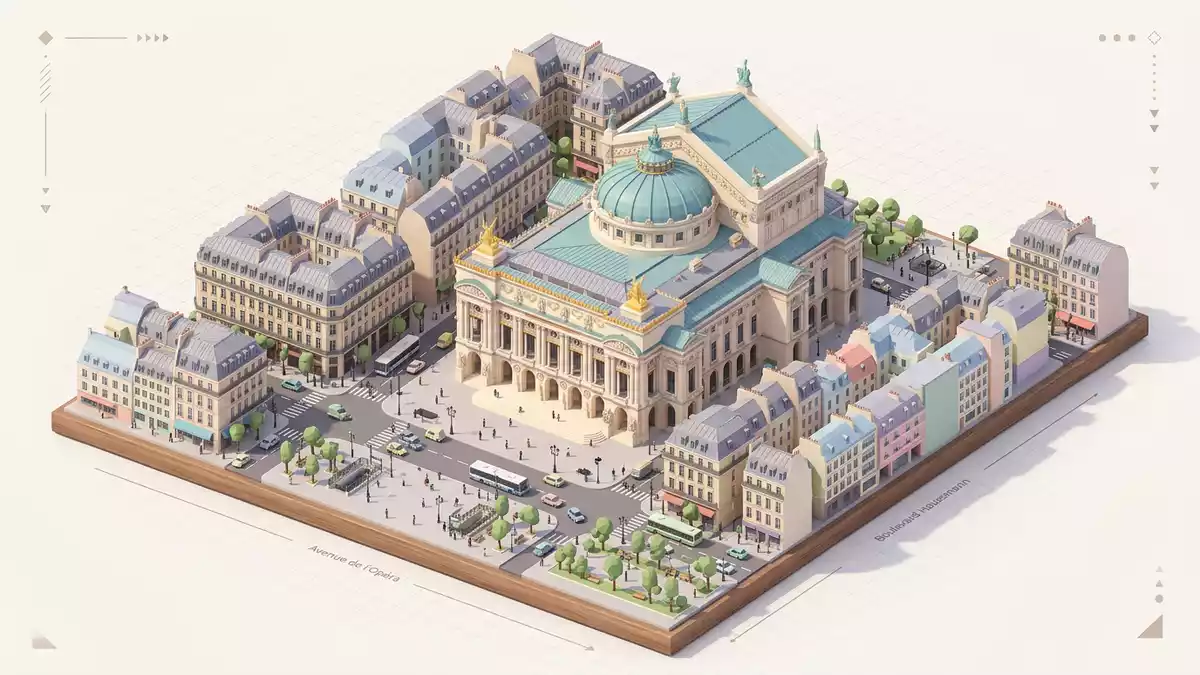
Opera Garnier, also known as the Palais Garnier, is the grand opera house that anchors Place de l’Opéra in central Paris, embodying the theatrical splendour of the nineteenth century. Commissioned under Emperor Napoleon III and designed by Charles Garnier, it was inaugurated in 1875 as the flagship home of the Paris Opera, and its gilded façades and lavish interiors still frame one of the most extravagant architectural experiences in the city.
A palace for opera in nineteenth?century Paris
Opera Garnier stands in the 9th arrondissement on Place de l’Opéra, with its main front aligned to Boulevard des Capucines, where its façades dominate a crossroads of major Haussmannian boulevards.Boulevard des Capucines The building was commissioned by Napoleon III as part of the Second Empire reshaping of Paris associated with Baron Haussmann, replacing the earlier opera house in Rue Le Peletier that had been destroyed by fire in the 1870s.theatre Le Peletier Charles Garnier, a relatively young architect at the time, won the 1861 competition to design the new opera house, and the project became closely associated with his name and vision.competition to design a new imperial opera house
Construction of Opera Garnier began in the early 1860s and extended into the 1870s, encompassing the fall of the Second Empire and the beginnings of the Third Republic.built for the Paris Opera from 1861 to 1875 The building was inaugurated on 5 January 1875, marking the formal transfer of the institution into its new home.inaugurated on 5 January 1875 For more than a century it served as the principal theatre of the Paris Opera and its ballet company, a role it maintained until the opening of Opéra Bastille in the late twentieth century, after which Palais Garnier became particularly associated with ballet and with public visits to its historic spaces.
Second Empire opulence on the façade
The exterior of Opera Garnier is one of the clearest expressions of Second Empire architecture, combining classical symmetry with a profusion of sculptural detail and gilded ornament. The main façade presents a rhythmic sequence of paired columns, porticoes and statuary, crowned by a heavy entablature and a balustrade lined with figures representing allegories of music, dance and drama.architecture éclectique and style Second Empire Above the cornice, groups of winged figures and decorative elements rise against the skyline, while gilded highlights catch the light on domes and sculptural features, reinforcing the building’s palatial character.
The façades around the building continue this elaborate treatment, with grand arches leading into the loggias, sculpted busts of composers set into niches, and rich stone carving across pediments and spandrels. The composition integrates different architectural influences—classical orders, Renaissance revival motifs and Baroque richness—into a single theatrical whole that reflects the eclectic taste of the nineteenth century.eclectic style of the Second Empire The exterior also announces the building’s function through inscriptions and sculpted references to the Académie Nationale de Musique, linking Opera Garnier visually to the wider history of opera in France.
Inside the theatre of spectacle
Beyond the main entrance, Opera Garnier opens into a sequence of interiors designed as much for social display as for musical performance. The ceremonial staircase rises from the lower vestibule to the grand foyers, framed by polished stone, balustrades and sculpted newel figures, and lit by ornate chandeliers. This space is arranged as a wide, sweeping volume that allows broad views across the levels and balconies, turning the ascent to the auditorium into part of the spectacle of a visit.
The Grand Foyer runs parallel to the main façade as a long, richly decorated hall, with walls and ceilings covered in gilded mouldings, paintings and mirrors that extend the apparent depth of the room. Here, ceiling compositions and wall panels depict scenes related to music and performance, and the detailing is dense enough that individual motifs—harps, masks, laurel crowns—emerge only on closer inspection.grandiose setting inspired by earlier theatres and villas The auditorium itself, designed in the Italian tradition with tiers of boxes surrounding the stage and parterre, provides a contained but ornate performance space, where red seating, decorative plasterwork and a monumental chandelier contribute to the layered visual experience.
Visiting Opera Garnier: what travellers from Western Europe should know
- Opera Garnier is located on Place de l’Opéra in the 9th arrondissement of Paris, with its principal façade on Boulevard des Capucines, close to several Métro stations and major boulevards.
- Access to the main interior spaces involves staircases and level changes, including the large ceremonial staircase and smaller flights leading to foyers and auditorium boxes.
- The building stands within a dense urban fabric of nineteenth?century streets and avenues; nearby landmarks include Galeries Lafayette and other grand department stores in the same district.
- France’s official language is French and the currency is the euro.
Searching for Opera Garnier on social platforms
These links open searches for Opera Garnier on each platform.
Frequently asked questions about Opera Garnier
Where is Opera Garnier located in Paris?
Opera Garnier stands on Place de l’Opéra in the 9th arrondissement, with its principal front on Boulevard des Capucines, amid Haussmann?era boulevards.
What can visitors expect inside Opera Garnier?
Visitors encounter a sequence of richly decorated interiors, including the ceremonial staircase, the Grand Foyer and the historic auditorium, all designed with elaborate nineteenth?century ornament.
What makes Opera Garnier distinctive among opera houses?
Opera Garnier is distinctive for its Second Empire eclectic style, combining a grand palace?like exterior with lavish interiors that integrate architecture, sculpture and painting into a single theatrical composition.


