
Opera Garnier and the layered grandeur of Paris
Published on 09/09/2026 at 19:21 | Editorial responsibility: Rafael Müller, Editor-in-Chief AD HOC NEWS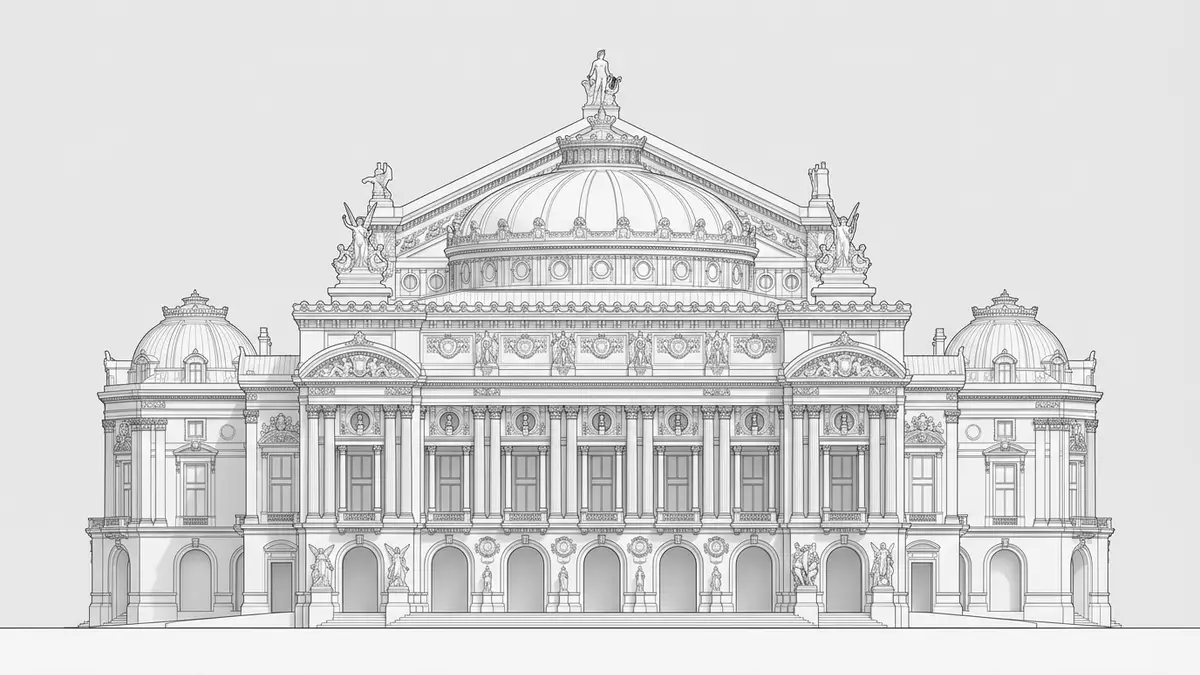
Opera Garnier in Paris is a 19th-century opera house by Charles Garnier, opened in 1875 and set at the Place de l’Opéra. Its appeal lies in the contrast between a monumental exterior and an interior of staircases, foyers and public rooms.
Charles Garnier’s Paris opera house
The building was commissioned for the Paris Opera during the Second Empire and remains one of the clearest statements of Charles Garnier’s work. It is also known as the Palais Garnier, and its long, formal name still belongs to the building’s identity.
The house took shape between 1861 and 1875 and belongs to the Napoleon III style, with classical, baroque and renaissance references woven into a highly decorated facade. Its status as a monument historique has been formally recorded since 1923monument historique. The most visible impression is not restraint but accumulation: sculpted groups, gilded figures and a facade that treats ornament as part of the architecture.
Rooms, stairs and public space
Inside, the building opens into a sequence of stairwells, galleries and salons that turn circulation into part of the architecture. The grand staircase is a white marble structure with red and green marble balustrades, and the grand foyer is a long reception hall with gilded surfaces and painted ceilingsgrand staircase.
The auditorium keeps the horseshoe form associated with Italian opera houses, and the ceiling carries Marc Chagall’s 1964 painting. Beneath that, the interior still reads as a theatre of public display as much as a performance space, with foyers, lounges and the museum-library arranged around the main house. The stage building and public rooms together make the site feel less like a single hall than a small architectural world.
Decoration, materials and scale
Opera Garnier is especially striking for the range of materials used across its surfaces. Marble, stone, bronze, gilt decoration and painted ceilings create a dense interior and an equally worked exterior, while the main facade presents sculpture alongside architectural order.
The building measures 154.9 m (508 ft) in length, 101.2 m (332 ft) at the east and west pavilions, and 56 m (184 ft) to the apex of the stage flytower154.9 m. Its scale is part of the experience: the house reads as an urban palace rather than a simple theatre. That effect is reinforced by the sequence of pavilions, loggias and the great stair that breaks the building into visible layers.
Visiting Opera Garnier: what travellers from Western Europe should know
- The opera house stands at the Place de l’Opéra in the 9th arrondissement of Paris. It is served by the Opéra station and several central Paris bus routes.
- The grand staircase, foyers and auditorium involve broad internal stairways and large rooms. The house presents a formal sequence of public spaces rather than a single gallery.
- Opera Garnier houses the Bibliothèque-Musée de l’Opéra de Paris. The building therefore combines a performance venue with archival and museum functions.
- The auditorium keeps a horseshoe plan, while the exterior carries sculpture and decorative stonework across its main elevations. These features are central to the building’s identity.
Searching for Opera Garnier on social platforms
These links open searches for Opera Garnier on each platform.
Frequently asked questions about Opera Garnier
Where is Opera Garnier?
Opera Garnier is at the Place de l’Opéra in Paris, in the 9th arrondissement. It sits within the city’s central theatre and shopping district.
What does a visit include?
The building brings together the grand staircase, foyers, auditorium and the museum-library. Its interior is as much about rooms and routes as about the stage itself.
What makes Opera Garnier distinctive?
Its distinction lies in the combination of Charles Garnier’s 1875 design, the Napoleon III style and the layered use of ornament, marble and sculpture. The result is a theatre that reads as an architectural ensemble rather than a single auditorium.


