
Opera Garnier, a theatrical palace of stone and light
Published on 09/14/2026 at 10:17 | Editorial responsibility: Rafael Müller, Editor-in-Chief AD HOC NEWS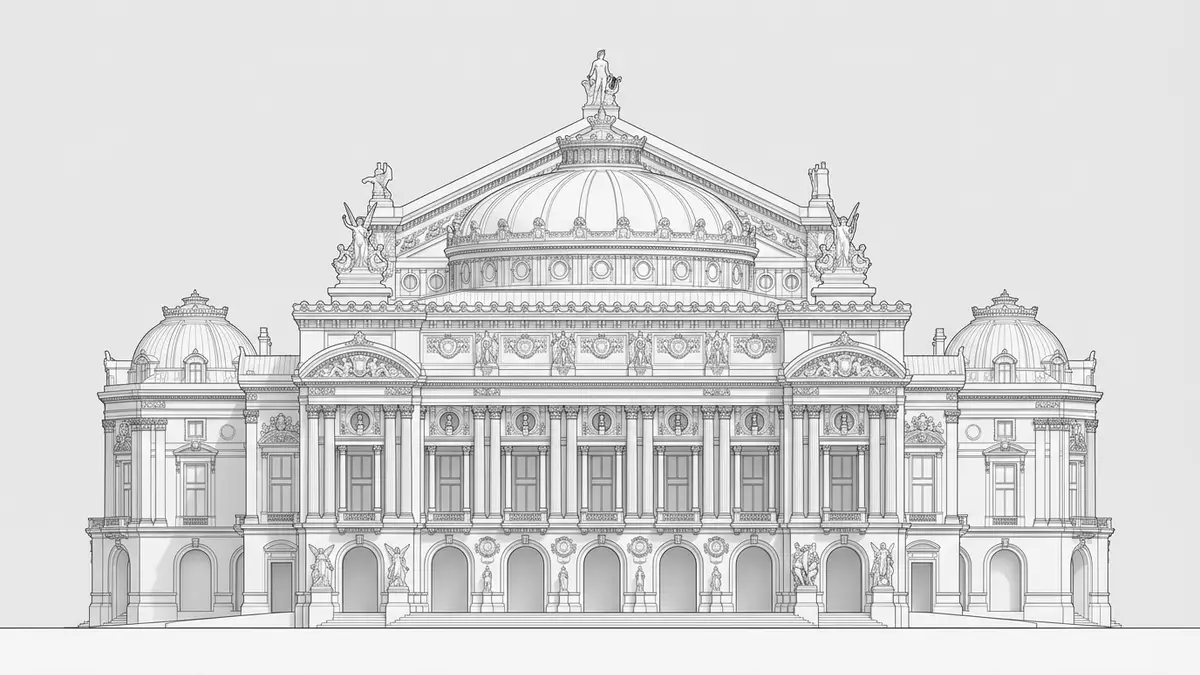
Opera Garnier in Paris is one of the great theatre buildings of the nineteenth century, combining opera, ballet and architectural spectacle within a single monumental envelope. Designed by the architect Charles Garnier under the Second Empire, it rose in the 1860s and 1870s as the Paris Opera’s grand home in the 9th arrondissement, on Place de l’Opéra.
A palace built for performance
Opera Garnier was commissioned by Emperor Napoleon III as part of a broader reshaping of Paris in the mid-nineteenth century, a programme associated with Baron Haussmann and the new boulevards cut through the old city.The Paris Opera house was built in the nineteenth century The competition for the new imperial opera house was launched in 1861, with Charles Garnier, then a comparatively unknown architect in his thirties, selected from many submitted designs.He won the competition to design the new opera house in 1861
Construction of Opera Garnier extended for about fifteen years in the 1860s and first half of the 1870s, interrupted by events such as the Franco?Prussian War and political change in France.Work on the building ran from the 1860s to 1875, when it was inaugurated The opera house was inaugurated in January 1875 and later took on the name Palais Garnier, recognising both its opulence and its architect.It became widely known as Palais Garnier after its completion in the 1870s
Napoleon III style in stone, marble and gilding
Opera Garnier is a landmark example of the eclectic architecture associated with the Second Empire and the Napoleon III style, blending references drawn from Baroque, classical and Renaissance forms.The opera house is described as representative of the Napoleon III style, combining Baroque and Renaissance elements The exterior sets the tone, with a richly decorated façade facing Place de l’Opéra, studded with sculpted figures, columns and elaborate stonework above the main entrances.
Inside, Opera Garnier unfolds as a sequence of grand spaces, in which materials and ornament are used in layers: coloured marbles on staircases and balustrades, gilded surfaces catching light in foyers, and painted ceilings overhead.The building is often described as an architectural marvel of the Second Empire, with a blend of classical, Baroque and Renaissance influences The auditorium continues the theme, forming a horseshoe?shaped theatre with tiers of boxes, a stage framed by a monumental arch and a central chandelier above the audience.
Opera, ballet and a Paris landmark
When it opened in 1875, Opera Garnier became the principal home of the Paris Opera, succeeding earlier theatres such as the Salle Le Peletier.The new opera house replaced the earlier theatre in Rue Le Peletier as the home of the Paris Opera It housed performances of opera and ballet and incorporated spaces for the Paris Opera’s library?museum. In the late twentieth century, once Opéra Bastille opened in 1989, programming at Palais Garnier shifted, and the building came to be used largely for ballet while remaining an emblematic cultural venue in Paris.After Opéra Bastille opened in 1989, Palais Garnier was used mainly for ballet
Opera Garnier stands on Place de l’Opéra in the 9th arrondissement, where several major streets converge, including Avenue de l’Opéra; its position and scale make it a reference point in the city’s urban landscape.The opera house occupies a prominent site on Place de l’Opéra in the 9th arrondissement of Paris Beyond its role as a working theatre, it is associated with literary and musical adaptations of Gaston Leroux’s “The Phantom of the Opera”, which drew inspiration from the building and contributed to its image in fiction.Palais Garnier provided the setting that inspired Gaston Leroux’s “The Phantom of the Opera”
Visiting Opera Garnier: what travellers from Western Europe should know
- Opera Garnier stands on Place de l’Opéra in central Paris, in the 9th arrondissement, close to major streets such as Avenue de l’Opéra and Boulevard des Capucines.
- Inside, the building is arranged over several levels, with broad flights of marble stairs, long corridors and foyers; visiting involves movement between these interior spaces.
- The official language is French and the currency is the euro.
Searching for Opera Garnier on social platforms
These links open searches for Opera Garnier on each platform.
Frequently asked questions about Opera Garnier
Where is Opera Garnier located in Paris?
Opera Garnier stands on Place de l’Opéra in the 9th arrondissement of Paris, at the junction of several major streets and near central city boulevards.
What can visitors expect on a visit to Opera Garnier?
Visitors encounter an ornate nineteenth?century opera house, with grand staircases, foyers and an auditorium, as well as spaces associated with the Paris Opera’s cultural collections.
What makes Opera Garnier distinctive among theatre buildings?
Opera Garnier combines its role as a working theatre with a highly eclectic Second Empire architectural style, extensive interior decoration and a prominent urban site in central Paris.


